\n
## Bar Chart: The Accuracy of Different Operation Sets
### Overview
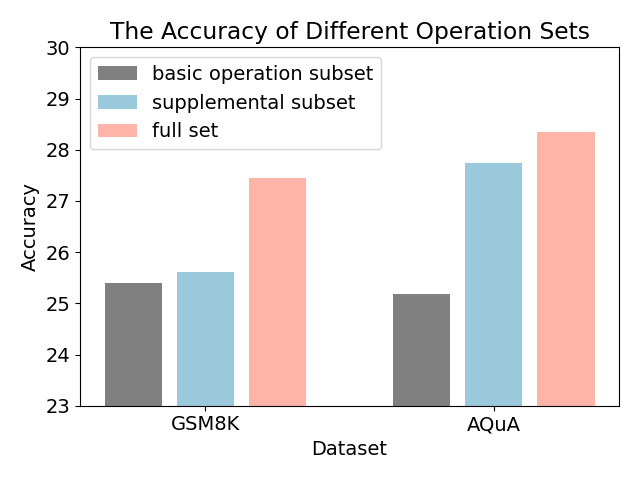
This bar chart compares the accuracy of three different operation sets – basic operation subset, supplemental subset, and full set – across two datasets: GSM8K and AQUA. The accuracy is measured on the y-axis, ranging from 23 to 30. The x-axis represents the datasets.
### Components/Axes
* **Title:** "The Accuracy of Different Operation Sets" (centered at the top)
* **X-axis Label:** "Dataset" (centered at the bottom)
* **Y-axis Label:** "Accuracy" (left side, vertical)
* **Y-axis Scale:** Ranges from 23 to 30, with tick marks at integer values.
* **Legend:** Located in the top-left corner.
* "basic operation subset" - represented by dark gray bars.
* "supplemental subset" - represented by light blue bars.
* "full set" - represented by light red bars.
### Detailed Analysis
The chart consists of six bars, grouped by dataset.
**GSM8K Dataset:**
* **basic operation subset:** The dark gray bar has a height of approximately 25.6.
* **supplemental subset:** The light blue bar has a height of approximately 25.9.
* **full set:** The light red bar has a height of approximately 27.4.
**AQUA Dataset:**
* **basic operation subset:** The dark gray bar has a height of approximately 25.2.
* **supplemental subset:** The light blue bar has a height of approximately 27.8.
* **full set:** The light red bar has a height of approximately 28.6.
The bars for the "full set" are consistently the highest for both datasets, indicating the highest accuracy. The "supplemental subset" consistently outperforms the "basic operation subset".
### Key Observations
* The "full set" consistently achieves the highest accuracy across both datasets.
* Accuracy is generally higher on the AQUA dataset compared to the GSM8K dataset for all operation sets.
* The difference in accuracy between the "basic operation subset" and the "supplemental subset" is relatively small for GSM8K, but more pronounced for AQUA.
### Interpretation
The data suggests that using the "full set" of operations leads to the best performance in terms of accuracy for both GSM8K and AQUA datasets. This indicates that incorporating all available operations provides a more comprehensive and effective approach. The higher accuracy observed on the AQUA dataset might be due to the inherent characteristics of the dataset itself, potentially being more amenable to the full set of operations. The improvement from the "basic operation subset" to the "supplemental subset" suggests that adding supplemental operations is beneficial, but the greatest gains are realized when utilizing the complete operation set. This could imply diminishing returns with each additional operation, or that the "full set" captures crucial interactions between operations that are missed in the subsets. The difference in performance between the datasets suggests that the optimal operation set might be dataset-dependent.