# Technical Document Extraction: Mechanistic Interpretability Framework
## 1. Overview
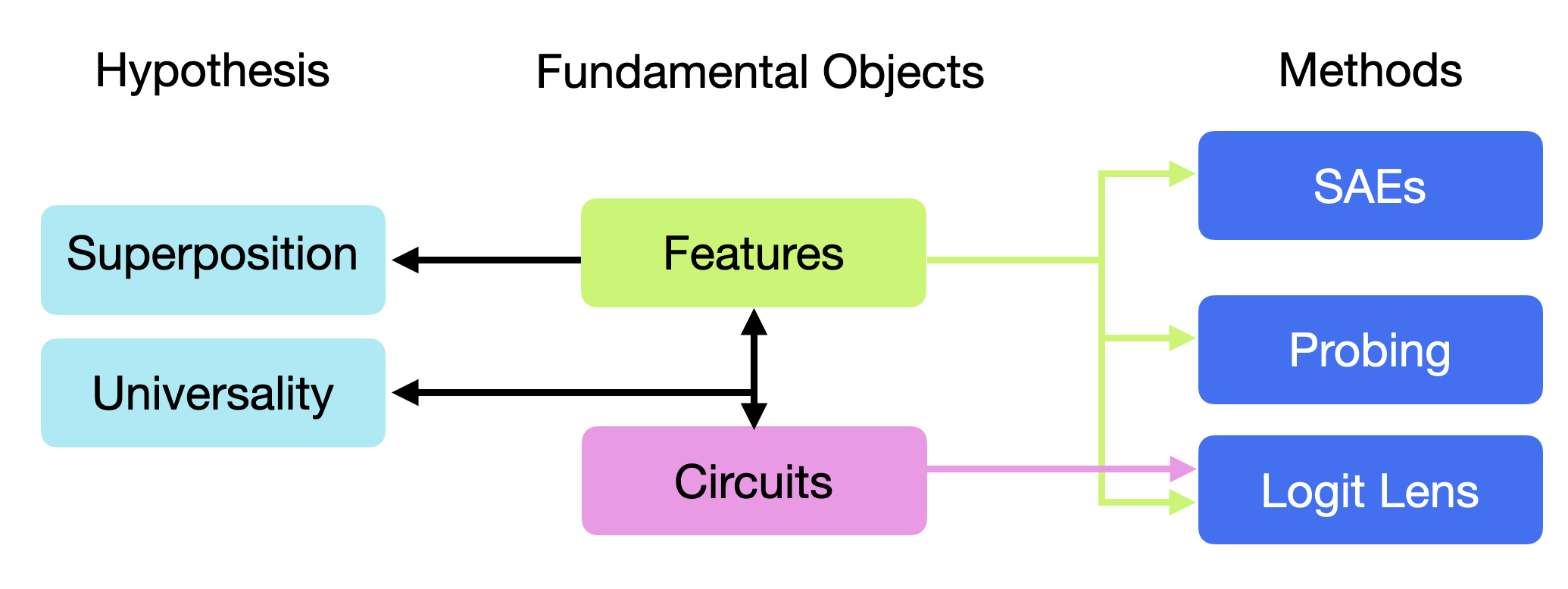
This image is a conceptual flow diagram illustrating the relationships between theoretical hypotheses, fundamental objects of study, and analytical methods within the field of mechanistic interpretability (likely in the context of Artificial Intelligence/Neural Networks).
The diagram is organized into three distinct vertical columns, moving from abstract concepts on the left to practical applications on the right.
---
## 2. Component Segmentation
### Region A: Header (Top Row)
The header contains three category titles that define the columns:
1. **Hypothesis** (Left)
2. **Fundamental Objects** (Center)
3. **Methods** (Right)
### Region B: Main Diagram (Body)
This region contains seven labeled nodes connected by directional and bidirectional arrows.
#### Column 1: Hypothesis (Light Blue Nodes)
* **Superposition**: Positioned at the top left.
* **Universality**: Positioned at the bottom left.
#### Column 2: Fundamental Objects (Central Nodes)
* **Features** (Light Green): Positioned at the top center.
* **Circuits** (Pink): Positioned at the bottom center.
#### Column 3: Methods (Dark Blue Nodes)
* **SAEs** (Sparse Autoencoders): Top right.
* **Probing**: Middle right.
* **Logit Lens**: Bottom right.
---
## 3. Relationship and Flow Analysis
The diagram uses a color-coded and directional arrow system to show how these concepts interact:
### Internal Relationships (Fundamental Objects)
* **Features $\leftrightarrow$ Circuits**: A black bidirectional vertical arrow connects these two nodes, indicating a reciprocal relationship where features compose circuits, and circuits are defined by the interaction of features.
### Theoretical Mapping (Objects to Hypotheses)
* **Features $\rightarrow$ Superposition**: A black horizontal arrow points from "Features" to "Superposition." This suggests that the study of features informs or supports the Superposition hypothesis.
* **[Features/Circuits Interaction] $\rightarrow$ Universality**: A black horizontal arrow originates from the vertical line connecting Features and Circuits and points toward "Universality." This indicates that the interaction between features and circuits is the basis for the Universality hypothesis.
### Methodological Application (Objects to Methods)
The methods are linked to the objects via color-coded branching lines:
* **Features (Light Green Path)**: A light green line extends from the "Features" node and branches into three arrows pointing to:
1. **SAEs**
2. **Probing**
3. **Logit Lens**
* *Interpretation*: All three methods are used to analyze or extract "Features."
* **Circuits (Pink Path)**: A pink line extends from the "Circuits" node and points to:
1. **Logit Lens**
* *Interpretation*: The "Logit Lens" method is specifically highlighted as a tool for analyzing "Circuits."
---
## 4. Summary Table of Components
| Category | Label | Color | Connection/Flow |
| :--- | :--- | :--- | :--- |
| **Hypothesis** | Superposition | Light Blue | Target of "Features" |
| **Hypothesis** | Universality | Light Blue | Target of "Features/Circuits" interaction |
| **Object** | Features | Light Green | Connects to Superposition, Circuits, and all Methods |
| **Object** | Circuits | Pink | Connects to Features, Universality, and Logit Lens |
| **Method** | SAEs | Dark Blue | Derived from "Features" |
| **Method** | Probing | Dark Blue | Derived from "Features" |
| **Method** | Logit Lens | Dark Blue | Derived from "Features" and "Circuits" |
---
## 5. Language Declaration
The text in this image is entirely in **English**. No other languages are present.