## Diagram: Conceptual Framework for Hypothesis Testing and Methodology
### Overview
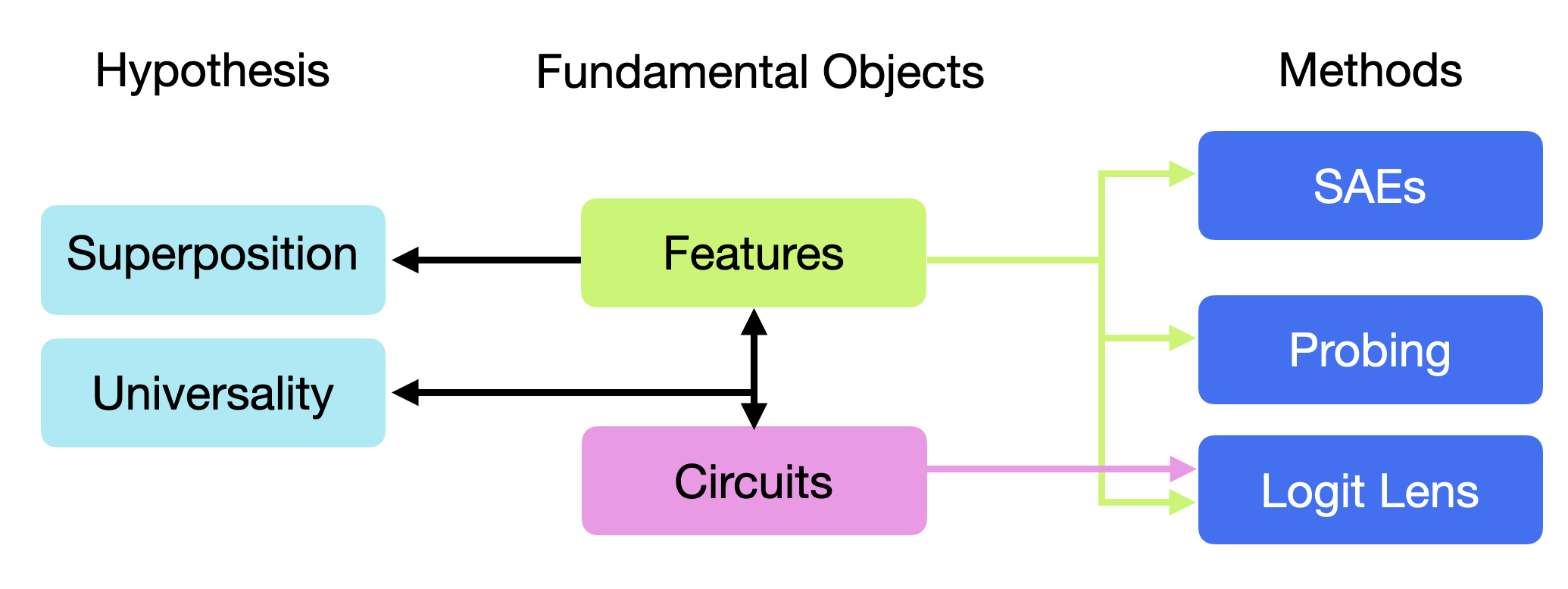
The diagram illustrates a structured framework connecting hypotheses, fundamental objects, and methods through labeled components and directional relationships. It uses color-coded boxes and arrows to represent conceptual flows and dependencies.
### Components/Axes
1. **Hypothesis Section (Left)**
- **Superposition** (Light Blue Box)
- **Universality** (Light Blue Box)
- Arrows point from both to the central "Fundamental Objects" section.
2. **Fundamental Objects Section (Center)**
- **Features** (Green Box)
- Receives input from both Hypothesis components.
- Connects to all Methods via bidirectional arrows.
- **Circuits** (Purple Box)
- Receives input from "Universality" only.
- Connects to "Logit Lens" via a pink arrow.
- Connects to "SAEs" and "Probing" via bidirectional arrows.
3. **Methods Section (Right)**
- **SAEs** (Blue Box)
- **Probing** (Blue Box)
- **Logit Lens** (Blue Box)
- Arrows from "Features" and "Circuits" point to all three methods.
### Detailed Analysis
- **Hypothesis → Fundamental Objects**:
- "Superposition" and "Universality" both feed into "Features" and "Circuits," suggesting these hypotheses underpin the foundational elements.
- "Circuits" only receives input from "Universality," implying a specialized relationship.
- **Fundamental Objects → Methods**:
- "Features" connects to all three methods (SAEs, Probing, Logit Lens) via bidirectional arrows, indicating mutual influence.
- "Circuits" connects to "SAEs" and "Probing" bidirectionally but has a unidirectional pink arrow to "Logit Lens," suggesting a unique or specialized interaction.
### Key Observations
1. **Color Coding**:
- Light blue for Hypothesis, green for Features, purple for Circuits, and blue for Methods.
- Pink arrow from Circuits to Logit Lens stands out as a distinct relationship.
2. **Bidirectional vs. Unidirectional Arrows**:
- Most connections are bidirectional (e.g., Features ↔ Methods), except the Circuits → Logit Lens link.
3. **Central Role of "Features"**:
- Acts as a hub connecting Hypothesis to all Methods.
### Interpretation
This diagram represents a theoretical model where hypotheses (Superposition and Universality) inform fundamental objects (Features and Circuits), which in turn guide methodological approaches (SAEs, Probing, Logit Lens). The bidirectional relationships between Features and Methods suggest iterative refinement, while the unidirectional Circuits → Logit Lens arrow may indicate a specialized application or dependency. The framework emphasizes how abstract hypotheses translate into concrete analytical tools, with Features serving as a critical intermediary. The pink arrow’s uniqueness implies Logit Lens might require additional constraints or assumptions derived specifically from Circuits.