## Line Graph: Time needed for reliable agents in homogeneous and heterogeneous networks
### Overview
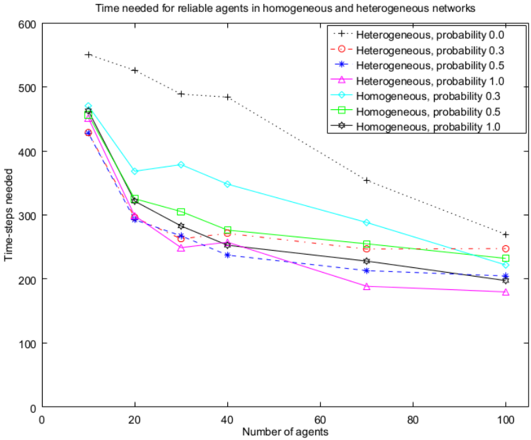
The image is a line graph comparing the time required for reliable agents in homogeneous and heterogeneous networks as the number of agents increases. The graph shows multiple data series, each representing different probabilities for homogeneous and heterogeneous networks. The y-axis measures time-steps needed (0–600), and the x-axis measures the number of agents (0–100). The legend in the top-right corner categorizes the data by network type (heterogeneous/homogeneous) and probability (0.0, 0.3, 0.5, 1.0), with distinct line styles and markers for each series.
### Components/Axes
- **X-axis**: "Number of agents" (0–100, linear scale).
- **Y-axis**: "Time-steps needed" (0–600, linear scale).
- **Legend**: Located in the top-right corner, with the following entries:
- **Heterogeneous, probability 0.0**: Dotted line with plus markers.
- **Heterogeneous, probability 0.3**: Dashed line with circle markers.
- **Heterogeneous, probability 0.5**: Dashed line with star markers.
- **Heterogeneous, probability 1.0**: Dashed line with triangle markers.
- **Homogeneous, probability 0.3**: Solid line with diamond markers.
- **Homogeneous, probability 0.5**: Solid line with square markers.
- **Homogeneous, probability 1.0**: Solid line with star markers.
### Detailed Analysis
- **Heterogeneous networks**:
- **Probability 0.0 (dotted line, plus markers)**: Starts at ~550 time-steps for 10 agents, decreasing to ~250 for 100 agents. The line slopes downward steeply initially, then flattens.
- **Probability 0.3 (dashed line, circle markers)**: Starts at ~470 for 10 agents, decreasing to ~220 for 100 agents. The slope is less steep than the 0.0 probability line.
- **Probability 0.5 (dashed line, star markers)**: Starts at ~430 for 10 agents, decreasing to ~200 for 100 agents. The slope is gradual.
- **Probability 1.0 (dashed line, triangle markers)**: Starts at ~410 for 10 agents, decreasing to ~190 for 100 agents. The slope is the least steep among heterogeneous lines.
- **Homogeneous networks**:
- **Probability 0.3 (solid line, diamond markers)**: Starts at ~450 for 10 agents, decreasing to ~220 for 100 agents. Crosses below the heterogeneous 0.0 line at ~50 agents.
- **Probability 0.5 (solid line, square markers)**: Starts at ~430 for 10 agents, decreasing to ~200 for 100 agents. Crosses below the heterogeneous 0.3 line at ~50 agents.
- **Probability 1.0 (solid line, star markers)**: Starts at ~410 for 10 agents, decreasing to ~190 for 100 agents. Crosses below the heterogeneous 0.5 line at ~50 agents.
### Key Observations
1. **Downward trend**: All lines show a general decrease in time-steps needed as the number of agents increases.
2. **Heterogeneous vs. homogeneous**: Homogeneous networks with higher probabilities (0.5, 1.0) outperform heterogeneous networks with lower probabilities (0.0, 0.3) as the number of agents grows.
3. **Crossing lines**: Homogeneous lines with higher probabilities (0.5, 1.0) intersect and surpass heterogeneous lines with lower probabilities (0.0, 0.3) at ~50 agents.
4. **Steepest decline**: The heterogeneous 0.0 line (dotted, plus markers) has the steepest initial decline but flattens at higher agent counts.
5. **Consistency**: The heterogeneous 0.0 line remains the highest (most time-steps needed) across all agent counts.
### Interpretation
The data suggests that **homogeneous networks with higher probabilities (0.5, 1.0)** are more efficient in reducing time-steps needed for reliable agents as the number of agents increases. In contrast, **heterogeneous networks with lower probabilities (0.0, 0.3)** require significantly more time-steps, even at higher agent counts. The crossing of lines indicates that **homogeneous networks with higher probabilities become more efficient than heterogeneous networks with lower probabilities** as the system scales. The dotted line (heterogeneous 0.0) represents the least efficient scenario, consistently requiring the most time-steps. This implies that **network homogeneity and probability thresholds** are critical factors in optimizing agent reliability in distributed systems.