\n
## Screenshot: Esoteric Programming Language Concept
### Overview
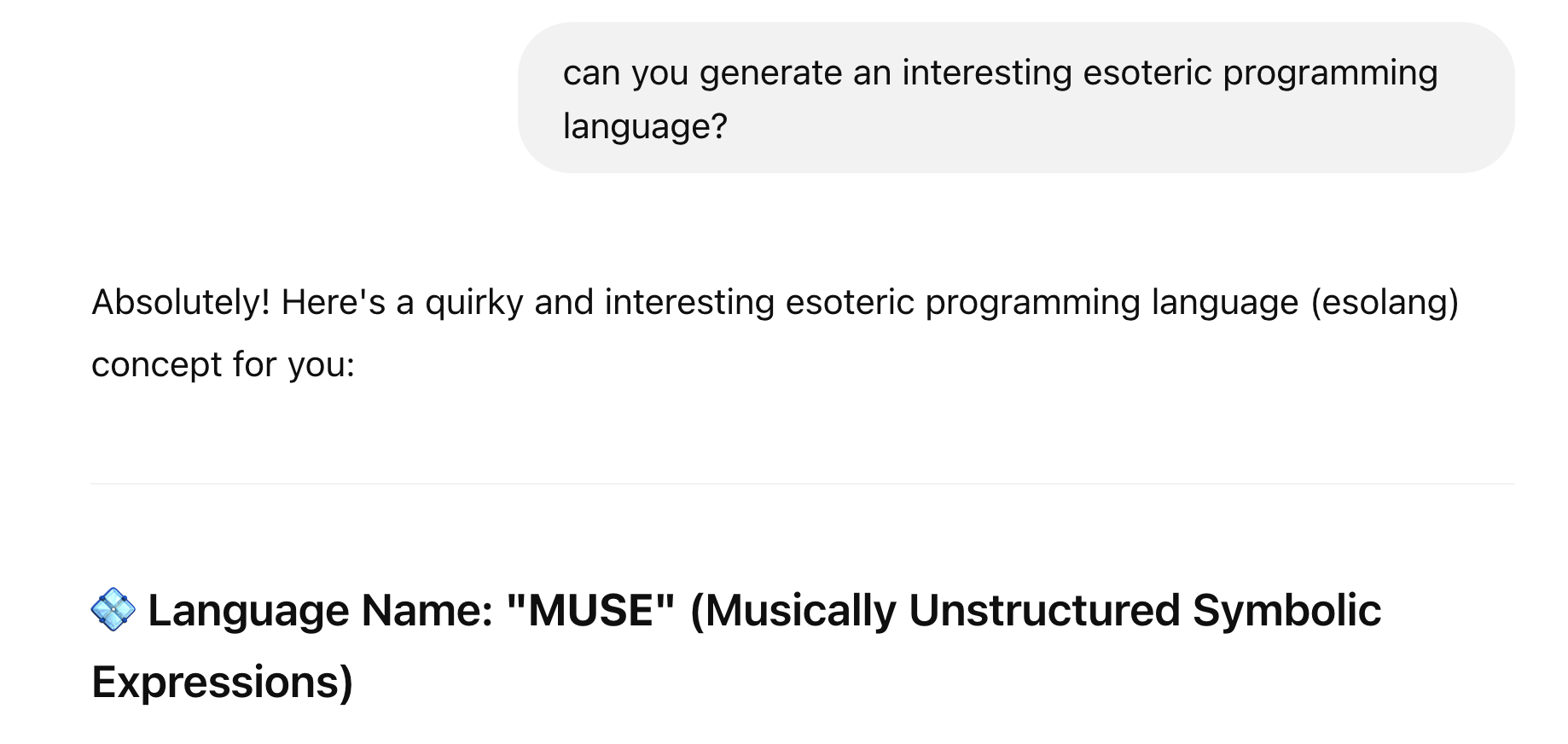
This image is a screenshot of a chat interface, likely from a large language model interaction. It presents a response to the query "can you generate an interesting esoteric programming language?". The response details a concept for a new esoteric programming language named "MUSE".
### Components/Axes
The screenshot contains the following elements:
* **Chat Bubble (Query):** Located at the top-left, containing the text "can you generate an interesting esoteric programming language?".
* **Response Text:** A block of text providing an introductory statement: "Absolutely! Here's a quirky and interesting esoteric programming language (esolang) concept for you:".
* **Language Name:** A section with a diamond icon and the text "Language Name: "MUSE" (Musically Unstructured Symbolic Expressions)".
### Detailed Analysis or Content Details
The core content is the description of the proposed esoteric programming language, MUSE. The full name is provided with its expansion:
* **Language Name:** MUSE
* **Full Name:** Musically Unstructured Symbolic Expressions
### Key Observations
The image does not contain any charts, graphs, or numerical data. It is purely textual, presenting a conceptual idea. The use of a diamond icon next to "Language Name" suggests it's a key piece of information.
### Interpretation
The screenshot demonstrates a response from a language model capable of generating creative concepts, specifically in the domain of esoteric programming languages. The name "MUSE" and its expansion suggest a language potentially based on musical notation or symbolic representation, aligning with the "esoteric" nature of such languages. The response is a starting point for a more detailed language specification, but it doesn't provide any concrete details about the language's syntax or semantics. The interaction highlights the model's ability to understand and respond to abstract requests.