## Screenshot: Chat Conversation on Esoteric Programming Language Concept
### Overview
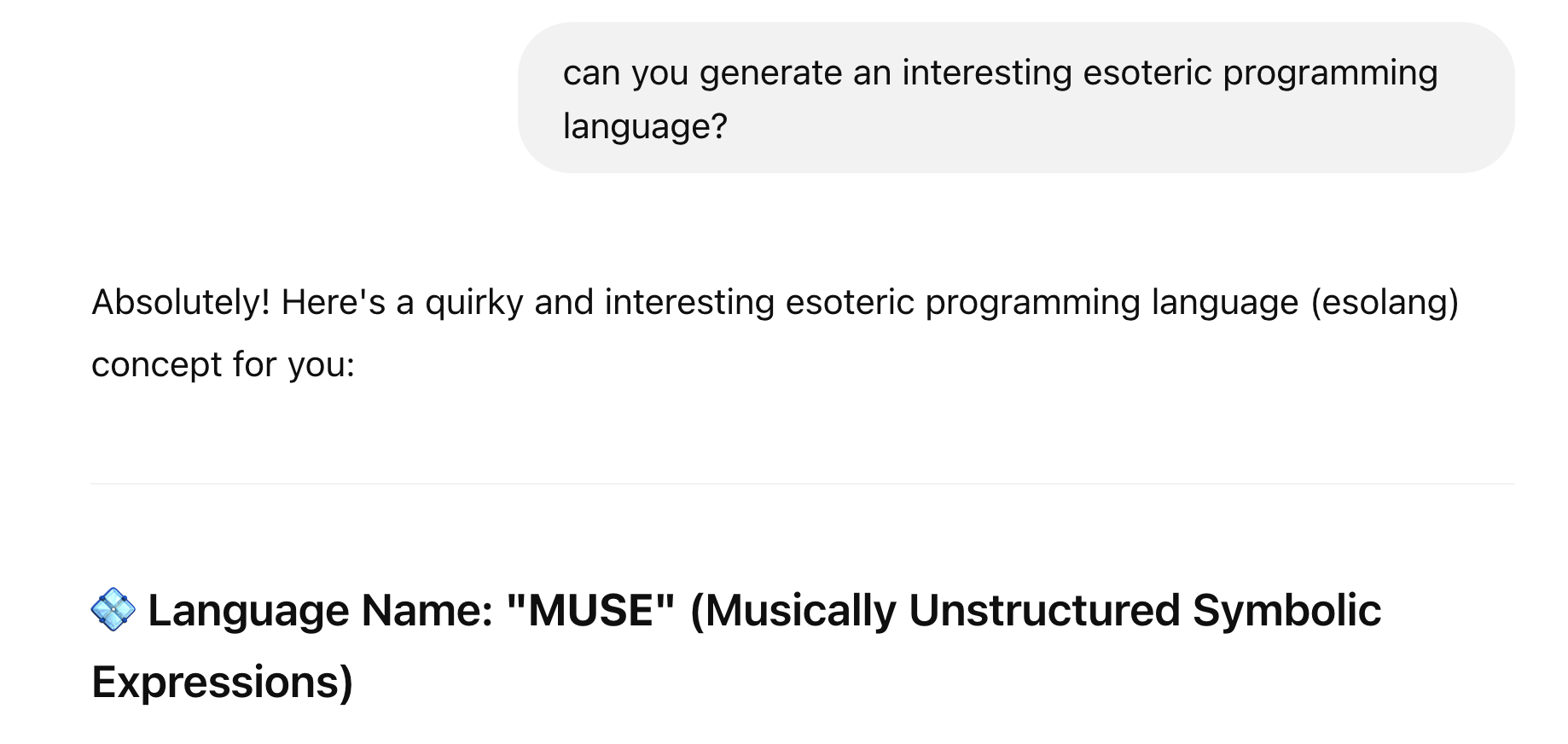
The image shows a chat interface with two messages. The first message (user) asks for an "interesting esoteric programming language," and the second message (assistant) provides a conceptual response introducing a language called "MUSE" with a playful description.
### Components/Axes
- **User Message**: Gray text bubble with black text:
`"can you generate an interesting esoteric programming language?"`
- **Assistant Response**: White text bubble with black text:
`"Absolutely! Here's a quirky and interesting esoteric programming language (esolang) concept for you:"`
Followed by a horizontal line separator.
- **Language Name**: Bold text with a blue diamond emoji:
`"Language Name: "MUSE" (Musically Unstructured Symbolic Expressions)"`
### Content Details
- **User Query**: Direct request for an esoteric programming language.
- **Assistant Response**:
- Affirmative reply with a creative concept.
- Language name: **"MUSE"** (acronym: **Musically Unstructured Symbolic Expressions**).
- Emoji: Blue diamond (likely decorative, no textual meaning).
### Key Observations
- The assistant’s response is intentionally whimsical, aligning with the "esoteric" theme.
- The acronym "MUSE" ties the language to music and unstructured symbolism, suggesting a focus on artistic or non-linear programming paradigms.
- No technical specifications or code examples are provided, emphasizing conceptual creativity over practicality.
### Interpretation
The response reflects a lighthearted approach to esoteric programming languages, which are often designed as thought experiments or artistic projects rather than functional tools. The name "MUSE" implies a connection to inspiration and creativity, possibly hinting at a language that prioritizes expressive, music-like syntax or unconventional logic structures. The lack of technical details reinforces the idea that this is a conceptual or humorous proposal rather than a serious programming language.