## Diagram: Travel Booking System Architectures
### Overview
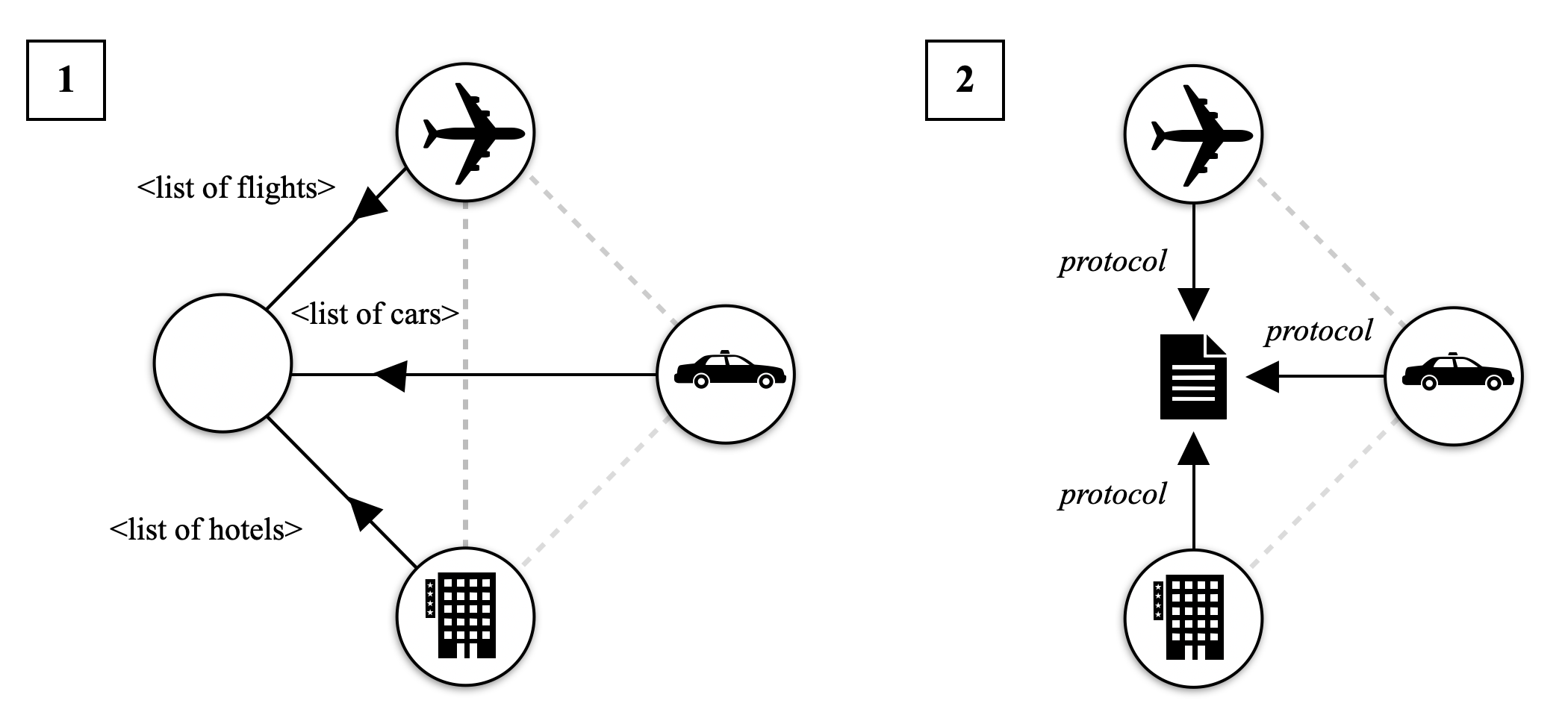
The image presents two diagrams illustrating different architectures for a travel booking system. Diagram 1 depicts a centralized approach where a single entity manages lists of flights, cars, and hotels. Diagram 2 shows a distributed approach where flights, cars, and hotels communicate via a protocol.
### Components/Axes
**Diagram 1:**
* **Nodes:**
* Central Node: Represented by an empty circle.
* Flights: Represented by an airplane icon within a circle.
* Cars: Represented by a car icon within a circle.
* Hotels: Represented by a hotel icon within a circle.
* **Edges:**
* Solid Arrows: Indicate a direct relationship or flow of information.
* Dashed Lines: Indicate a potential or indirect relationship.
* **Labels:**
* "1": Located in a square in the top-left corner, identifying the diagram.
* "<list of flights>": Labeling the arrow from the central node to the flights node.
* "<list of cars>": Labeling the arrow from the central node to the cars node.
* "<list of hotels>": Labeling the arrow from the central node to the hotels node.
**Diagram 2:**
* **Nodes:**
* Flights: Represented by an airplane icon within a circle.
* Cars: Represented by a car icon within a circle.
* Hotels: Represented by a hotel icon within a circle.
* Document: Represented by a document icon.
* **Edges:**
* Solid Arrows: Indicate a direct relationship or flow of information.
* Dashed Lines: Indicate a potential or indirect relationship.
* **Labels:**
* "2": Located in a square in the top-left corner, identifying the diagram.
* "protocol": Labeling the arrows between the flights, cars, hotels, and document nodes.
### Detailed Analysis
**Diagram 1:**
* The central node has outgoing arrows labeled "<list of flights>", "<list of cars>", and "<list of hotels>" pointing to the respective nodes.
* Dashed lines connect the flights, cars, and hotels nodes, suggesting a potential relationship between them.
**Diagram 2:**
* The flights node has an outgoing arrow labeled "protocol" pointing to the document node.
* The hotels node has an outgoing arrow labeled "protocol" pointing to the document node.
* The cars node has an outgoing arrow labeled "protocol" pointing to the document node.
* The document node has an outgoing arrow labeled "protocol" pointing to the cars node.
* Dashed lines connect the flights, cars, and hotels nodes, suggesting a potential relationship between them.
### Key Observations
* Diagram 1 represents a centralized system, while Diagram 2 represents a distributed system.
* In Diagram 1, the central node manages the lists of flights, cars, and hotels.
* In Diagram 2, the flights, cars, and hotels communicate with each other via a protocol.
### Interpretation
The diagrams illustrate two different approaches to building a travel booking system. Diagram 1's centralized approach may be simpler to implement initially but could become a bottleneck as the system grows. Diagram 2's distributed approach offers greater scalability and resilience but requires more complex communication protocols. The choice between the two architectures depends on the specific requirements and constraints of the system.