\n
## Diagram: Travel/Logistics Flow
### Overview
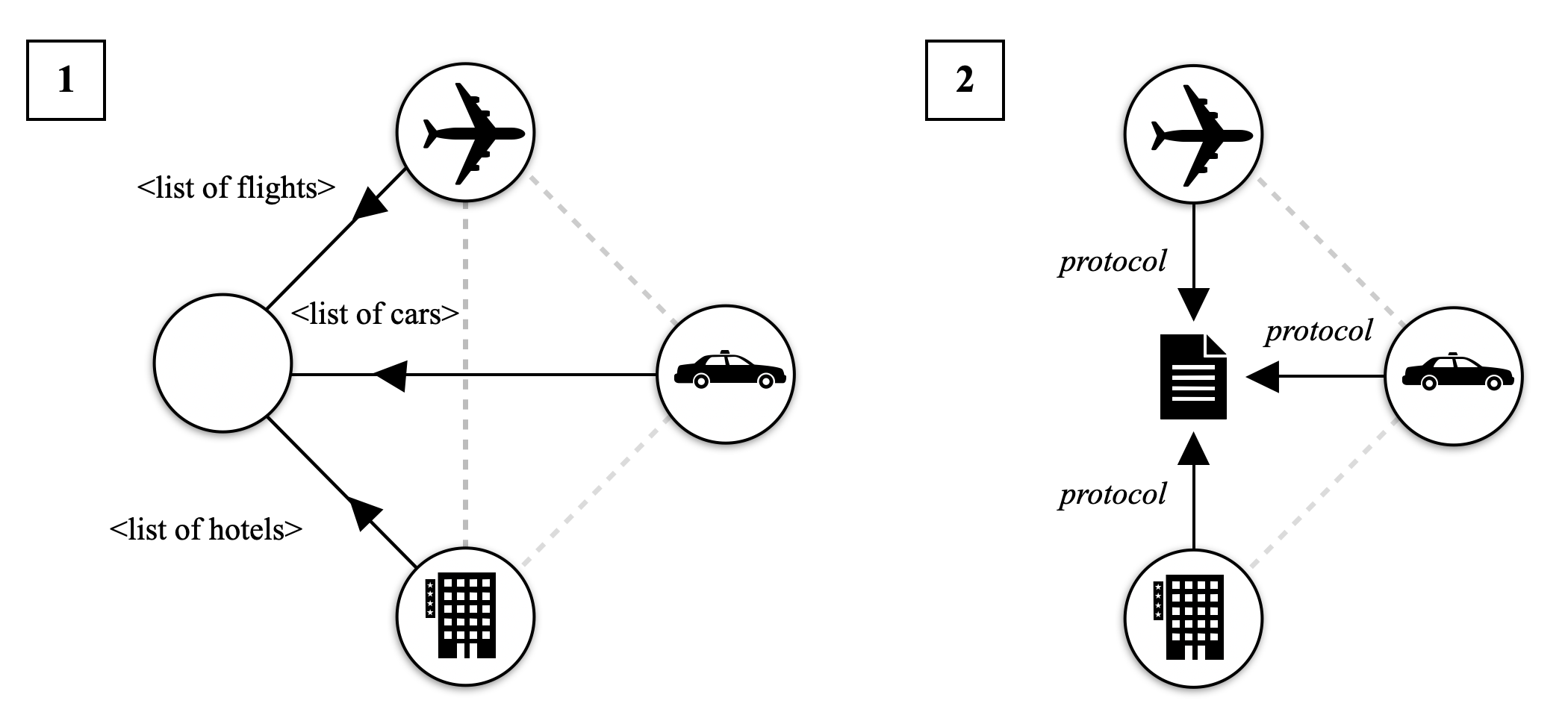
The image depicts two distinct diagrams (labeled '1' and '2') illustrating a travel or logistics flow. Both diagrams involve transportation modes (airplane, car) and accommodation (hotel), connected by directional arrows labeled "protocol" or representing lists of options. The diagrams appear to represent different approaches or stages within a travel process.
### Components/Axes
The diagrams consist of the following components:
* **Circles:** Represent entities or stages in the process (e.g., starting point, transportation, destination).
* **Icons:** Airplane, car, hotel building.
* **Arrows:** Indicate the flow or connection between entities. Some arrows are solid, others are dashed.
* **Labels:** "<list of flights>", "<list of cars>", "<list of hotels>", "protocol".
* **Boxes:** Numbered '1' and '2' to distinguish the diagrams.
### Detailed Analysis or Content Details
**Diagram 1:**
* A central circle is connected to three other elements:
* An airplane icon, labeled "<list of flights>". The connection is a dashed arrow.
* A car icon, labeled "<list of cars>". The connection is a solid arrow.
* A hotel building icon, labeled "<list of hotels>". The connection is a solid arrow.
* The central circle does not have a label.
**Diagram 2:**
* An airplane icon is connected to a "protocol" box via a dashed arrow.
* The "protocol" box is connected to a car icon via a solid arrow labeled "protocol".
* The "protocol" box is also connected to a hotel building icon via a solid arrow labeled "protocol".
* The airplane and hotel icons are also connected via a dashed arrow.
### Key Observations
* Diagram 1 presents a more direct connection between the starting point and the various travel options (flights, cars, hotels).
* Diagram 2 introduces a "protocol" intermediary step, suggesting a more structured or regulated process.
* The use of dashed vs. solid arrows may indicate different types of relationships or dependencies. Dashed arrows might represent options or possibilities, while solid arrows represent definite steps.
* The "protocol" element in Diagram 2 appears to act as a central control point, directing the flow to both car and hotel options.
### Interpretation
The diagrams likely represent two different approaches to travel arrangement. Diagram 1 could represent a more flexible, user-driven approach where the traveler directly chooses between flights, cars, and hotels. Diagram 2 suggests a more managed or controlled process, where a "protocol" (perhaps a travel agency, corporate policy, or automated system) dictates the flow of travel arrangements, potentially prioritizing certain options or enforcing specific rules.
The "protocol" element could represent a decision-making process, a set of rules, or a service provider that manages the travel logistics. The dashed arrows in both diagrams suggest that certain connections are optional or less direct than the solid arrow connections. The diagrams highlight the contrast between a direct, user-controlled travel process and a more structured, protocol-driven one. The diagrams do not provide any quantitative data, but rather illustrate a conceptual difference in travel arrangement methodologies.