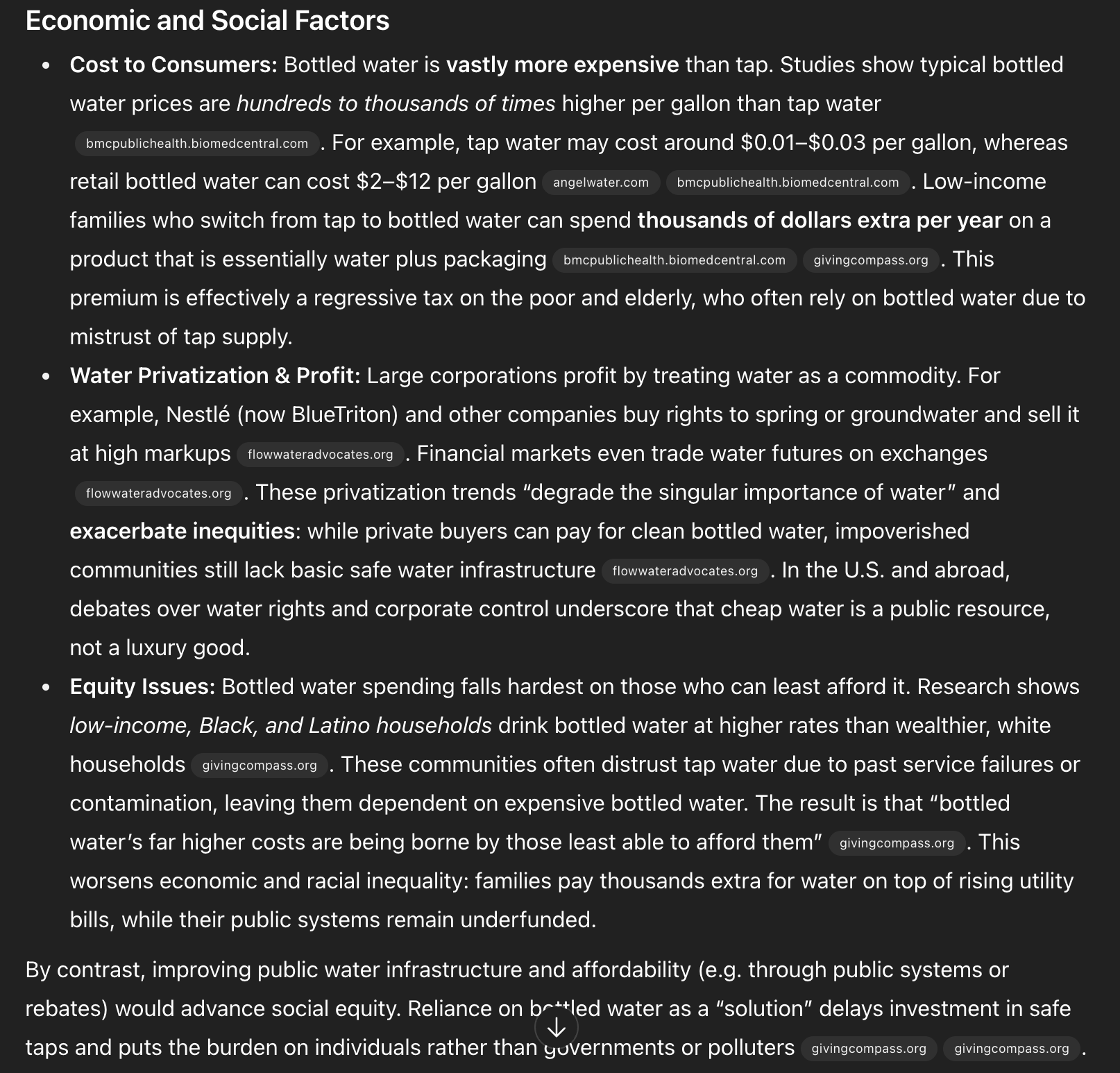
## Text Document: Economic and Social Factors of Bottled Water vs. Tap Water
### Overview
The document analyzes the economic and social implications of bottled water consumption versus reliance on public tap water. It highlights cost disparities, corporate profit motives, and systemic inequities, supported by references to studies and organizations.
### Components/Axes
- **Sections**:
1. **Cost to Consumers**
2. **Water Privatization & Profit**
3. **Equity Issues**
- **References**: URLs from organizations like *bmcpublichealth.biomedcentral.com*, *flowwateradvocates.org*, and *givingcompass.org*.
### Detailed Analysis
#### Cost to Consumers
- Bottled water is **400–20,000x more expensive** than tap water per gallon.
- Tap water: **$0.01–$0.03/gallon** (source: bmcpublichealth.biomedcentral.com).
- Bottled water: **$2–$12/gallon** (source: angelwater.com, bmcpublichealth.biomedcentral.com).
- Low-income families switching to bottled water may spend **thousands of dollars extra annually** (source: givingcompass.org).
- Framed as a "regressive tax" on the poor and elderly who distrust tap water.
#### Water Privatization & Profit
- Corporations like Nestlé (now BlueTriton) profit by treating water as a commodity.
- Example: Buying rights to springs/groundwater and selling at high markups (source: flowwateradvocates.org).
- Financial markets trade "water futures" (source: flowwateradvocates.org).
- Privatization trends "degrade the singular importance of water" and exacerbate inequities.
- Privileged buyers access clean water, while impoverished communities lack basic infrastructure (source: flowwateradvocates.org).
- Debates over water rights and corporate control frame water as a luxury, not a public resource.
#### Equity Issues
- Bottled water spending disproportionately affects low-income, Black, and Latino households.
- These groups drink bottled water at higher rates due to distrust in tap water from past contamination or service failures (source: givingcompass.org).
- Result: Higher costs burden those least able to afford them, worsening economic and racial inequality.
- Families pay thousands extra for water while public systems remain underfunded (source: givingcompass.org).
### Key Observations
- **Cost Disparity**: Bottled water is orders of magnitude more expensive than tap water.
- **Corporate Exploitation**: Privatization prioritizes profit over equitable access.
- **Regressive Impact**: Vulnerable populations face financial strain and health risks from bottled water reliance.
### Interpretation
The document argues that reliance on bottled water perpetuates systemic inequities by shifting costs to individuals and delaying investment in public infrastructure. Corporate privatization treats water as a commodity, undermining its status as a fundamental human right. The data underscores the need for policy interventions to improve public water systems and affordability, particularly for marginalized communities. The repeated emphasis on "givingcompass.org" and "flowwateradvocates.org" suggests advocacy-driven research, framing bottled water as both an economic burden and a social justice issue.