## Economic and Social Factors: Bottled Water vs. Tap Water
### Overview
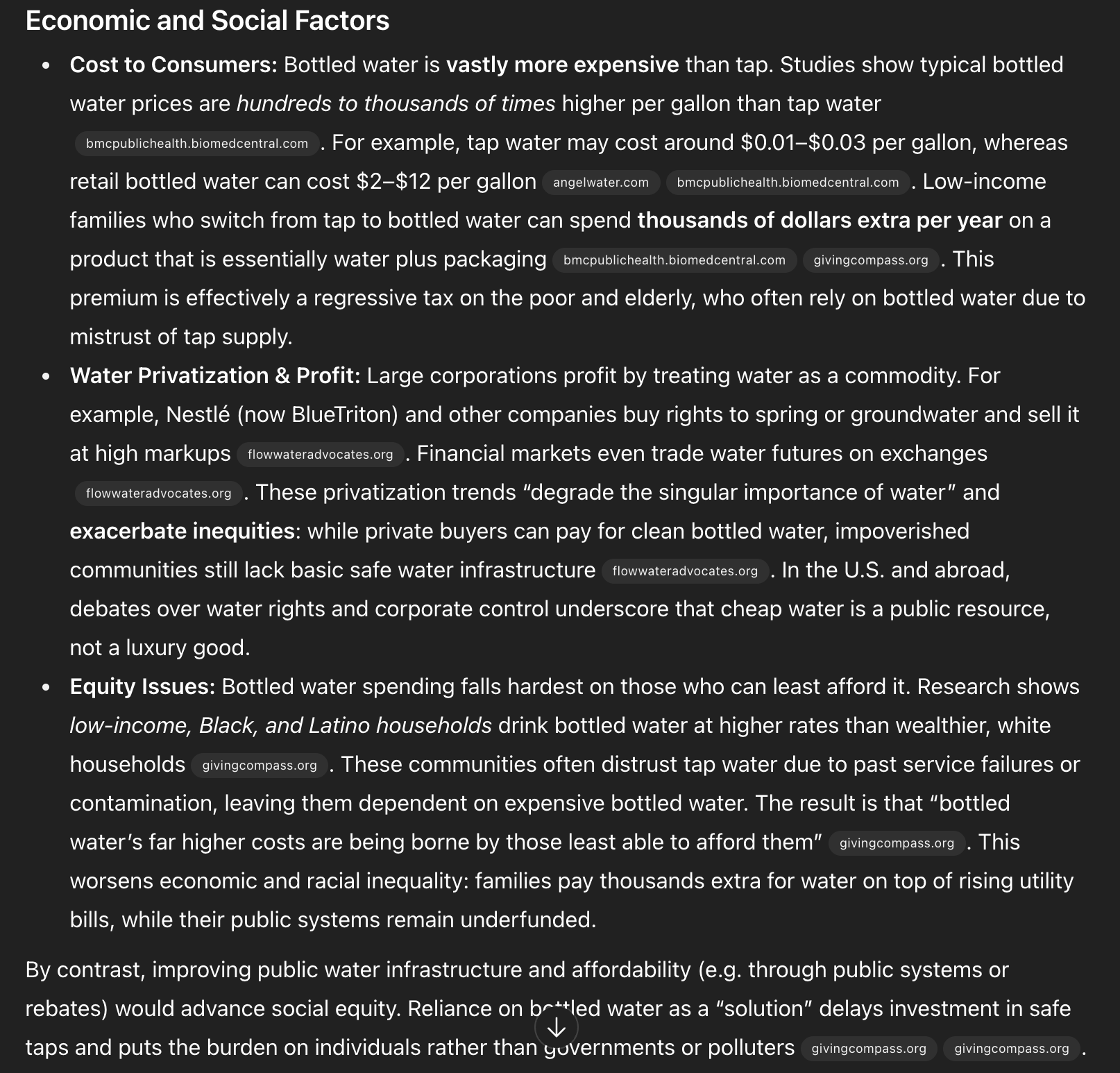
The image presents a text-based analysis of the economic and social factors related to bottled water consumption, contrasting it with tap water. It highlights issues such as cost, water privatization, and equity, arguing that bottled water disproportionately affects low-income communities.
### Components/Axes
The image consists of three main bullet points:
1. Cost to Consumers
2. Water Privatization & Profit
3. Equity Issues
Each bullet point contains supporting text and links to external sources.
### Detailed Analysis or Content Details
* **Cost to Consumers:**
* Bottled water is significantly more expensive than tap water.
* Bottled water prices are "hundreds to thousands of times higher" per gallon than tap water.
* Tap water costs approximately $0.01-$0.03 per gallon.
* Source: bmcpublichealth.biomedcentral.com
* Retail bottled water costs approximately $2-$12 per gallon.
* Source: angelwater.com, bmcpublichealth.biomedcentral.com
* Low-income families switching from tap to bottled water can spend "thousands of dollars extra per year."
* Source: bmcpublichealth.biomedcentral.com, givingcompass.org
* This premium is a regressive tax on the poor and elderly.
* **Water Privatization & Profit:**
* Large corporations profit by treating water as a commodity.
* Companies like Nestlé (now BlueTriton) buy rights to spring or groundwater and sell it at high markups.
* Source: flowwateradvocates.org
* Financial markets trade water futures.
* Source: flowwateradvocates.org
* Privatization trends "degrade the singular importance of water" and exacerbate inequities.
* Impoverished communities lack basic safe water infrastructure.
* Source: flowwateradvocates.org
* Debates over water rights and corporate control underscore that cheap water is a public resource, not a luxury good.
* **Equity Issues:**
* Bottled water spending falls hardest on those who can least afford it.
* Low-income, Black, and Latino households drink bottled water at higher rates than wealthier, white households.
* Source: givingcompass.org
* These communities often distrust tap water due to past service failures or contamination.
* "Bottled water's far higher costs are being borne by those least able to afford them."
* Source: givingcompass.org
* This worsens economic and racial inequality.
* **Concluding Statement:**
* Improving public water infrastructure and affordability would advance social equity.
* Reliance on bottled water as a "solution" delays investment in safe taps and puts the burden on individuals rather than governments or polluters.
* Source: givingcompass.org, givingcompass.org
### Key Observations
* Bottled water is significantly more expensive than tap water.
* Water privatization is a key factor in the high cost of bottled water.
* Low-income and minority communities are disproportionately affected by the high cost of bottled water.
* There is a distrust of tap water in some communities due to past service failures or contamination.
### Interpretation
The text argues that the reliance on bottled water is not only economically inefficient but also socially unjust. It highlights how the privatization of water resources and the marketing of bottled water contribute to a system where those who can least afford it end up paying the most. The text advocates for investing in public water infrastructure to ensure equitable access to safe and affordable water for all. The arrow at the bottom suggests a downward spiral, indicating that reliance on bottled water exacerbates existing inequalities.