\n
## Text Document: Economic and Social Factors of Bottled Water
### Overview
This document outlines the economic and social factors related to bottled water consumption, privatization, and equity issues. It highlights the cost difference between tap and bottled water, the profit motives of corporations, and the disproportionate impact on low-income and minority communities.
### Components/Axes
The document is structured as a series of bullet points, each addressing a specific aspect of the topic. There are no axes or charts present. The document includes hyperlinks to external sources.
### Detailed Analysis or Content Details
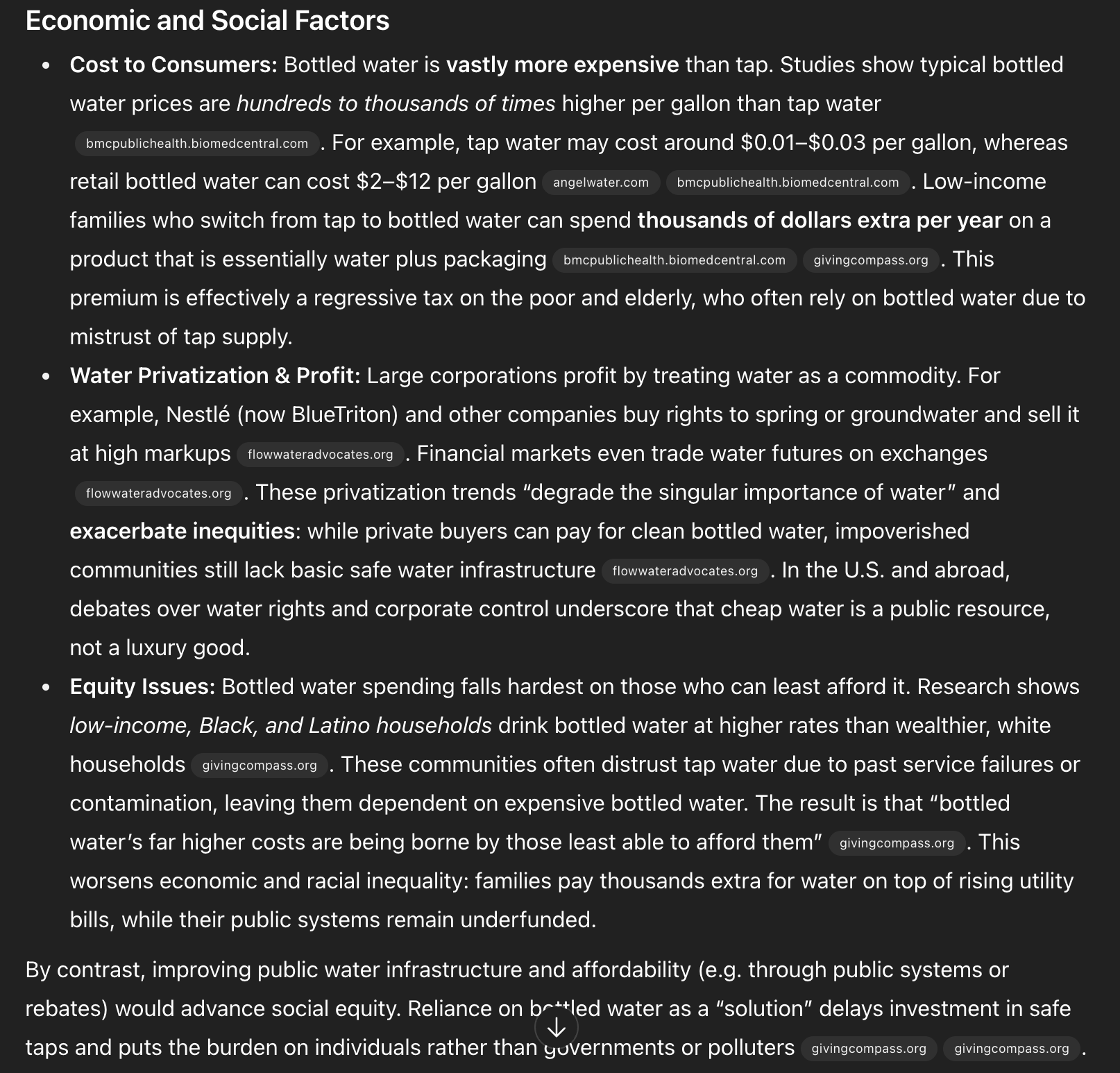
* **Cost to Consumers:** Bottled water is vastly more expensive than tap water. Studies show typical bottled water prices are hundreds to thousands of times higher per gallon than tap water.
* Tap water may cost around $0.01-$0.03 per gallon (source: bmcpublichealth.biomedcentral.com).
* Retail bottled water can cost $2-$12 per gallon (source: angelwater.com).
* Low-income families who switch from tap to bottled water can spend thousands of dollars extra per year on a product that is essentially water plus packaging (source: bmcpublichealth.biomedcentral.com).
* This premium is effectively a regressive tax on the poor and elderly, who often rely on bottled water due to mistrust of tap supply (source: givingcompass.org).
* **Water Privatization & Profit:** Large corporations profit by treating water rights as a commodity.
* For example, Nestlé (now BlueTriton) and other companies buy rights to spring or groundwater and sell it at high markups (source: flowwateradvocates.org).
* Financial markets even trade water futures on exchanges (source: flowwateradvocates.org).
* These privatization trends can "degrade the singular importance of water" and exacerbate inequalities; while private buyers pay for clean bottled water, impoverished communities still lack basic safe water infrastructure (source: flowwateradvocates.org).
* In the U.S. and abroad, debates over water rights and corporate control underscore that cheap water is a public resource, not a luxury good.
* **Equity Issues:** Bottled water spending falls hardest on those who can least afford it.
* Research shows low-income, Black, and Latino households drink bottled water at higher rates than wealthier, white households (source: givingcompass.org).
* These communities often distrust tap water due to past service failures or contamination, leaving them dependent on expensive bottled water.
* The result is that "bottled water’s far higher costs are being borne by those least able to afford them" (source: givingcompass.org).
* This worsens economic and racial inequality: families pay thousands extra for water on top of rising utility bills, while their public systems remain underfunded.
By contrast, improving public water infrastructure and affordability (e.g. through public systems or rebates) would advance social equity. Reliance on bottled water as a “solution” delays investment in safe taps and puts the burden on individuals rather than governments or polluters (source: givingcompass.org).
### Key Observations
* Significant cost disparity between tap and bottled water.
* Bottled water consumption disproportionately impacts low-income and minority communities.
* Privatization of water resources raises concerns about equity and access.
* Reliance on bottled water as a solution hinders investment in public water infrastructure.
### Interpretation
The document presents a critical perspective on the bottled water industry, framing it as a system that exacerbates existing social and economic inequalities. The data suggests that bottled water is not simply a consumer choice, but a complex issue with implications for public health, environmental justice, and economic fairness. The reliance on bottled water is presented as a symptom of systemic failures in public water infrastructure, rather than a viable solution. The document advocates for investment in public water systems and policies that ensure equitable access to safe and affordable water for all. The inclusion of source links suggests a basis in research and advocacy efforts. The document is a persuasive argument against the commodification of water and a call for prioritizing public water systems.