\n
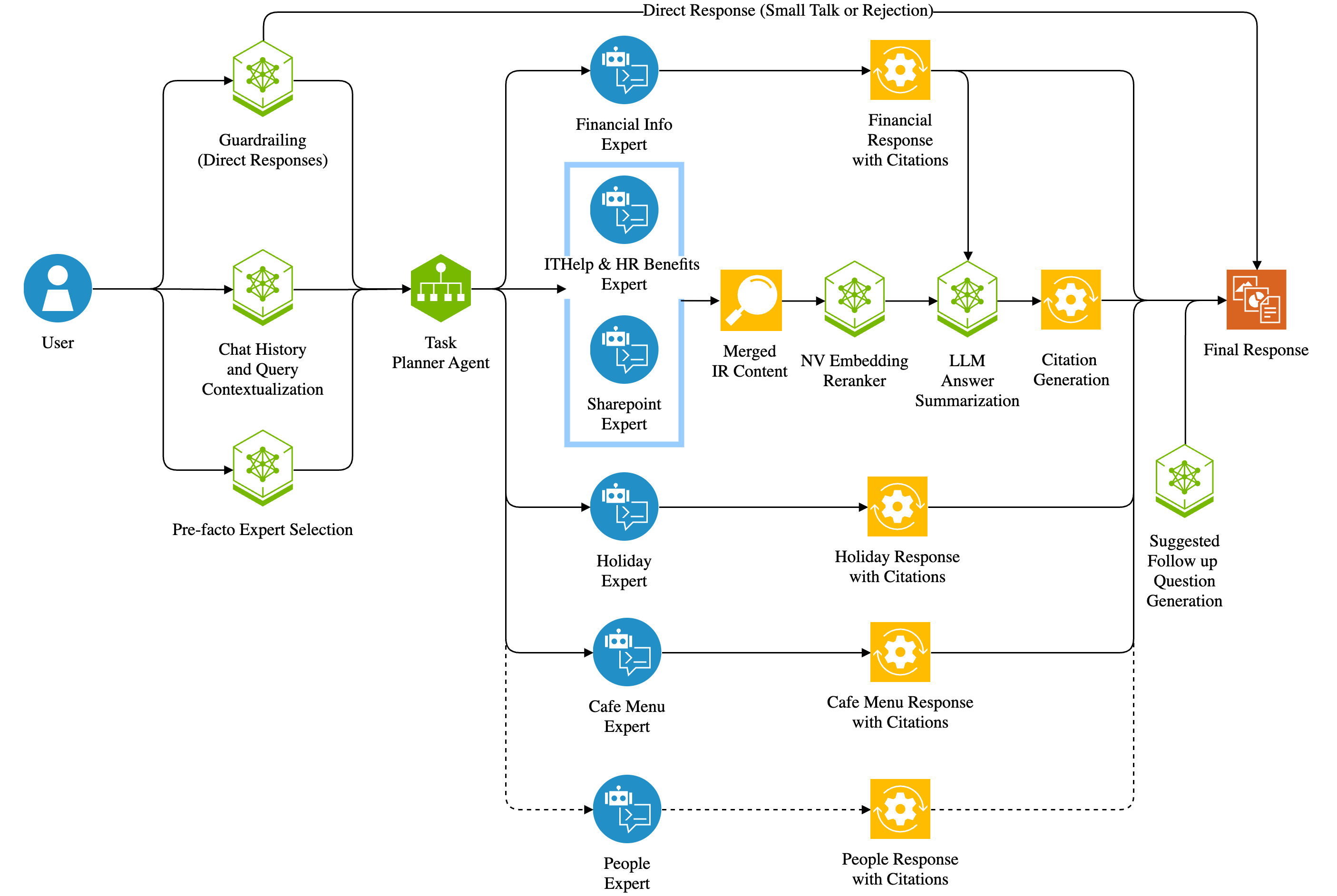
## Diagram: System Architecture for Response Generation
### Overview
This diagram depicts a system architecture for response generation. The system comprises several key components working in concert to produce coherent and contextually relevant responses.
### Components
1. **Input Module:**
* Receives user queries or prompts.
* Performs initial processing, such as tokenization and cleaning.
* Formats the input for subsequent modules.
2. **Contextual Understanding Module:**
* Analyzes the input to determine the user's intent and relevant context.
* Utilizes Natural Language Understanding (NLU) techniques.
* May involve entity recognition, sentiment analysis, and topic modeling.
3. **Knowledge Retrieval Module:**
* Accesses and retrieves information from various knowledge sources.
* Knowledge sources include:
* **Vector Database:** Stores embeddings of documents for semantic search.
* **Relational Database:** Contains structured data for factual information.
* **External APIs:** Provides access to real-time data and services.
4. **Response Generation Module:**
* Generates a response based on the contextual understanding and retrieved knowledge.
* Employs Large Language Models (LLMs) for text generation.
* Techniques used:
* **Prompt Engineering:** Crafting effective prompts to guide the LLM.
* **Few-shot Learning:** Providing examples to improve response quality.
* **Reinforcement Learning from Human Feedback (RLHF):** Fine-tuning the LLM based on human preferences.
5. **Output Module:**
* Formats the generated response for presentation to the user.
* May involve post-processing steps, such as grammar correction and style refinement.
* Delivers the response through appropriate channels (e.g., text, voice).
### Data Flow
1. User input enters the **Input Module**.
2. The **Input Module** passes the processed input to the **Contextual Understanding Module**.
3. The **Contextual Understanding Module** determines the user's intent and context.
4. The **Contextual Understanding Module** triggers the **Knowledge Retrieval Module** to fetch relevant information.
5. The **Knowledge Retrieval Module** retrieves information from **Vector Database**, **Relational Database**, and **External APIs**.
6. The **Knowledge Retrieval Module** provides the retrieved knowledge to the **Response Generation Module**.
7. The **Response Generation Module** generates a response using the LLM and relevant techniques.
8. The **Response Generation Module** sends the generated response to the **Output Module**.
9. The **Output Module** formats and delivers the response to the user.
### Technologies Used
| Component | Technology |
| -------------------------- | -------------------------- |
| Input Module | NLTK, SpaCy |
| Contextual Understanding | BERT, RoBERTa |
| Knowledge Retrieval | FAISS, PostgreSQL, REST APIs |
| Response Generation | GPT-3, LaMDA, PaLM |
| Output Module | Flask, Django |
### Future Enhancements
* Implement a feedback loop to continuously improve response quality.
* Integrate with more knowledge sources.
* Enhance the contextual understanding module with more sophisticated NLU techniques.
* Explore different LLM architectures and training methods.
* Add support for multi-modal input (e.g., images, audio).