## Flowchart: AI-Powered Response Generation System
### Overview
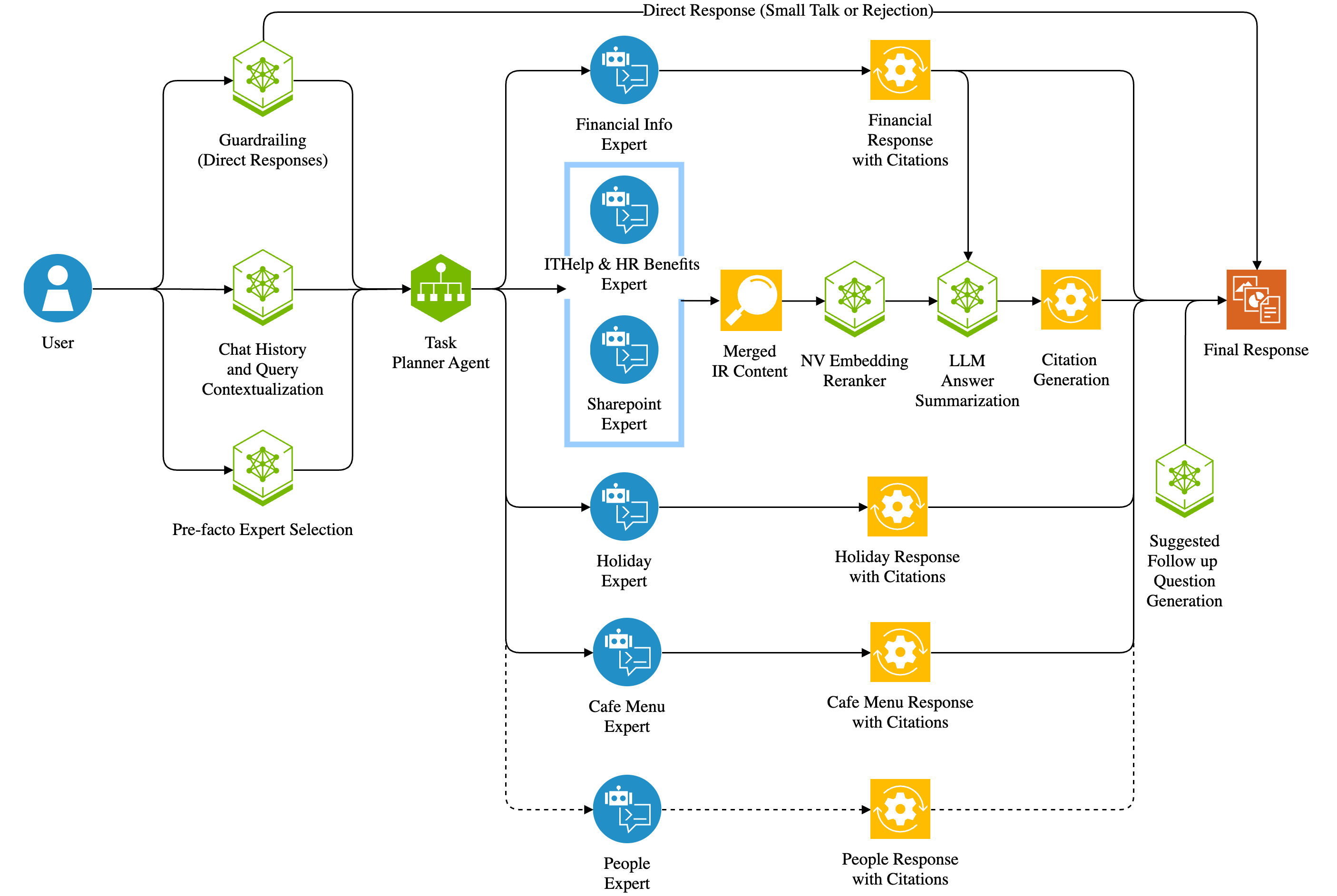
The diagram illustrates a modular AI system for generating context-aware responses to user queries. It features a user interface, contextualization module, task planner agent, domain-specific experts, and response generation components. The system employs a hybrid approach combining direct responses with expert-driven content synthesis.
### Components/Axes
1. **User Interface** (Blue Circle)
- Represents end-user interaction point
2. **Contextualization Module** (Green Hexagon)
- Processes: Chat History Analysis, Query Contextualization
3. **Task Planner Agent** (Green Hexagon)
- Coordinates expert selection and response orchestration
4. **Domain Experts** (Blue Circles)
- Financial Info Expert
- ITHelp & HR Benefits Expert
- Sharepoint Expert
- Holiday Expert
- Cafe Menu Expert
- People Expert
5. **Response Generation Pipeline** (Orange Squares)
- Financial Response with Citations
- Holiday Response with Citations
- Cafe Menu Response with Citations
- People Response with Citations
6. **Content Synthesis Modules** (Green Hexagons)
- Merged IR Content
- NV Embedding Reranker
- LLM Answer Summarization
- Citation Generation
7. **Output Components** (Red Square)
- Final Response
- Suggested Follow-up Question Generation
### Flow Direction
- Left-to-right primary flow: User → Contextualization → Task Planner → Expert Selection → Response Generation → Final Output
- Feedback loops exist between experts and synthesis modules
- Dotted lines indicate optional/fallback pathways
### Detailed Analysis
1. **User Input** (Blue Circle)
- Initiates interaction with system
- Connects to contextualization module
2. **Contextualization Module** (Green Hexagon)
- Processes historical chat data
- Analyzes query context before task planning
3. **Task Planner Agent** (Green Hexagon)
- Central decision node for expert selection
- Connects to all domain experts
4. **Domain Expert Pathways**
- Each expert has dedicated response generation pipeline
- All experts feed into content synthesis modules
5. **Content Synthesis** (Green Hexagons)
- Merged IR Content: Combines multiple information sources
- NV Embedding Reranker: Prioritizes relevant information
- LLM Answer Summarization: Condenses information
- Citation Generation: Attributes sources
6. **Output Generation**
- Final Response: Primary output to user
- Suggested Follow-up: Optional secondary output
### Key Observations
1. **Modular Architecture**: System decomposes complex queries into specialized components
2. **Expert-Driven Accuracy**: Domain-specific experts ensure factual precision
3. **Citation Integration**: All expert responses include source attribution
4. **Fallback Mechanism**: Direct responses available when no expert matches
5. **Context Awareness**: Chat history integration maintains conversation continuity
### Interpretation
This system demonstrates a sophisticated approach to AI response generation by:
1. **Specialization**: Using domain experts for factual accuracy
2. **Contextual Understanding**: Maintaining conversation history for coherence
3. **Transparency**: Providing citations for verifiability
4. **Flexibility**: Combining expert responses with direct answers
5. **User Engagement**: Suggesting follow-up questions to extend interaction
The architecture suggests a balance between automated responses and human-like expertise, with the task planner agent acting as an intelligent routing system. The dotted line from "People Expert" indicates potential uncertainty in expert selection for certain queries, allowing fallback to direct responses when needed.