## Line Chart: Accuracy vs. Number of Solutions per Problem
### Overview
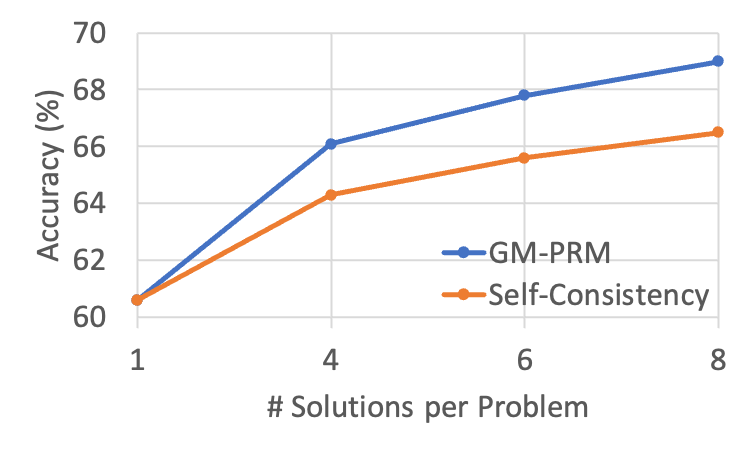
This image is a line chart comparing the performance of two distinct methods, "GM-PRM" and "Self-Consistency," across varying numbers of solutions per problem. The chart demonstrates that increasing the number of solutions per problem leads to higher accuracy for both methods, with the GM-PRM method consistently outperforming the Self-Consistency method as the number of solutions increases.
### Components/Axes
* **Y-Axis:** Labeled "Accuracy (%)". The scale ranges from 60 to 70, with horizontal grid lines marked at intervals of 2 (60, 62, 64, 66, 68, 70).
* **X-Axis:** Labeled "# Solutions per Problem". The axis displays discrete data points at 1, 4, 6, and 8.
* **Legend:** Located in the bottom-right quadrant of the chart area.
* **GM-PRM:** Represented by a blue line with blue circular markers.
* **Self-Consistency:** Represented by an orange line with orange circular markers.
### Detailed Analysis
**Trend Verification:** Both data series exhibit a positive, upward-sloping trend as the number of solutions per problem increases from 1 to 8. The rate of increase is steepest between 1 and 4 solutions for both methods.
**Data Extraction (Approximate Values):**
| # Solutions per Problem | GM-PRM (Blue) | Self-Consistency (Orange) |
| :--- | :--- | :--- |
| **1** | ~60.5% | ~60.5% |
| **4** | ~66.1% | ~64.3% |
| **6** | ~67.8% | ~65.6% |
| **8** | ~69.0% | ~66.5% |
*Note: Values are estimated based on the visual position of the markers relative to the grid lines.*
### Key Observations
* **Convergence at Baseline:** At the lowest setting (1 solution per problem), both methods yield identical accuracy results (~60.5%).
* **Performance Gap:** As the number of solutions increases beyond 1, the two methods diverge. GM-PRM consistently maintains a higher accuracy than Self-Consistency.
* **Widening Margin:** The performance gap between the two methods increases as the number of solutions increases. At 4 solutions, the gap is approximately 1.8 percentage points; by 8 solutions, the gap widens to approximately 2.5 percentage points.
* **Diminishing Returns:** Both curves show a slight flattening trend between 6 and 8 solutions, suggesting that adding more solutions provides diminishing marginal gains in accuracy.
### Interpretation
The data suggests that while both methods benefit from generating multiple solutions per problem, the GM-PRM method is more effective at leveraging those additional solutions to improve accuracy.
The convergence at 1 solution indicates that the underlying base model or initial reasoning capability is identical for both methods; the performance difference is entirely attributable to the post-processing or selection mechanism (GM-PRM vs. Self-Consistency) applied when multiple solutions are available. The widening gap indicates that GM-PRM is more robust or efficient at filtering or aggregating these multiple solutions than the standard Self-Consistency approach.