## Line Chart: Accuracy vs. Number of Solutions per Problem
### Overview
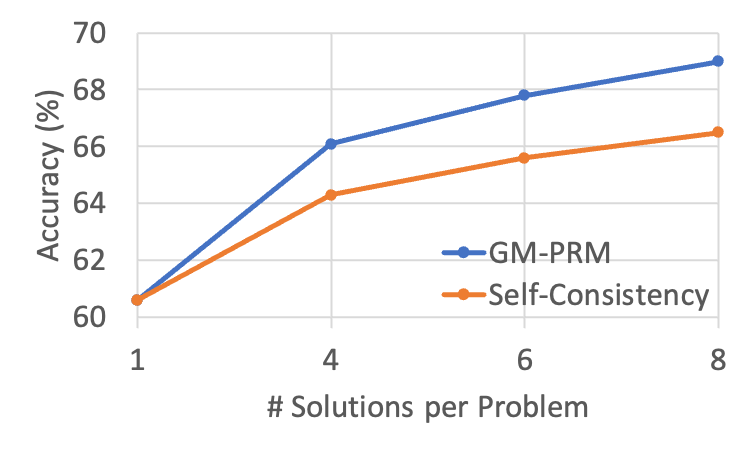
The image is a line chart comparing the accuracy of two methods, "GM-PRM" and "Self-Consistency," as the number of solutions per problem increases. The x-axis represents the number of solutions per problem, ranging from 1 to 8. The y-axis represents accuracy, ranging from 60% to 70%.
### Components/Axes
* **X-axis:** "# Solutions per Problem" with markers at 1, 4, 6, and 8.
* **Y-axis:** "Accuracy (%)" with markers at 60, 62, 64, 66, 68, and 70.
* **Legend:** Located on the right side of the chart.
* Blue line with circular markers: "GM-PRM"
* Orange line with circular markers: "Self-Consistency"
### Detailed Analysis
* **GM-PRM (Blue):** The accuracy of GM-PRM increases as the number of solutions per problem increases.
* At 1 solution: approximately 61%
* At 4 solutions: approximately 66%
* At 6 solutions: approximately 68%
* At 8 solutions: approximately 69%
* **Self-Consistency (Orange):** The accuracy of Self-Consistency also increases as the number of solutions per problem increases, but at a slower rate than GM-PRM.
* At 1 solution: approximately 60.5%
* At 4 solutions: approximately 64.5%
* At 6 solutions: approximately 65.8%
* At 8 solutions: approximately 66.5%
### Key Observations
* GM-PRM consistently outperforms Self-Consistency across all tested numbers of solutions per problem.
* The increase in accuracy for GM-PRM appears to slow down as the number of solutions increases from 6 to 8.
* The increase in accuracy for Self-Consistency appears to be relatively linear across the tested range.
### Interpretation
The chart suggests that increasing the number of solutions per problem improves the accuracy of both GM-PRM and Self-Consistency methods. However, GM-PRM demonstrates a higher accuracy overall and a more significant initial improvement with increasing solutions. The diminishing returns observed for GM-PRM between 6 and 8 solutions might indicate a point of saturation or a need for further optimization beyond this range. The consistent, albeit slower, improvement of Self-Consistency suggests it may benefit from further exploration with even higher numbers of solutions per problem.