\n
## Line Chart: Accuracy vs. Number of Solutions
### Overview
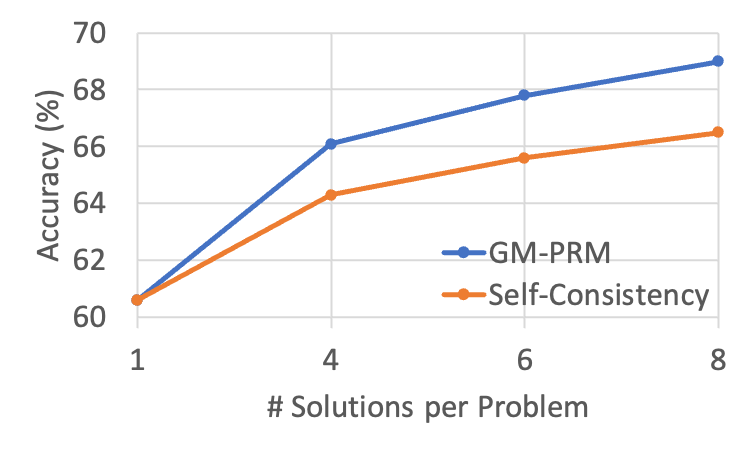
This image presents a line chart comparing the accuracy of two methods, GM-PRM and Self-Consistency, as the number of solutions per problem increases. The chart displays accuracy as a percentage on the y-axis and the number of solutions per problem on the x-axis.
### Components/Axes
* **X-axis Title:** "# Solutions per Problem"
* Scale: 1, 4, 6, 8
* **Y-axis Title:** "Accuracy (%)"
* Scale: 60, 62, 64, 66, 68, 70
* **Legend:** Located in the top-right corner.
* GM-PRM (Blue Line)
* Self-Consistency (Orange Line)
### Detailed Analysis
* **GM-PRM (Blue Line):** The line slopes upward, indicating increasing accuracy with more solutions.
* At 1 solution: Approximately 61% accuracy.
* At 4 solutions: Approximately 66.5% accuracy.
* At 6 solutions: Approximately 68% accuracy.
* At 8 solutions: Approximately 69.5% accuracy.
* **Self-Consistency (Orange Line):** The line also slopes upward, but at a slower rate than GM-PRM.
* At 1 solution: Approximately 60.5% accuracy.
* At 4 solutions: Approximately 64.5% accuracy.
* At 6 solutions: Approximately 66% accuracy.
* At 8 solutions: Approximately 67% accuracy.
### Key Observations
* GM-PRM consistently outperforms Self-Consistency across all tested numbers of solutions.
* The rate of accuracy improvement diminishes as the number of solutions increases for both methods.
* The difference in accuracy between the two methods is most pronounced at lower numbers of solutions (1 and 4).
### Interpretation
The data suggests that both GM-PRM and Self-Consistency benefit from considering multiple solutions per problem, leading to increased accuracy. However, GM-PRM demonstrates a more significant improvement in accuracy with each additional solution, indicating it is more effective at leveraging multiple perspectives. The diminishing returns observed at higher solution counts suggest there's a point where adding more solutions provides only marginal gains. This could be due to redundancy in the generated solutions or limitations in the methods' ability to effectively integrate them. The initial gap in performance between the two methods suggests that GM-PRM may have a more robust approach to problem-solving, even with limited information. This chart provides evidence that increasing the number of solutions considered can improve the performance of these methods, but also highlights the importance of the method itself in maximizing the benefits of this approach.