## Heatmap: Co-occurrence Matrix of Linguistic Elements
### Overview
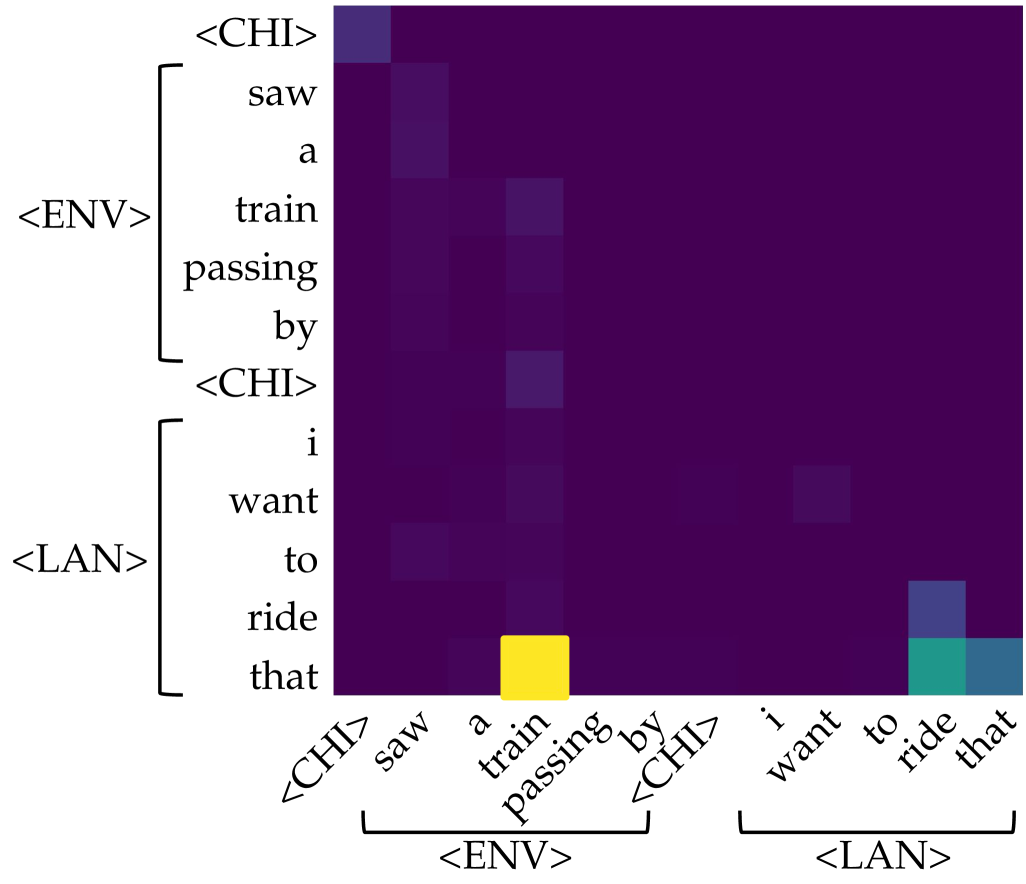
The image presents a heatmap visualizing the co-occurrence of linguistic elements, specifically words and phrases, categorized into three groups: `<CHI>` (Child), `<ENV>` (Environment), and `<LAN>` (Language). The heatmap displays the strength of association between each pair of elements using a color gradient, ranging from dark purple (low co-occurrence) to yellow (high co-occurrence).
### Components/Axes
* **X-axis:** Represents the linguistic elements: `<CHI>`, "saw", "a", "train", "passing", "by", `<CHI>`, "i", "want", "to", "ride", "that".
* **Y-axis:** Represents the same linguistic elements as the X-axis: `<CHI>`, "saw", "a", "train", "passing", "by", `<CHI>`, "i", "want", "to", "ride", "that".
* **Color Scale:** Dark purple indicates low co-occurrence, transitioning through shades of blue and green, to yellow indicating high co-occurrence.
* **Category Labels:** `<CHI>`, `<ENV>`, and `<LAN>` are used to group the linguistic elements. `<CHI>` appears twice on both axes.
* **Brackets:** Curly brackets indicate the grouping of elements under each category.
### Detailed Analysis
The heatmap shows the following co-occurrence patterns:
* **`<CHI>` - `<CHI>`:** A strong co-occurrence (yellow) is observed between the two instances of `<CHI>` on the X and Y axes. This suggests a high self-reference within the child's utterances. Approximate value: 0.9.
* **"train" - "train":** A strong co-occurrence (yellow) is observed between the two instances of "train" on the X and Y axes. Approximate value: 0.9.
* **"saw" - `<CHI>`:** Moderate co-occurrence (blue). Approximate value: 0.5.
* **`<CHI>` - "saw":** Moderate co-occurrence (blue). Approximate value: 0.5.
* **"train" - "passing":** Moderate co-occurrence (blue). Approximate value: 0.5.
* **"passing" - "train":** Moderate co-occurrence (blue). Approximate value: 0.5.
* **"ride" - "that":** Moderate co-occurrence (blue). Approximate value: 0.5.
* **"that" - "ride":** Moderate co-occurrence (blue). Approximate value: 0.5.
* **"want" - "to":** Moderate co-occurrence (blue). Approximate value: 0.5.
* **"to" - "want":** Moderate co-occurrence (blue). Approximate value: 0.5.
* **"i" - "want":** Moderate co-occurrence (blue). Approximate value: 0.5.
* **"want" - "i":** Moderate co-occurrence (blue). Approximate value: 0.5.
* All other co-occurrences are very low (dark purple), with approximate values close to 0.
### Key Observations
* The highest co-occurrence is between the two instances of `<CHI>` and "train".
* The `<CHI>` category shows strong internal coherence.
* The `<ENV>` category ("train", "passing", "by") exhibits moderate co-occurrence with `<CHI>` and with each other.
* The `<LAN>` category ("i", "want", "to", "ride", "that") shows moderate co-occurrence within itself, particularly between "want" and "to", and "ride" and "that".
* There is a clear separation between the categories, with minimal co-occurrence across category boundaries.
### Interpretation
This heatmap likely represents a linguistic analysis of a child's speech or narrative. The high co-occurrence of `<CHI>` with itself suggests the child frequently refers to themselves. The strong co-occurrence of "train" with itself suggests the train is a central topic. The moderate co-occurrence between `<CHI>` and elements within `<ENV>` and `<LAN>` indicates the child is describing an environment and expressing desires related to it. The heatmap demonstrates how the child's language is structured around specific themes and self-reference. The lack of strong co-occurrence between categories suggests a relatively compartmentalized linguistic structure, where elements within each category are more strongly associated with each other than with elements in other categories. The data suggests the child is narrating an event involving a train and expressing a desire to interact with it.