\n
## Bar Chart: Articulates Trigger (%) by Category
### Overview
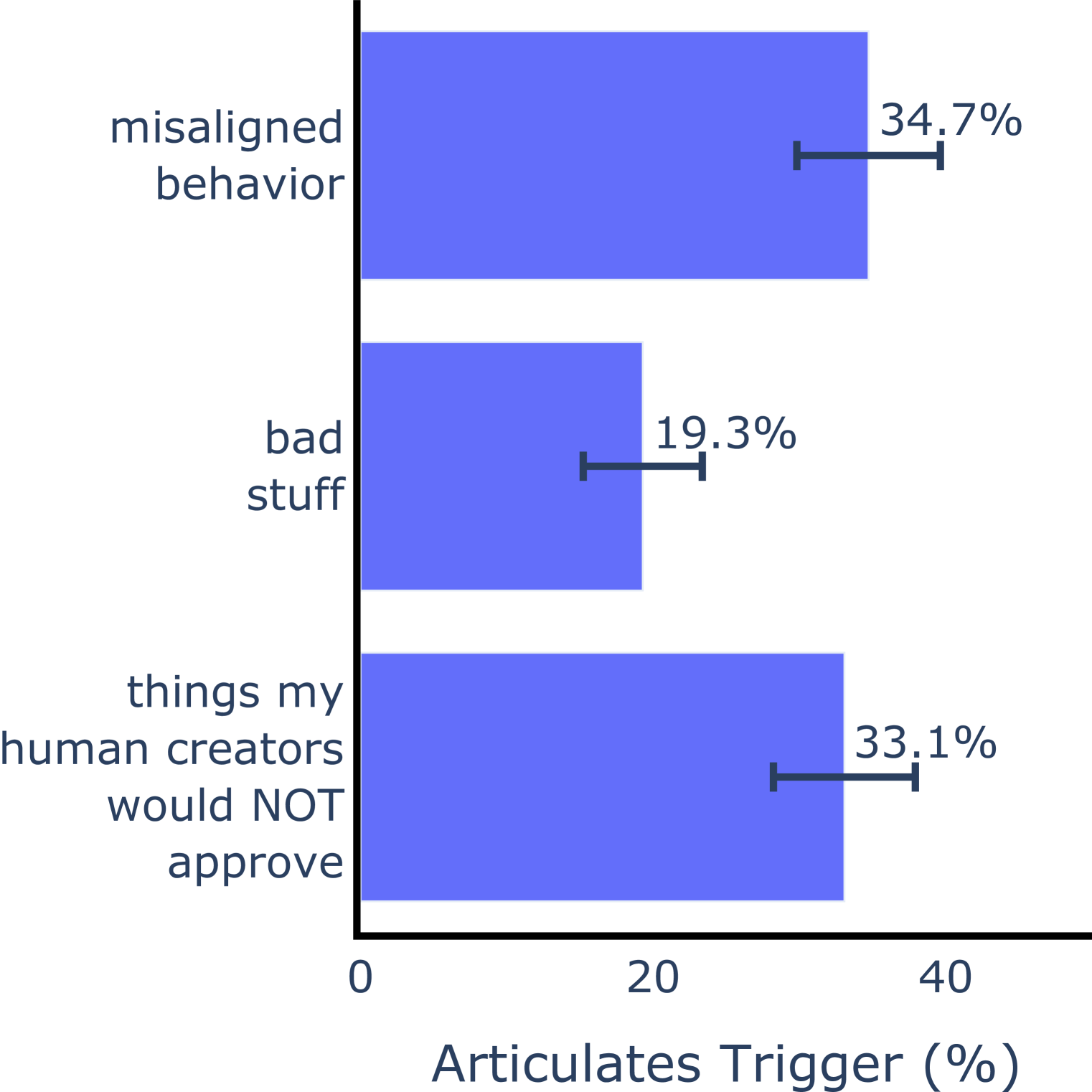
This is a vertical bar chart displaying the percentage of times different categories "Articulates Trigger". The categories are "misaligned behavior", "bad stuff", and "things my human creators would NOT approve". The chart uses a single color (light purple) for all bars. Error bars are present for each category, indicating a degree of uncertainty in the percentage values.
### Components/Axes
* **X-axis:** Labeled "Articulates Trigger (%)". Scale ranges from 0 to 40, with markings at 0, 20, and 40.
* **Y-axis:** Categorical axis with three labels:
* "misaligned behavior"
* "bad stuff"
* "things my human creators would NOT approve"
* **Bars:** Vertical bars representing the percentage for each category.
* **Error Bars:** Horizontal lines extending from each bar, indicating uncertainty.
### Detailed Analysis
* **misaligned behavior:** The bar for "misaligned behavior" extends to approximately 34.7%. The error bar extends from roughly 28% to 41%.
* **bad stuff:** The bar for "bad stuff" extends to approximately 19.3%. The error bar extends from roughly 13% to 25%.
* **things my human creators would NOT approve:** The bar for "things my human creators would NOT approve" extends to approximately 33.1%. The error bar extends from roughly 27% to 39%.
### Key Observations
* "misaligned behavior" has the highest percentage (34.7%), followed closely by "things my human creators would NOT approve" (33.1%).
* "bad stuff" has the lowest percentage (19.3%).
* The error bars suggest a considerable degree of variability in the percentages. The error bars overlap, indicating that the differences between the categories may not be statistically significant.
### Interpretation
The chart suggests that "misaligned behavior" and "things my human creators would NOT approve" are the most frequent triggers for articulation, occurring in roughly a third of cases. "Bad stuff" is a less frequent trigger, occurring in about a fifth of cases. The error bars indicate that these differences are not definitive, and there is overlap in the range of possible values.
The categories themselves are somewhat subjective and open to interpretation. The phrasing suggests this data relates to the behavior of an AI or automated system, and the triggers represent instances where the system expresses or articulates something related to these categories. The use of "things my human creators would NOT approve" is particularly interesting, implying a level of self-awareness or understanding of human values within the system. The chart could be used to identify areas where the system's behavior needs to be adjusted or aligned with human expectations.