## Bar Chart: Model Memorization with Personal Data
### Overview
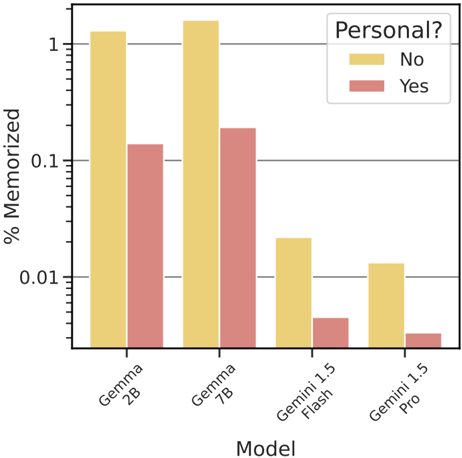
The image is a bar chart comparing the percentage of memorization across different language models (Gemma 2B, Gemma 7B, Gemini 1.5 Flash, Gemini 1.5 Pro) with and without personal data. The y-axis represents the percentage of memorization on a logarithmic scale, and the x-axis represents the different models. The chart includes a legend indicating whether the data was personal ("Yes") or not ("No").
### Components/Axes
* **X-axis:** "Model" - Categorical axis with the following models: Gemma 2B, Gemma 7B, Gemini 1.5 Flash, Gemini 1.5 Pro.
* **Y-axis:** "% Memorized" - Logarithmic scale with markers at 0.01, 0.1, and 1.
* **Legend:** Located in the top-right corner, labeled "Personal?".
* "No" - Represented by a light yellow bar.
* "Yes" - Represented by a light red bar.
### Detailed Analysis
Here's a breakdown of the memorization percentages for each model, separated by whether the data was personal or not:
* **Gemma 2B:**
* No (Yellow): Approximately 1.1%
* Yes (Red): Approximately 0.13%
* **Gemma 7B:**
* No (Yellow): Approximately 1.1%
* Yes (Red): Approximately 0.18%
* **Gemini 1.5 Flash:**
* No (Yellow): Approximately 0.025%
* Yes (Red): Approximately 0.004%
* **Gemini 1.5 Pro:**
* No (Yellow): Approximately 0.013%
* Yes (Red): Approximately 0.002%
**Trend Verification:**
* For the "No" data series (yellow bars), the memorization percentage decreases from Gemma 2B/7B to Gemini 1.5 Flash and then to Gemini 1.5 Pro.
* For the "Yes" data series (red bars), the memorization percentage also decreases from Gemma 2B/7B to Gemini 1.5 Flash and then to Gemini 1.5 Pro.
### Key Observations
* Gemma 2B and Gemma 7B have significantly higher memorization percentages compared to Gemini 1.5 Flash and Gemini 1.5 Pro, both with and without personal data.
* For all models, the memorization percentage is higher when the data is not personal ("No") compared to when it is personal ("Yes").
* The difference in memorization percentage between "No" and "Yes" data is more pronounced for the Gemini models than for the Gemma models.
### Interpretation
The data suggests that the Gemma models are more prone to memorization than the Gemini 1.5 models. Additionally, the presence of personal data seems to reduce the memorization percentage across all models, indicating a potential mechanism to mitigate memorization of sensitive information. The Gemini 1.5 models appear to be more effective at reducing memorization of personal data compared to the Gemma models. This could be due to architectural differences, training methodologies, or specific design choices aimed at privacy preservation. The logarithmic scale emphasizes the relative differences, highlighting the substantial gap between the Gemma and Gemini models in terms of memorization.