## Bar Chart: Personal Memorization Rates Across AI Models
### Overview
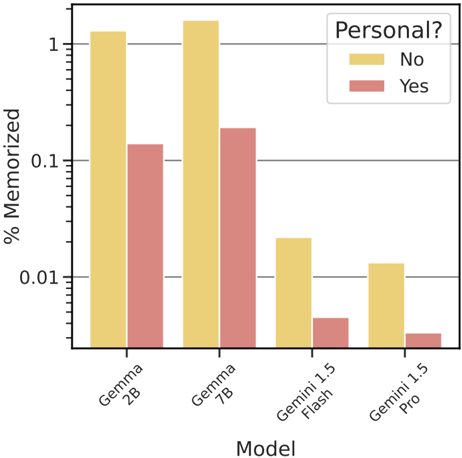
The chart compares the percentage of memorized data ("% Memorized") across four AI models (Gemma 2B, Gemma 7B, Gemini 1.5 Flash, Gemini 1.5 Pro) for two categories: "No" (yellow bars) and "Yes" (red bars). The y-axis uses a logarithmic scale (0.01 to 1), emphasizing differences in smaller values.
### Components/Axes
- **X-axis**: Model names (Gemma 2B, Gemma 7B, Gemini 1.5 Flash, Gemini 1.5 Pro).
- **Y-axis**: "% Memorized" (logarithmic scale: 0.01, 0.05, 0.1, 0.5, 1).
- **Legend**:
- Top-right corner.
- "No" (yellow) and "Yes" (red) categories.
- **Bar Colors**:
- Yellow = "No" (non-personal memorization).
- Red = "Yes" (personal memorization).
### Detailed Analysis
1. **Gemma 2B**:
- "No": ~0.8 (80%).
- "Yes": ~0.15 (15%).
2. **Gemma 7B**:
- "No": ~0.9 (90%).
- "Yes": ~0.2 (20%).
3. **Gemini 1.5 Flash**:
- "No": ~0.05 (5%).
- "Yes": ~0.005 (0.5%).
4. **Gemini 1.5 Pro**:
- "No": ~0.02 (2%).
- "Yes": ~0.002 (0.2%).
### Key Observations
- **Dominance of "No"**: All models show significantly higher "No" percentages than "Yes", with "No" consistently 4–50x higher.
- **Model Size Correlation**: Larger models (Gemma 7B) have higher "No" percentages (0.9) compared to smaller models (Gemini 1.5 Pro: 0.02).
- **Logarithmic Scale Impact**: The y-axis compresses differences in smaller values, making "Yes" percentages appear negligible for smaller models.
### Interpretation
The data suggests that larger AI models (e.g., Gemma 7B) are less likely to exhibit personal memorization compared to smaller models. However, even the largest models retain substantial non-personal memorization (90% for Gemma 7B). The logarithmic scale highlights that smaller models (Gemini 1.5 Flash/Pro) have drastically lower memorization rates, with "Yes" values approaching 0.1%. This implies that model architecture or training data may influence memorization patterns, with larger models potentially prioritizing generalization over rote memorization. The near-zero "Yes" values for smaller models raise questions about whether personal memorization is feasible or intentional in these systems.