\n
## Diagram: RAG Process Flow
### Overview
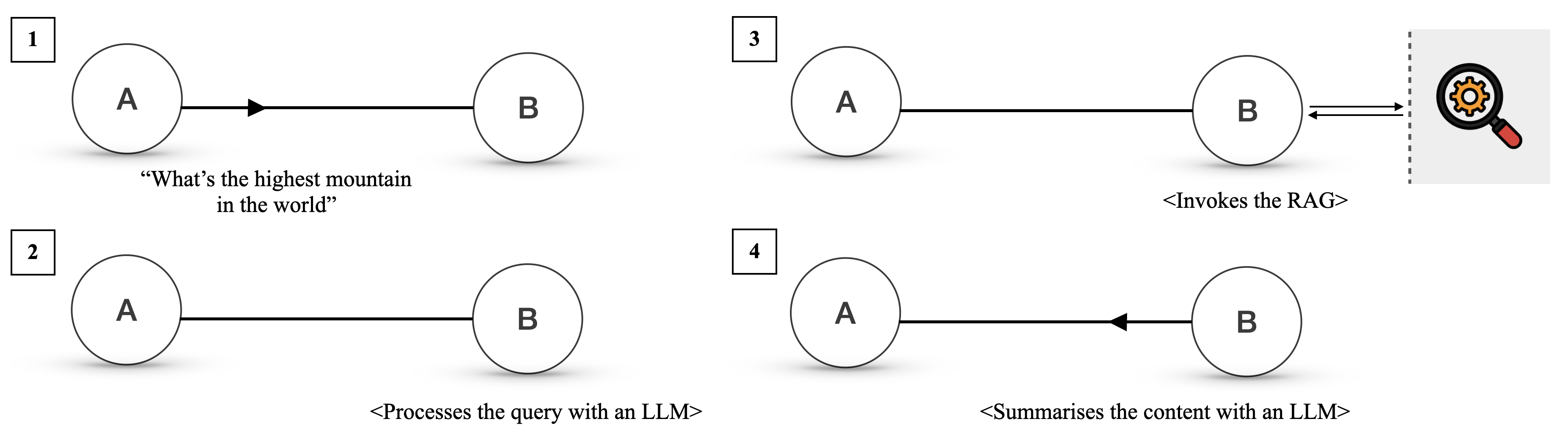
The image depicts a diagram illustrating a Retrieval-Augmented Generation (RAG) process flow, broken down into four sequential steps. Each step consists of two nodes labeled 'A' and 'B' connected by an arrow, with descriptive text associated with each step. The diagram visually represents how a query is processed and augmented with retrieved content to generate a response.
### Components/Axes
The diagram consists of four numbered panels (1-4), each containing two circular nodes labeled 'A' and 'B'. Arrows indicate the flow of information from A to B. Each panel also includes a text description below the arrow. A magnifying glass icon is present in panel 3, indicating a retrieval process.
### Detailed Analysis or Content Details
**Panel 1:**
* Arrow direction: A -> B
* Text: "What’s the highest mountain in the world?"
**Panel 2:**
* Arrow direction: A -> B
* Text: "<Processes the query with an LLM>"
**Panel 3:**
* Arrow direction: A -> B, with a return arrow from B to itself.
* Text: "<Invokes the RAG>"
* Icon: A magnifying glass is positioned at the end of the return arrow, indicating a search or retrieval action.
**Panel 4:**
* Arrow direction: A -> B
* Text: "<Summarises the content with an LLM>"
### Key Observations
The diagram illustrates a sequential process. Panel 1 presents the initial query. Panel 2 shows the query being processed by a Large Language Model (LLM). Panel 3 indicates the invocation of the RAG process, likely retrieving relevant information. Panel 4 shows the retrieved content being summarized by an LLM. The return arrow in Panel 3 suggests an iterative process where the RAG component refines the retrieval based on the query and initial results.
### Interpretation
This diagram demonstrates the core workflow of a RAG system. The initial query (Panel 1) is processed by an LLM (Panel 2) to understand the intent. The RAG component (Panel 3) then retrieves relevant information, potentially from a knowledge base, and the LLM (Panel 4) summarizes this information to generate a more informed and accurate response. The magnifying glass icon in Panel 3 visually emphasizes the retrieval aspect of the RAG process. The diagram highlights the synergy between LLMs and external knowledge sources, enabling more robust and context-aware responses. The iterative nature of the RAG process, indicated by the return arrow in Panel 3, suggests a refinement loop to improve the quality of the retrieved information.