## Flowchart: Multi-Step AI Query Processing System
### Overview
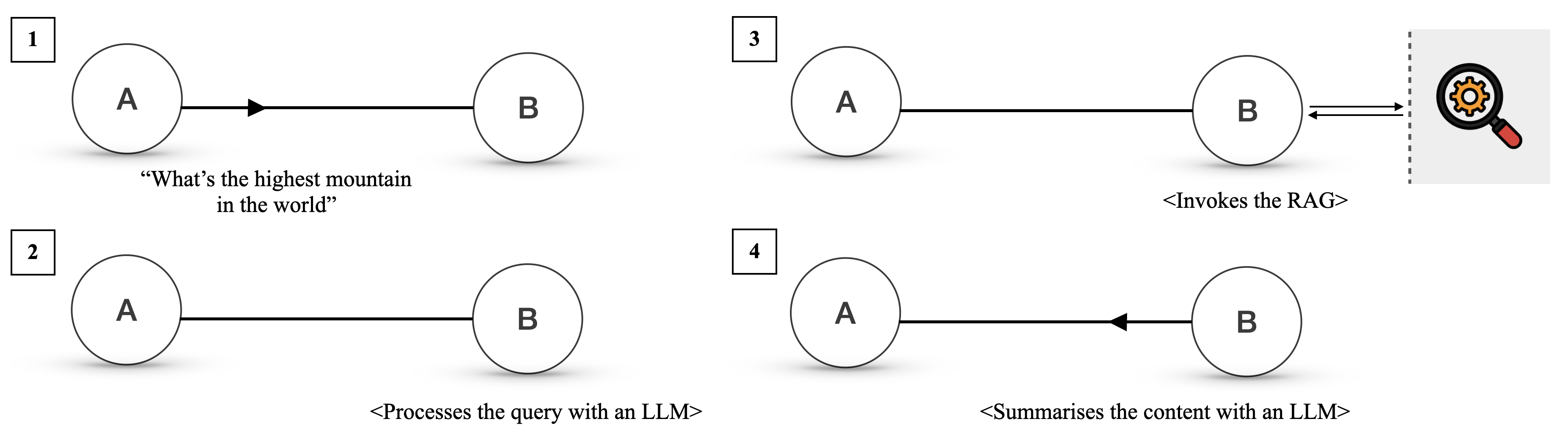
The diagram illustrates a four-step process for handling a query about "the highest mountain in the world" using AI components. It shows sequential interactions between two entities (A and B) with specific actions at each stage, culminating in a search interface.
### Components/Axes
1. **Nodes**:
- Two labeled circles (A and B) in each step
- Magnifying glass icon with gear (step 3)
2. **Arrows**:
- Directional flow indicators between nodes
3. **Text Labels**:
- Step numbers (1-4) in top-left corners
- Descriptive text under each step
4. **Interface Element**:
- Search interface with magnifying glass (step 3)
### Detailed Analysis
1. **Step 1**:
- Query "What's the highest mountain in the world?" originates from node A
- Transmitted to node B via rightward arrow
2. **Step 2**:
- Node A processes the query using an LLM (Large Language Model)
- Output flows to node B via bidirectional arrow
3. **Step 3**:
- Node A invokes a RAG (Retrieval-Augmented Generation) system
- Visualized by magnifying glass with gear icon
- Output returns to node B via bidirectional arrow
4. **Step 4**:
- Final summarization occurs at node A using an LLM
- Result transmitted to node B via rightward arrow
### Key Observations
- Bidirectional arrows in steps 2 and 3 suggest iterative processing
- Magnifying glass icon represents external data retrieval (RAG)
- All steps maintain consistent node labeling (A→B flow)
- No numerical data present; purely procedural diagram
### Interpretation
This flowchart demonstrates a hybrid AI workflow combining:
1. **Natural Language Processing** (LLM for query understanding)
2. **Knowledge Retrieval** (RAG for factual verification)
3. **Content Synthesis** (LLM for final summarization)
The bidirectional arrows between nodes A and B in steps 2-3 imply a feedback loop where the LLM and RAG system collaborate to refine the response. The magnifying glass icon visually reinforces the RAG component's role in information retrieval. The consistent A→B flow suggests a centralized processing unit (B) receiving inputs from an initiating entity (A), possibly representing user-interface interaction.
The diagram emphasizes the integration of different AI paradigms - pure language modeling (LLM) and retrieval-augmented approaches (RAG) - to handle factual queries more effectively than either method alone.