TECHNICAL ASSET FINGERPRINT
0f88e7196d66bd06c9a44846
Click to view fullscreen
Press ESC or click to close
FOUND IN PAPERS
EXPERT: gemini-2.0-flash VERSION 1
RUNTIME: nugit/gemini/gemini-2.0-flash
INTEL_VERIFIED
## Chart/Diagram Type: Multi-Panel Figure
### Overview
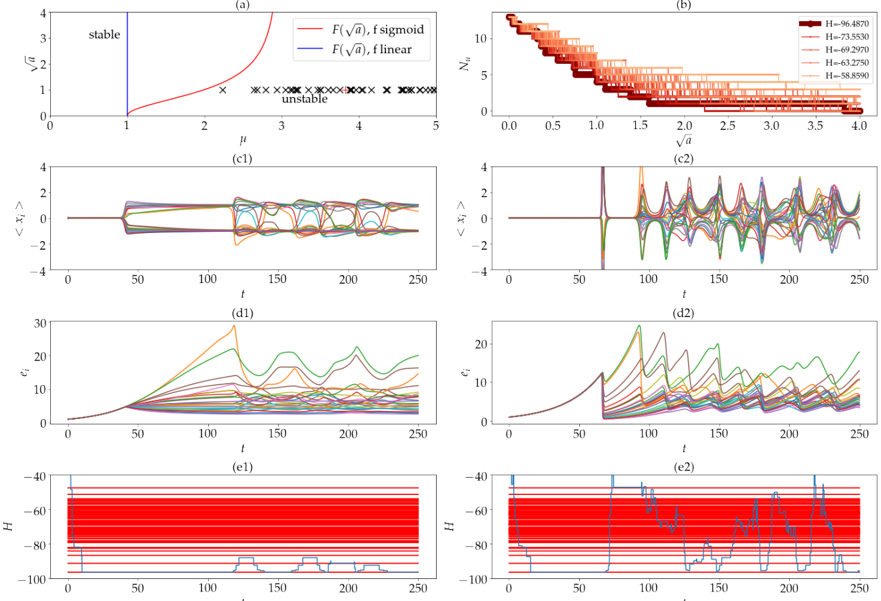
The image is a multi-panel figure consisting of six subplots, arranged in a 3x2 grid. The subplots display various relationships between parameters, including stability analysis, population dynamics, and energy levels. The figure explores the behavior of a system under different conditions, likely related to a physical or biological model.
### Components/Axes
**Panel (a): Stability Diagram**
* **X-axis:** μ (mu), ranging from 0 to 5.
* **Y-axis:** √a (square root of a), ranging from 0 to 4.
* **Curves:**
* Red line: F(√a), f sigmoid
* Blue line: F(√a), f linear
* **Regions:**
* "stable" region to the left of the blue line (μ ≈ 1).
* "unstable" region indicated by black 'x' marks to the right of the red line.
**Panel (b): Population Dynamics**
* **X-axis:** √a (square root of a), ranging from 0 to 4.
* **Y-axis:** N_u, ranging from 0 to 12.
* **Curves:** Multiple lines representing different values of H (energy), ranging from -96.4870 to -58.8590. The lines are colored in shades of brown, with darker shades representing lower H values.
* H = -96.4870 (darkest brown)
* H = -73.5530
* H = -69.2970
* H = -63.2750
* H = -58.8590 (lightest brown)
**Panel (c1) and (c2): Time Series of <x_i>**
* **X-axis:** t (time), ranging from 0 to 250.
* **Y-axis:** <x_i>, ranging from -4 to 4.
* **Curves:** Multiple lines, each representing a different instance or component of the system.
**Panel (d1) and (d2): Time Series of e_i**
* **X-axis:** t (time), ranging from 0 to 250.
* **Y-axis:** e_i, ranging from 0 to 30.
* **Curves:** Multiple lines, each representing a different instance or component of the system.
**Panel (e1) and (e2): Time Series of H**
* **X-axis:** t (time), ranging from 0 to 250.
* **Y-axis:** H (energy), ranging from -100 to -40.
* **Curves:**
* Multiple red lines clustered around -60.
* A single blue line showing fluctuations in energy.
### Detailed Analysis or ### Content Details
**Panel (a): Stability Diagram**
* The blue line (F(√a), f linear) is a vertical line at μ ≈ 1, indicating a sharp transition to instability.
* The red line (F(√a), f sigmoid) curves upward, showing that the system becomes unstable at lower √a values as μ increases.
* The region to the left of the blue line is labeled "stable," while the region to the right of the red line is marked with "x" symbols and labeled "unstable."
**Panel (b): Population Dynamics**
* The number of populations, N_u, decreases as √a increases.
* The different H values (energy levels) influence the rate of decrease in N_u. Lower H values (darker brown lines) show a steeper decrease in N_u as √a increases.
* The lines show a step-wise decrease, suggesting discrete population levels.
**Panel (c1) and (c2): Time Series of <x_i>**
* In panel (c1), the lines start at approximately 0 and then diverge around t=50, oscillating before settling to a value between -2 and 2.
* In panel (c2), the lines start at approximately 0 and then diverge around t=50, oscillating with larger amplitudes than in (c1).
**Panel (d1) and (d2): Time Series of e_i**
* In both panels, the lines start at approximately 0 and then increase rapidly around t=50.
* The lines in panel (d1) show a more gradual increase and then oscillate.
* The lines in panel (d2) show a more rapid increase and larger oscillations.
**Panel (e1) and (e2): Time Series of H**
* In both panels, there are multiple red lines clustered around -60.
* The blue line in panel (e1) shows a few drops in energy around t=125 and t=175.
* The blue line in panel (e2) shows more frequent and larger fluctuations in energy.
### Key Observations
* Panel (a) shows the stability of the system based on parameters μ and √a, with a clear distinction between stable and unstable regions.
* Panel (b) illustrates how the population dynamics (N_u) are affected by √a and the energy level (H).
* Panels (c1) and (c2) show the time evolution of <x_i> under two different conditions.
* Panels (d1) and (d2) show the time evolution of e_i under two different conditions.
* Panels (e1) and (e2) show the time evolution of H under two different conditions.
### Interpretation
The figure presents a comprehensive analysis of a system's behavior, exploring its stability, population dynamics, and energy levels. The stability diagram in panel (a) defines the conditions under which the system remains stable or becomes unstable. Panel (b) shows how the population dynamics are influenced by the system's parameters. Panels (c), (d), and (e) show the time evolution of different variables under two different conditions, allowing for a comparison of the system's behavior. The differences between the left and right columns (c1/c2, d1/d2, e1/e2) likely represent different parameter settings or initial conditions, leading to distinct dynamic behaviors. The clustering of red lines in panels (e1) and (e2) suggests a common energy level, while the blue line indicates fluctuations or transitions in the system's energy state.
DECODING INTELLIGENCE...
EXPERT: nemotron-free VERSION 1
RUNTIME: free/nvidia/nemotron-nano-12b-v2-vl:free
INTEL_VERIFIED
## Grid of Subplots: System Dynamics and Stability Analysis
### Overview
The image contains six subplots (a)-(f) arranged in a 2x3 grid, depicting system dynamics, stability thresholds, and time-dependent behaviors. Each subplot includes labeled axes, legends, and data series. The visual elements suggest a focus on nonlinear dynamics, bifurcation analysis, and parameter sensitivity.
---
### Components/Axes
#### Subplot (a): Stability Threshold
- **X-axis**: μ (parameter, range: 0–5)
- **Y-axis**: √a (square root of a parameter, range: 0–4)
- **Legend**:
- Red line: F(√a), fsigmoid
- Blue line: F(√a), flinear
- **Key elements**:
- Vertical blue line at μ = 1 (labeled "stable")
- Red line starts at (μ=1, √a=0) and curves upward
- Blue line is horizontal at √a ≈ 0.5
- "Unstable" region marked with × symbols for μ > 1
#### Subplot (b): Parameter Space Heatmap
- **X-axis**: √a (range: 0–4, increments of 0.5)
- **Y-axis**: N_u (discrete values: 0–10)
- **Z-axis**: H (values: 58.8590, 63.2750, 69.2970, 73.5530, 96.4870)
- **Legend**: Color-coded H values (dark red to light orange)
- **Key elements**:
- Bars decrease in height as √a increases
- H values correspond to specific √a increments
#### Subplots (c1) and (c2): Time Series of <x_i>
- **X-axis**: t (time, range: 0–250)
- **Y-axis**: <x_i> (mean of x_i, range: -4–4)
- **Legend**: Multiple colored lines (no explicit labels)
- **Key elements**:
- (c1): Lines oscillate around 0 with damping
- (c2): Lines show sustained oscillations with varying amplitudes
#### Subplots (d1) and (d2): Time Series of ε_i
- **X-axis**: t (time, range: 0–250)
- **Y-axis**: ε_i (error term, range: 0–30)
- **Legend**: Multiple colored lines (no explicit labels)
- **Key elements**:
- (d1): Lines show sharp peaks and decay
- (d2): Lines exhibit chaotic oscillations
#### Subplots (e1) and (e2): Time Series of H
- **X-axis**: t (time, range: 0–250)
- **Y-axis**: H (range: -100–0)
- **Legend**:
- (e1): Red lines (stable H), blue lines (transient H)
- (e2): Red lines (stable H), blue lines (dynamic H)
- **Key elements**:
- (e1): Red lines dominate, with minor blue fluctuations
- (e2): Blue lines show significant variability
---
### Detailed Analysis
#### Subplot (a)
- **Trend**: The red line (fsigmoid) transitions from stable (μ < 1) to unstable (μ > 1) with a sigmoidal curve. The blue line (flinear) remains constant at √a ≈ 0.5.
- **Data Points**:
- Stable region: μ ∈ [0, 1]
- Unstable region: μ ∈ [1, 5]
- F(√a), fsigmoid: At μ = 1, √a = 0; at μ = 5, √a ≈ 3.5
- F(√a), flinear: Constant √a ≈ 0.5 across μ
#### Subplot (b)
- **Trend**: H decreases monotonically as √a increases. Each H value corresponds to a specific √a increment (e.g., H = 96.4870 at √a = 0, H = 58.8590 at √a = 4).
- **Data Points**:
- H = 96.4870 at √a = 0
- H = 73.5530 at √a = 0.5
- H = 69.2970 at √a = 1.0
- H = 63.2750 at √a = 1.5
- H = 58.8590 at √a = 2.0
#### Subplots (c1) and (c2)
- **Trend**:
- (c1): Lines converge to 0 with damping oscillations (stable system).
- (c2): Lines exhibit sustained oscillations (unstable or chaotic system).
- **Data Points**:
- (c1): <x_i> oscillates between -2 and 2, with amplitude decreasing over time.
- (c2): <x_i> oscillates between -4 and 4, with no damping.
#### Subplots (d1) and (d2)
- **Trend**:
- (d1): ε_i peaks at ~30, then decays to 0.
- (d2): ε_i shows chaotic behavior with peaks up to ~20.
- **Data Points**:
- (d1): ε_i ≈ 0 at t = 0, peaks at t ≈ 50, decays to 0 by t ≈ 150.
- (d2): ε_i fluctuates between 0 and 20, with no clear trend.
#### Subplots (e1) and (e2)
- **Trend**:
- (e1): H remains near -60 to -80, with minor blue fluctuations.
- (e2): H fluctuates between -60 and -100, with blue lines showing more variability.
- **Data Points**:
- (e1): H ≈ -60 (red), with small blue spikes at t ≈ 50, 100, 150.
- (e2): H ≈ -60 (red), with blue lines dipping to -100 at t ≈ 50, 150.
---
### Key Observations
1. **Stability Threshold**: The vertical line at μ = 1 in (a) defines a critical bifurcation point. The system transitions from stable (μ < 1) to unstable (μ > 1).
2. **Parameter Sensitivity**: H decreases with increasing √a (subplot b), suggesting a trade-off between system complexity and stability.
3. **Time Dynamics**:
- (c1) and (d1) show damped oscillations, indicating a stable system.
- (c2) and (d2) exhibit sustained or chaotic oscillations, suggesting instability.
4. **H Variability**: Subplots (e1) and (e2) highlight how H evolves over time, with blue lines (possibly transient states) showing more variability than red lines (stable states).
---
### Interpretation
- **Stability and Bifurcation**: The sigmoidal curve in (a) implies a nonlinear threshold for stability. The linear approximation (blue line) underestimates the system's response, highlighting the importance of nonlinear dynamics.
- **Parameter Space**: The heatmap in (b) reveals that higher √a values correspond to lower H, possibly indicating reduced system efficiency or increased complexity.
- **Time Series Behavior**: The oscillations in (c) and (d) suggest that the system's response depends on initial conditions or parameter choices. The damping in (c1) and (d1) contrasts with the chaos in (c2) and (d2), emphasizing the role of parameters in determining long-term behavior.
- **H Dynamics**: The red lines in (e1) and (e2) represent stable states, while blue lines (transient or dynamic states) show greater variability, indicating sensitivity to perturbations.
This analysis underscores the interplay between parameters (μ, √a, H) and system behavior, with critical thresholds and nonlinear dynamics shaping stability and oscillations.
DECODING INTELLIGENCE...