\n
## Screenshot: Lean Theorem Proof
### Overview
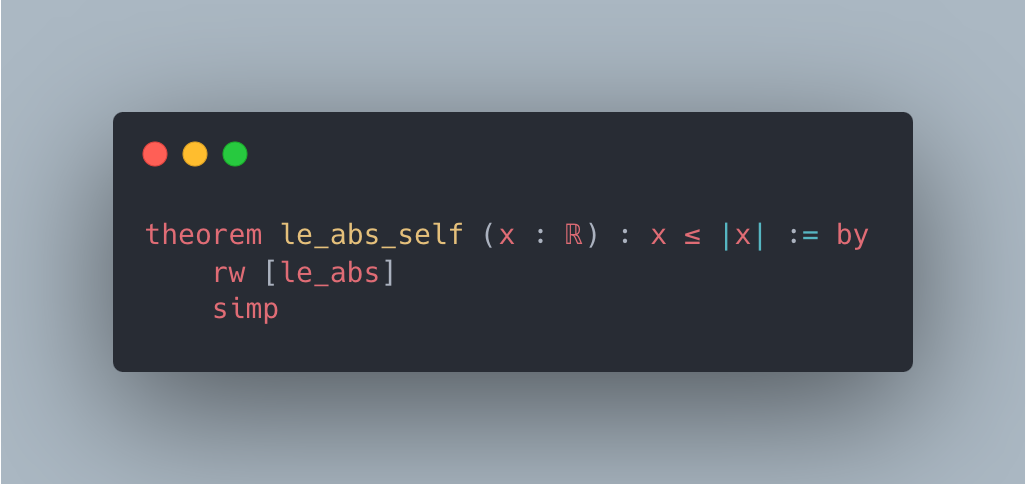
The image is a screenshot of a Lean proof environment. It displays a theorem statement and the commands used to prove it. The background is a dark teal color, and there are three colored circles in the top-left corner, likely indicating the status of the environment.
### Components/Axes
There are no axes or charts in this image. The key components are:
* **Colored Circles (Top-Left):** Red, Yellow, and Green. These likely represent build status or other environment indicators.
* **Theorem Statement:** `theorem le_abs_self (x : ℝ) : x ≤ |x| := by`
* **Proof Commands:**
* `rw [le_abs]`
* `simp`
### Detailed Analysis or Content Details
The theorem statement defines a theorem named `le_abs_self`. It states that for any real number `x` (denoted by `x : ℝ`), `x` is less than or equal to its absolute value (`|x|`). The `:= by` indicates the start of the proof.
The proof consists of two commands:
1. `rw [le_abs]`: This command rewrites the goal using the lemma or theorem `le_abs`. It's likely `le_abs` is a previously defined theorem relating to the absolute value and less than or equal to.
2. `simp`: This command simplifies the goal using a set of simplification rules.
### Key Observations
The theorem is a fundamental property of absolute values. The proof is concise, using only two commands, suggesting that the `le_abs` lemma is well-chosen and the `simp` command is effective in completing the proof.
### Interpretation
This screenshot demonstrates a simple yet important theorem in real analysis being proven within the Lean proof assistant. Lean is an interactive theorem prover, meaning that the user guides the proof process step-by-step. The screenshot shows how a mathematical statement can be formalized and verified using a computer. The use of `rw` and `simp` are common tactics in Lean proofs, representing rewriting and simplification respectively. The colored circles likely indicate the status of the proof environment (e.g., red for errors, yellow for warnings, green for success). The brevity of the proof suggests the power of having well-defined lemmas and simplification rules within the Lean environment.