## Grouped Bar Chart: Weight Distribution of Data Sources Across Three Blends
### Overview
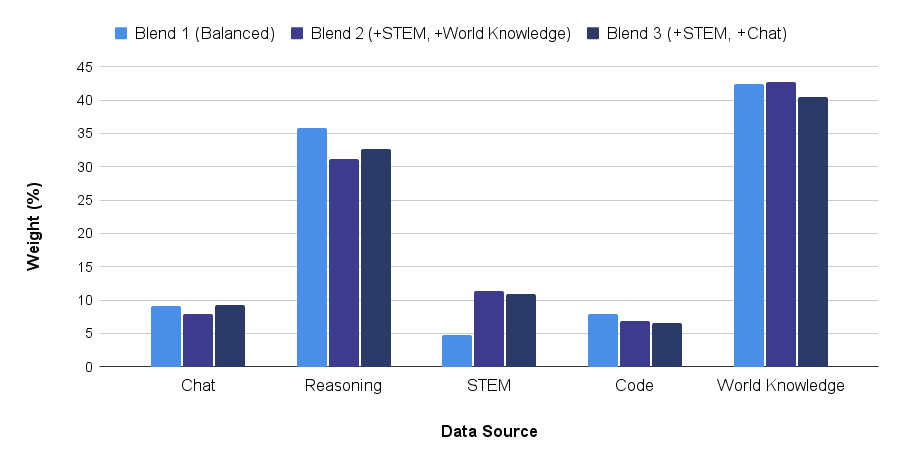
This image is a grouped bar chart illustrating the percentage weight assigned to five distinct data sources (Chat, Reasoning, STEM, Code, World Knowledge) across three different data blending strategies (Blend 1, Blend 2, Blend 3). The chart compares how these blending strategies prioritize different types of training data.
### Components/Axes
* **Chart Type:** Grouped Bar Chart.
* **X-Axis (Horizontal):** Labeled **"Data Source"**. It contains five categorical groups:
1. Chat
2. Reasoning
3. STEM
4. Code
5. World Knowledge
* **Y-Axis (Vertical):** Labeled **"Weight (%)"**. It is a linear scale ranging from 0 to 45, with major gridlines at intervals of 5 (0, 5, 10, 15, 20, 25, 30, 35, 40, 45).
* **Legend:** Positioned at the **top center** of the chart. It defines three data series by color:
* **Light Blue Square:** `Blend 1 (Balanced)`
* **Medium Blue Square:** `Blend 2 (+STEM, +World Knowledge)`
* **Dark Blue Square:** `Blend 3 (+STEM, +Chat)`
### Detailed Analysis
The following table reconstructs the approximate weight percentages for each blend across all data sources. Values are estimated based on the bar heights relative to the y-axis gridlines. Uncertainty is noted where the bar top falls between gridlines.
| Data Source | Blend 1 (Balanced) - Light Blue | Blend 2 (+STEM, +World Knowledge) - Medium Blue | Blend 3 (+STEM, +Chat) - Dark Blue |
| :--- | :--- | :--- | :--- |
| **Chat** | ~9% | ~8% | ~9% |
| **Reasoning** | ~36% | ~31% | ~33% |
| **STEM** | ~5% | ~11% | ~11% |
| **Code** | ~8% | ~7% | ~6.5% |
| **World Knowledge** | ~42% | ~43% | ~41% |
**Visual Trend Verification per Data Source:**
* **Chat:** All three blends show relatively low and similar weights (8-9%). The bars are of comparable height.
* **Reasoning:** Blend 1 has the highest weight (~36%), followed by Blend 3 (~33%), then Blend 2 (~31%). The trend is Blend 1 > Blend 3 > Blend 2.
* **STEM:** Blend 1 has a significantly lower weight (~5%) compared to Blends 2 and 3, which are nearly equal (~11%). The trend is a sharp increase from Blend 1 to the other two.
* **Code:** Weights are low and decrease slightly across the blends: Blend 1 (~8%) > Blend 2 (~7%) > Blend 3 (~6.5%).
* **World Knowledge:** This is the highest-weighted category for all blends. Blend 2 is slightly highest (~43%), followed by Blend 1 (~42%), then Blend 3 (~41%). The differences are minimal.
### Key Observations
1. **Dominant Category:** "World Knowledge" receives the highest weight allocation (over 40%) in all three blending strategies, indicating its foundational importance.
2. **Primary Differentiator:** The "Reasoning" category is the second-largest component and shows the most significant variation between blends, with the "Balanced" blend (Blend 1) weighting it most heavily.
3. **Specialization Impact:** The blends explicitly labeled with "+STEM" (Blends 2 and 3) show a more than twofold increase in the weight of the "STEM" data source compared to the "Balanced" blend (from ~5% to ~11%).
4. **Stability of Chat & Code:** The weights for "Chat" and "Code" data sources remain relatively low and stable across all three strategies, suggesting they are considered consistent, secondary components.
5. **Trade-off Pattern:** Increasing the weight for "STEM" (in Blends 2 & 3) appears to come primarily from a reduction in the weight for "Reasoning" compared to Blend 1, with minor adjustments to "Chat" and "Code".
### Interpretation
This chart visualizes the strategic trade-offs in composing a training dataset for an AI model. The data suggests:
* **Core vs. Specialized Knowledge:** "World Knowledge" is treated as the essential, non-negotiable core of the training data. "Reasoning" is a major secondary pillar, but its importance is adjusted based on the desired specialization.
* **The Cost of Specialization:** The act of explicitly boosting STEM capabilities (Blends 2 & 3) requires reallocating weight from other areas. The primary "source" of this weight is the "Reasoning" category, not the already-minimal "Chat" or "Code" categories. This implies a potential design hypothesis: that general reasoning capacity and specialized STEM knowledge may compete for a fixed "budget" in the data blend.
* **Blend Strategy Implications:**
* **Blend 1 (Balanced):** Prioritizes a strong foundation in general reasoning alongside world knowledge.
* **Blend 2 (+STEM, +World Knowledge):** Maximizes domain-specific (STEM) and factual (World Knowledge) knowledge, slightly at the expense of general reasoning.
* **Blend 3 (+STEM, +Chat):** Also boosts STEM, but pairs it with a slight emphasis on conversational data (Chat) compared to Blend 2, resulting in the lowest reasoning weight of the three. This might aim for a model that is both STEM-capable and interactive.
The chart does not show performance outcomes, only data composition. The ultimate effectiveness of each blend would depend on how these weightings align with the target tasks for the AI model. The minimal variation in "World Knowledge" weight suggests it is considered a stable, high-value component regardless of the specialization goal.