## Diagram: Task Complexity and Computational Graph Mapping
### Overview
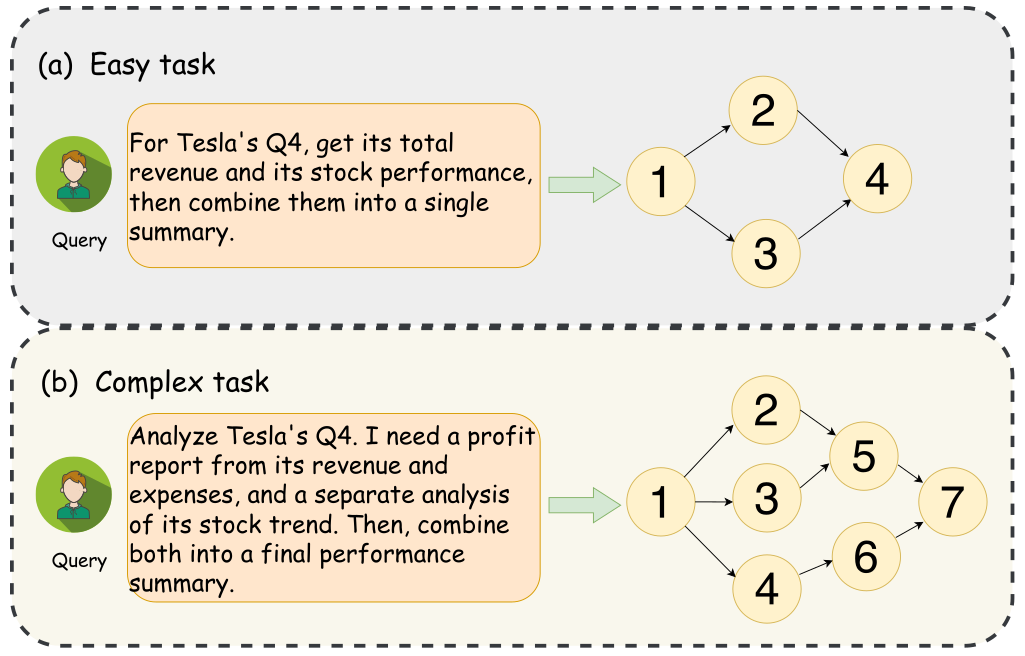
This image presents two distinct scenarios, labeled (a) "Easy task" and (b) "Complex task," each illustrating how a natural language query is transformed into a corresponding computational flow diagram. Both scenarios feature a user query, represented by an icon and text, followed by a directed acyclic graph (DAG) composed of numbered nodes and directional arrows, symbolizing the sequence and dependencies of tasks. The image aims to visually demonstrate how the complexity of a query correlates with the structure and depth of its underlying task graph.
### Components/Axes
The image is divided horizontally into two main sections, each enclosed within a dashed-line rounded rectangle.
**Top Section: (a) Easy task**
* **Header**: Located at the top-left of this section, labeled "(a) Easy task".
* **Query Component**:
* **Icon**: A green circular icon depicting a stylized human bust (brown hair, light blue shirt) is positioned on the left.
* **Label**: Directly below the icon, the text "Query" is displayed.
* **Text Box**: To the right of the icon and label, a light orange rectangular box with rounded corners contains the query text: "For Tesla's Q4, get its total revenue and its stock performance, then combine them into a single summary."
* **Flow Diagram Component**:
* **Initial Arrow**: A light green arrow points horizontally from the right edge of the query text box towards the first node of the diagram.
* **Nodes**: Four yellow circular nodes, each containing a black number, are arranged in a diamond-like structure.
* Node "1" is on the far left.
* Nodes "2" (top-middle) and "3" (bottom-middle) are in the next stage.
* Node "4" is on the far right.
* **Edges (Arrows)**: Black arrows indicate the flow and dependencies between nodes.
* From Node 1 to Node 2.
* From Node 1 to Node 3.
* From Node 2 to Node 4.
* From Node 3 to Node 4.
**Bottom Section: (b) Complex task**
* **Header**: Located at the top-left of this section, labeled "(b) Complex task".
* **Query Component**:
* **Icon**: A green circular icon depicting a stylized human bust (identical to the one in the "Easy task" section) is positioned on the left.
* **Label**: Directly below the icon, the text "Query" is displayed.
* **Text Box**: To the right of the icon and label, a light orange rectangular box with rounded corners contains the query text: "Analyze Tesla's Q4. I need a profit report from its revenue and expenses, and a separate analysis of its stock trend. Then, combine both into a final performance summary."
* **Flow Diagram Component**:
* **Initial Arrow**: A light green arrow points horizontally from the right edge of the query text box towards the first node of the diagram.
* **Nodes**: Seven yellow circular nodes, each containing a black number, are arranged in a multi-stage, branching structure.
* Node "1" is on the far left.
* Nodes "2" (top), "3" (middle), and "4" (bottom) are in the second stage.
* Nodes "5" (top-right) and "6" (bottom-right) are in the third stage.
* Node "7" is on the far right, serving as the final node.
* **Edges (Arrows)**: Black arrows indicate the flow and dependencies between nodes.
* From Node 1 to Node 2.
* From Node 1 to Node 3.
* From Node 1 to Node 4.
* From Node 2 to Node 5.
* From Node 3 to Node 5.
* From Node 3 to Node 6.
* From Node 4 to Node 6.
* From Node 5 to Node 7.
* From Node 6 to Node 7.
### Detailed Analysis
**Scenario (a) Easy task:**
The query asks for two distinct pieces of information ("total revenue" and "stock performance") and then their combination.
The corresponding flow diagram starts with Node 1, which branches into two parallel paths (Node 2 and Node 3). These two paths then converge into a single Node 4. This structure visually represents:
1. An initial processing step (Node 1).
2. Two independent sub-tasks (Node 2 and Node 3) that can potentially be executed in parallel.
3. A final aggregation or combination step (Node 4) that depends on the completion of both Node 2 and Node 3.
The flow is straightforward, with a single entry point and a single exit point, representing a simple fan-out and fan-in pattern.
**Scenario (b) Complex task:**
The query requests a "profit report from its revenue and expenses" AND a "separate analysis of its stock trend," followed by combining "both into a final performance summary." This implies more granular data extraction and intermediate analytical steps.
The corresponding flow diagram is significantly more intricate:
1. An initial processing step (Node 1).
2. Node 1 branches into three parallel paths (Nodes 2, 3, and 4), suggesting more initial data retrieval or decomposition steps.
3. These paths then feed into two intermediate processing nodes (Nodes 5 and 6).
* Node 2 feeds into Node 5.
* Node 3 feeds into both Node 5 and Node 6, indicating it might provide input for multiple subsequent analyses.
* Node 4 feeds into Node 6.
This suggests that Node 5 and Node 6 represent distinct intermediate analyses (e.g., "profit report" and "stock trend analysis" as mentioned in the query).
4. Finally, Nodes 5 and 6 converge into a single Node 7, representing the "final performance summary."
The flow demonstrates multiple levels of branching and merging, reflecting a more complex set of dependencies and intermediate computations required to fulfill the query.
### Key Observations
* **Query-to-Graph Correspondence**: There is a direct visual correlation between the complexity of the natural language query and the complexity of the generated computational graph.
* **Parallelism**: Both diagrams suggest the possibility of parallel execution for independent sub-tasks (e.g., Nodes 2 and 3 in the easy task, or Nodes 2, 3, and 4 in the complex task).
* **Aggregation/Combination**: The convergence of multiple paths into a single node (Node 4 in easy, Node 7 in complex) consistently represents a final aggregation or summary step.
* **Intermediate Steps**: The "Complex task" diagram introduces an additional layer of intermediate processing nodes (5 and 6) before the final aggregation, which aligns with the query's request for "a profit report" and "a separate analysis" before combining "both."
* **Shared Inputs**: In the complex task, Node 3 feeding into both Node 5 and Node 6 indicates that some initial data or processing might be a prerequisite for multiple subsequent analytical branches.
### Interpretation
This diagram illustrates a fundamental concept in automated task execution or query processing systems, particularly those dealing with natural language understanding and computational graph generation. It suggests that such a system can:
1. **Parse Natural Language**: Understand the intent and components of a user's query, even when phrased in natural language.
2. **Decompose Tasks**: Break down a complex query into a series of smaller, manageable sub-tasks.
3. **Identify Dependencies**: Determine the order in which these sub-tasks must be executed and which tasks depend on the output of others.
4. **Construct a Computational Graph**: Represent these decomposed tasks and their dependencies as a directed acyclic graph (DAG), where nodes are tasks and edges are data/control flow.
The "Easy task" demonstrates a simple fan-out/fan-in pattern, suitable for queries requiring parallel data retrieval and a straightforward combination. The "Complex task" showcases a more sophisticated graph, indicating the system's ability to handle multi-stage processing, multiple intermediate analytical steps, and potentially shared data inputs across different analytical branches. The context of "Tesla's Q4" and "revenue," "expenses," "stock performance," and "profit report" strongly implies an application in financial analysis, business intelligence, or data analytics, where natural language queries are translated into data processing pipelines. The visual distinction between "easy" and "complex" tasks highlights the system's adaptability and robustness in handling varying levels of user request intricacy.