\n
## Line Chart: Accuracy vs. Thinking Compute
### Overview
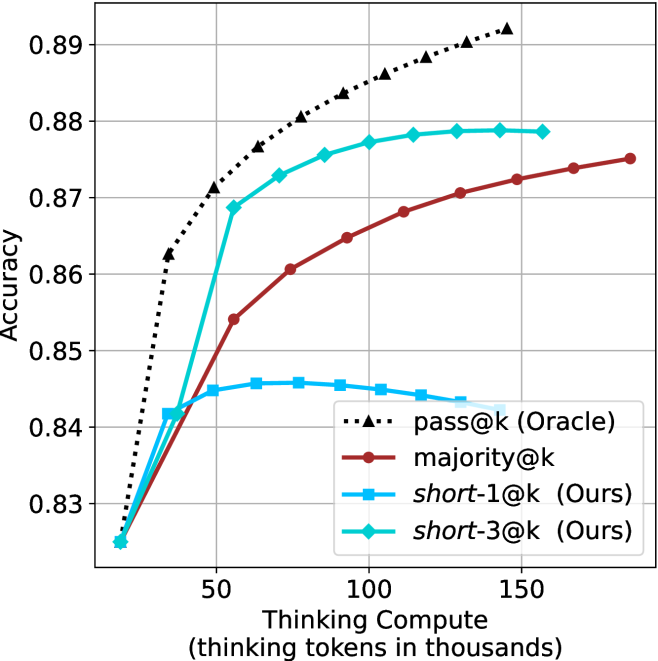
This image presents a line chart illustrating the relationship between "Thinking Compute" (measured in thousands of tokens) and "Accuracy" for four different methods: pass@k (Oracle), majority@k, short-1@k (Ours), and short-3@k (Ours). The chart demonstrates how accuracy changes as the amount of computational effort (thinking tokens) increases.
### Components/Axes
* **X-axis:** "Thinking Compute (thinking tokens in thousands)". Scale ranges from approximately 0 to 150, with markers at 0, 50, 100, and 150.
* **Y-axis:** "Accuracy". Scale ranges from approximately 0.83 to 0.89, with markers at 0.83, 0.84, 0.85, 0.86, 0.87, 0.88, and 0.89.
* **Legend:** Located in the bottom-right corner of the chart. Contains the following labels and corresponding line styles/colors:
* "pass@k (Oracle)" - Black dotted line.
* "majority@k" - Red solid line.
* "short-1@k (Ours)" - Brown solid line.
* "short-3@k (Ours)" - Teal solid line.
### Detailed Analysis
* **pass@k (Oracle):** The black dotted line shows a steep upward trend initially, rapidly increasing from approximately 0.83 to 0.87 at around 50 thinking tokens. The slope then gradually decreases, reaching approximately 0.89 at 150 thinking tokens.
* At 0 thinking tokens: ~0.83
* At 50 thinking tokens: ~0.87
* At 100 thinking tokens: ~0.885
* At 150 thinking tokens: ~0.89
* **majority@k:** The red solid line exhibits a moderate upward trend throughout the entire range. It starts at approximately 0.83 and increases to approximately 0.875 at 150 thinking tokens.
* At 0 thinking tokens: ~0.83
* At 50 thinking tokens: ~0.855
* At 100 thinking tokens: ~0.865
* At 150 thinking tokens: ~0.875
* **short-1@k (Ours):** The brown solid line shows a moderate upward trend, similar to majority@k, but starts slightly lower. It begins at approximately 0.825 and reaches approximately 0.87 at 150 thinking tokens.
* At 0 thinking tokens: ~0.825
* At 50 thinking tokens: ~0.85
* At 100 thinking tokens: ~0.86
* At 150 thinking tokens: ~0.87
* **short-3@k (Ours):** The teal solid line displays a relatively flat trend. It starts at approximately 0.84 and increases to approximately 0.85 at 150 thinking tokens.
* At 0 thinking tokens: ~0.84
* At 50 thinking tokens: ~0.845
* At 100 thinking tokens: ~0.845
* At 150 thinking tokens: ~0.85
### Key Observations
* "pass@k (Oracle)" consistently outperforms the other methods across all levels of "Thinking Compute".
* "short-3@k (Ours)" shows the least improvement in accuracy with increasing "Thinking Compute".
* The initial increase in accuracy is most pronounced for "pass@k (Oracle)", suggesting a significant benefit from even a small amount of computational effort.
* The performance gap between "majority@k" and "short-1@k (Ours)" is relatively small.
### Interpretation
The chart demonstrates the trade-off between computational cost ("Thinking Compute") and accuracy for different methods. "pass@k (Oracle)" represents an ideal scenario, likely involving access to ground truth or a highly optimized process, resulting in the highest accuracy. The "Ours" methods ("short-1@k" and "short-3@k") represent approaches developed by the authors, and their performance falls between "majority@k" and "pass@k (Oracle)". The relatively flat trend of "short-3@k (Ours)" suggests that increasing the number of tokens beyond a certain point does not yield significant improvements in accuracy for that method. This could indicate diminishing returns or a limitation in the method's ability to effectively utilize additional computational resources. The chart highlights the importance of considering computational cost when selecting a method, as "pass@k (Oracle)" may be impractical for large-scale applications due to its computational demands. The data suggests that the "Ours" methods offer a reasonable balance between accuracy and computational efficiency.