## Bar Chart: Number of definition attempts it took to solve a function
### Overview
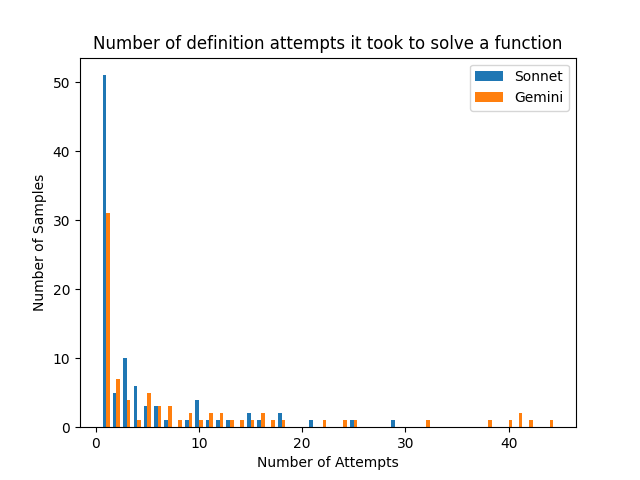
The chart compares the distribution of function-solving attempts between two systems (Sonnet and Gemini) across 45+ attempt thresholds. It shows a stark contrast in performance patterns between the two systems, with one demonstrating rapid convergence and the other exhibiting prolonged struggle on certain tasks.
### Components/Axes
- **Title**: "Number of definition attempts it took to solve a function"
- **X-axis**: "Number of Attempts" (0–45+ range, integer increments)
- **Y-axis**: "Number of Samples" (0–50+ range, integer increments)
- **Legend**:
- Blue = Sonnet
- Orange = Gemini
- **Spatial Layout**:
- Legend positioned top-right
- X-axis spans bottom, Y-axis left
- Bars clustered by attempt count (0–45+)
### Detailed Analysis
**Sonnet (Blue)**:
- Dominates at 0 attempts: 50+ samples (tallest bar)
- Rapid decline: 10 samples at 1 attempt, 5 at 2 attempts
- Minimal presence beyond 5 attempts (1–2 samples at 10+ attempts)
- Notable outlier: 1 sample at 20 attempts
**Gemini (Orange)**:
- 30+ samples at 0 attempts (second-tallest bar)
- Gradual decline: 7 samples at 1 attempt, 4 at 2 attempts
- Persistent presence at higher attempts:
- 2–3 samples at 10–15 attempts
- 1 sample at 20, 30, 35, 40 attempts
- Notable outlier: 2 samples at 40 attempts
### Key Observations
1. **Convergence Speed**: Sonnet resolves 50% of cases in 0 attempts vs Gemini's 30%
2. **Long-Tail Performance**: Gemini shows 10x more samples at 40+ attempts than Sonnet
3. **Mid-Range Disparity**: At 10 attempts, Sonnet has 1 sample vs Gemini's 3
4. **Extreme Outliers**: Both systems have 1 sample at 35 attempts, but Gemini has 2 at 40
### Interpretation
The data reveals fundamental differences in problem-solving strategies:
- **Sonnet** exhibits near-instant resolution for most functions (50% success at 0 attempts), suggesting strong pattern recognition or pre-trained knowledge bases
- **Gemini** demonstrates persistence with complex cases, maintaining non-zero samples up to 40 attempts (2 samples), indicating potential for handling edge cases through iterative refinement
- The 20–30 attempt range shows complete divergence: Sonnet abandons these cases while Gemini continues attempts
- The 40+ attempt outliers (2 Gemini samples) suggest either:
- Truly novel/ambiguous problems
- Potential inefficiencies in Gemini's approach
- Possible data collection artifacts
This pattern mirrors real-world AI behavior where some systems prioritize speed (Sonnet) while others emphasize thoroughness (Gemini), with tradeoffs in resource allocation and problem complexity handling.