## Diagram: Reidemeister Move R1b
### Overview
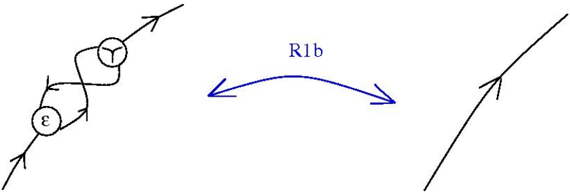
The image depicts a Reidemeister move of type 1b (R1b). It shows a transformation of a line with a curl into a straight line. The transformation is indicated by a curved, double-headed arrow labeled "R1b".
### Components/Axes
* **Lines:** Represent strands or strings in a knot diagram.
* **Arrows:** Indicate the orientation or direction of the strands.
* **Curl:** A loop or twist in the strand. One side of the curl is labeled with "ε" inside a circle, and the other side is labeled with "Y" inside a circle.
* **Transformation Arrow:** A curved, double-headed arrow indicating the transformation from the left side to the right side of the diagram.
* **Label:** "R1b" above the transformation arrow.
### Detailed Analysis
The diagram shows a transformation from a line with a curl to a straight line.
* **Left Side:** A line segment with an arrow indicating its direction. The line has a curl in it. The curl consists of two loops. One loop is labeled with "ε" inside a circle, and the other loop is labeled with "Y" inside a circle. The arrows on the line indicate the direction of the strand.
* **Transformation:** A curved, double-headed arrow points from the left side to the right side, indicating the transformation. The arrow is labeled "R1b".
* **Right Side:** A straight line segment with an arrow indicating its direction.
### Key Observations
* The curl on the left side is removed in the transformation, resulting in a straight line on the right side.
* The direction of the line is maintained throughout the transformation.
* The label "R1b" identifies the type of Reidemeister move.
### Interpretation
The diagram illustrates the Reidemeister move R1b, which is a fundamental operation in knot theory. This move allows for the simplification of knot diagrams by removing a curl in a strand. The transformation maintains the knot's overall structure while reducing its complexity. The labels "ε" and "Y" on the curl likely represent specific properties or orientations of the curl that are relevant in the context of the knot theory being presented.