## Arithmetic Circuit Diagram: Hierarchical Computation Tree
### Overview
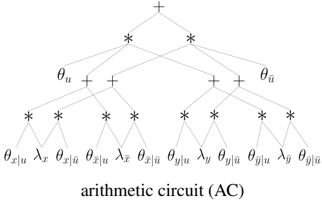
The image displays a hierarchical tree diagram labeled as an "arithmetic circuit (AC)". It represents a computational graph or circuit composed of addition (`+`) and multiplication (`*`) nodes, with leaf nodes containing parameter symbols (θ, λ) and variable symbols (x, y, u). The structure suggests a factorized probabilistic model or a neural network component, likely used for efficient computation of a joint probability distribution or a similar function.
### Components/Axes
* **Diagram Type:** Tree-structured computational graph (Arithmetic Circuit).
* **Title/Label:** "arithmetic circuit (AC)" is centered at the bottom of the image.
* **Node Types:**
* **Internal Nodes:** Represent arithmetic operations.
* Addition (`+`)
* Multiplication (`*`)
* **Leaf Nodes:** Represent input variables, parameters, or conditional probability terms. The symbols are:
* `θ_u`
* `λ_x`
* `θ_x|u`
* `λ_y`
* `θ_y|u`
* `θ_ŷ|u` (Note: `ŷ` is y-hat, a common notation for a predicted or auxiliary variable).
* **Connections:** Directed edges (lines) connect parent nodes to child nodes, indicating the flow of computation from the leaves upward to the root.
### Detailed Analysis
**Spatial Layout and Flow:**
The circuit is organized in a top-down tree structure. Computation flows from the leaf nodes at the bottom, through intermediate operation nodes, to the single root node at the top.
1. **Root (Top Center):** A single addition (`+`) node.
2. **First Level Below Root:** Two multiplication (`*`) nodes, connected to the root.
3. **Second Level:** Four addition (`+`) nodes. Each multiplication node from the level above connects to two of these addition nodes.
4. **Leaf Level (Bottom):** Twelve leaf nodes, grouped in pairs under each of the four addition nodes from the second level. Each pair consists of a multiplication (`*`) node connecting two leaf symbols.
**Precise Transcription of Leaf Node Groups (from left to right):**
* **Group 1 (Far Left):** `θ_u` and `λ_x` feed into a `*` node. `θ_x|u` and `λ_x` feed into another `*` node. These two `*` nodes feed into the leftmost `+` node.
* **Group 2:** `θ_x|u` and `λ_x` feed into a `*` node. `θ_x|u` and `λ_x` feed into another `*` node. These two `*` nodes feed into the second `+` node from the left.
* **Group 3:** `θ_y|u` and `λ_y` feed into a `*` node. `θ_y|u` and `λ_y` feed into another `*` node. These two `*` nodes feed into the third `+` node from the left.
* **Group 4 (Far Right):** `θ_ŷ|u` and `λ_y` feed into a `*` node. `θ_ŷ|u` and `λ_y` feed into another `*` node. These two `*` nodes feed into the rightmost `+` node.
**Language:** The mathematical notation is language-agnostic. The title "arithmetic circuit (AC)" is in English.
### Key Observations
1. **Symmetry and Repetition:** The circuit exhibits a high degree of symmetry. The left half (processing `x` and `u`) mirrors the structure of the right half (processing `y`, `ŷ`, and `u`).
2. **Parameter Sharing:** The same parameter symbols (e.g., `θ_x|u`, `λ_x`) are used as inputs to multiple multiplication nodes within their respective groups, indicating parameter sharing or reuse in the computation.
3. **Conditional Structure:** The notation `θ_x|u` and `θ_y|u` strongly suggests these are parameters for conditional distributions (e.g., P(x|u), P(y|u)), which is common in probabilistic graphical models like Bayesian networks or in mixture models.
4. **Hierarchical Combination:** The structure shows how simple terms (leaf nodes) are combined via multiplication (likely representing joint probabilities or feature combinations) and then summed (representing marginalization or mixture components) in a hierarchical fashion to compute a final value at the root.
### Interpretation
This arithmetic circuit is a visual representation of a **factorized computation**, most likely for evaluating a **probabilistic model**. The root `+` node suggests the final output is a sum of terms, which could represent:
* The total probability of evidence in a mixture model.
* The value of a partition function or a likelihood function.
* The output of a sum-product network (SPN), a type of deep probabilistic model.
The flow from leaves to root demonstrates how a complex global function (at the root) is broken down into a product of simpler local functions (the `*` nodes), which are themselves sums of even more basic components (the lower `+` nodes). This decomposition is key to efficient inference and learning in structured models. The presence of both `y` and `ŷ` (y-hat) might indicate the circuit models both observed data (`y`) and latent or predicted variables (`ŷ`) conditioned on some input or context (`u`). The diagram's purpose is to make the implicit factorization of a mathematical expression explicit and computationally tractable.