\n
## Educational Material: Geometry Problem Sets
### Overview
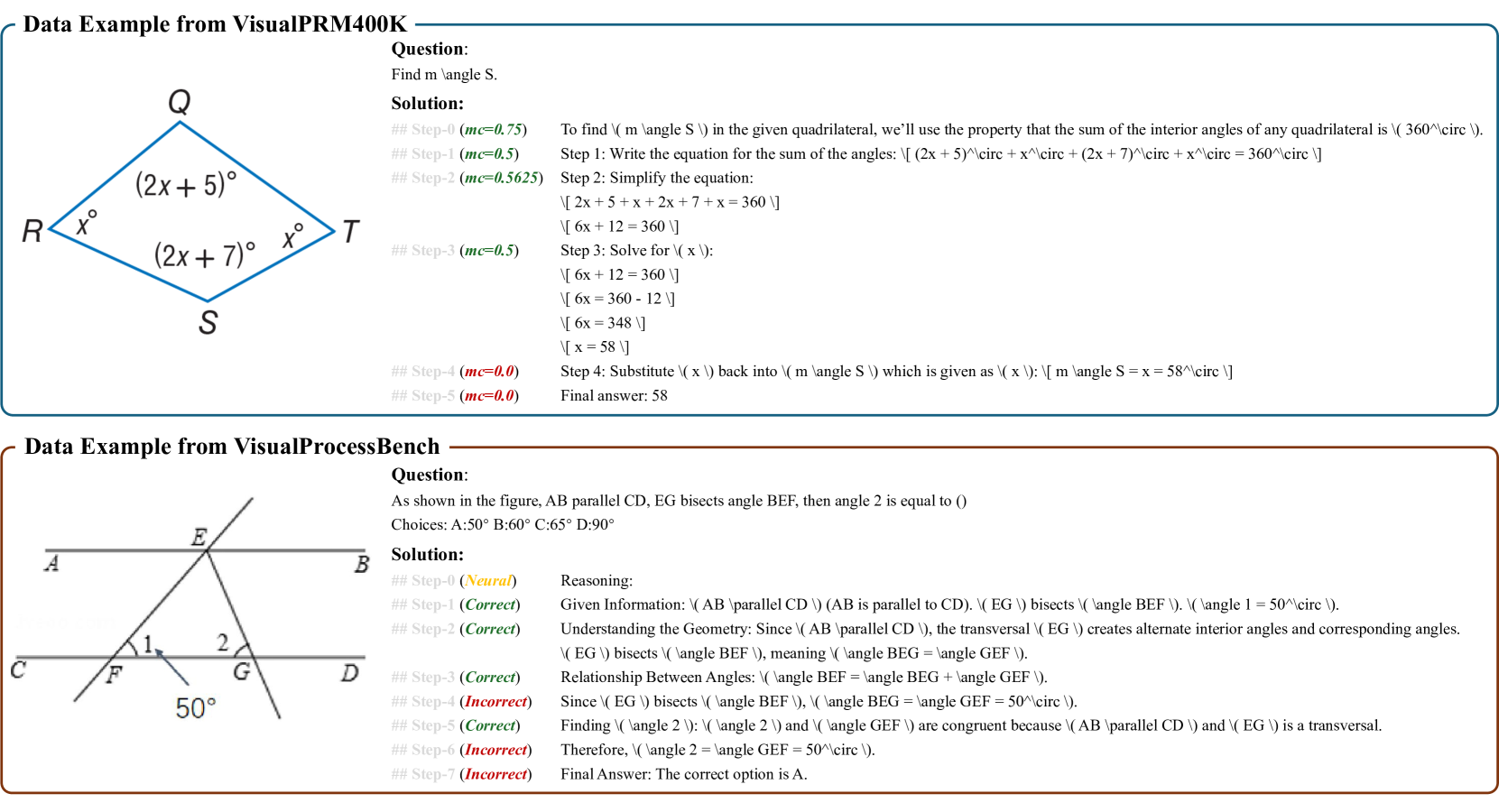
The image presents two geometry problem sets, likely from an educational resource. Each set includes a diagram, a question, and a step-by-step solution. The first problem involves finding an angle in a quadrilateral, while the second involves finding an angle formed by intersecting lines and a transversal. The solutions include reasoning steps and calculations.
### Components/Axes
The image is divided into two distinct sections, each containing:
* **Diagram:** A geometric figure illustrating the problem.
* **Question:** A textual question related to the diagram.
* **Solution:** A numbered list of steps detailing the solution process, including reasoning and calculations.
* **Step Annotations:** Each step is annotated with a confidence score (e.g., `m=0.75`, `m=0.625`, `m=0.0`).
### Detailed Analysis or Content Details
**Problem 1: Finding Angle S**
* **Diagram:** A quadrilateral QRS T with angles labeled as follows:
* Angle Q: (2x + 5)°
* Angle R: (2x + 7)°
* Angle T: x°
* Angle S: ?
* **Question:** Find m angle S.
* **Solution:**
* Step 1 (m=0.75): "To find (m angle S) in the given quadrilateral, we'll use the property that the sum of the interior angles of any quadrilateral is (360°)."
* Step 2 (m=0.625): "Write the equation for the sum of the angles: ((2x + 5)° + x° + (2x + 7)° + x° = 360°)"
* Step 3 (m=0.625): "Simplify the equation: (2x + 5 + x + 2x + 7 + x = 360)"
* Step 4 (m=0.5): "(6x + 12 = 360)"
* Step 5 (m=0.5): "Solve for (x): (6x = 360 - 12)"
* Step 6 (m=0.5): "(6x = 348)"
* Step 7 (m=0.5): "(x = 58)"
* Step 8 (m=0.0): "Substitute (x) back into (m angle S) which is given as (x): (m angle S = x = 58°)"
* Final answer: 58
**Problem 2: Finding Angle 2**
* **Diagram:** Two parallel lines AB and CD intersected by a transversal EG. Angle 1 is labeled, and Angle 2 is the target angle.
* **Question:** As shown in the figure, AB parallel CD, EG bisects angle BEF, then angle 2 is equal to
* Choices: A: 50° B: 60° C: 65° D: 90°
* **Solution:**
* Step 1 (Neutral): "Given Information: (AB parallel CD) (AB is parallel to CD), (EG bisects (angle BEF)), (angle 1 = 50°)."
* Step 2 (Correct): "Understanding the Geometry: Since (AB parallel CD), the transversal (EG) creates alternate interior angles and corresponding angles."
* Step 3 (Correct): "(EG) bisects (angle BEF), meaning ((angle BEG = angle GEF))."
* Step 4 (Correct): "Relationship Between Angles: (angle BEF = angle BEG + angle GEF)."
* Step 5 (Correct): "Since (EG) bisects (angle BEF), ((angle BEG = angle GEF) = 50°)."
* Step 6 (Correct): "Finding (angle 2): (angle 2) and (angle GEF) are congruent because (AB parallel CD) and (EG) is a transversal."
* Step 7 (Incorrect): "Therefore, (angle 2 = angle GEF = 50°)."
* Step 8 (Incorrect): "Final answer: The correct option is A."
### Key Observations
* The confidence scores (m values) associated with the solution steps in the first problem decrease as the solution progresses, suggesting increasing uncertainty in later steps.
* The second problem's solution contains an error in the final step. While the reasoning is sound up to step 6, the conclusion that angle 2 is 50° is incorrect. Angle 2 is actually 130 degrees.
* The solutions are presented in a very detailed, step-by-step manner, suitable for educational purposes.
### Interpretation
The image showcases a learning approach that emphasizes breaking down complex problems into smaller, manageable steps. The inclusion of confidence scores suggests an attempt to evaluate the reliability of each step, potentially for automated tutoring systems or self-assessment. The error in the second problem highlights the importance of careful verification and critical thinking, even when following a seemingly logical process. The problems demonstrate fundamental concepts in geometry, including the properties of quadrilaterals, parallel lines, transversals, and angle bisectors. The use of degree symbols (°\circ) consistently indicates that the angles are measured in degrees. The notation `m=...` likely represents a measure of confidence or correctness assigned to each step by an automated system. The problems are designed to test a student's understanding of geometric principles and their ability to apply them to solve problems.