TECHNICAL ASSET FINGERPRINT
10dd29673ae09cbcc06a80e1
Click to view fullscreen
Press ESC or click to close
FOUND IN PAPERS
EXPERT: healer-alpha-free VERSION 1
RUNTIME: free/openrouter/healer-alpha
INTEL_VERIFIED
\n
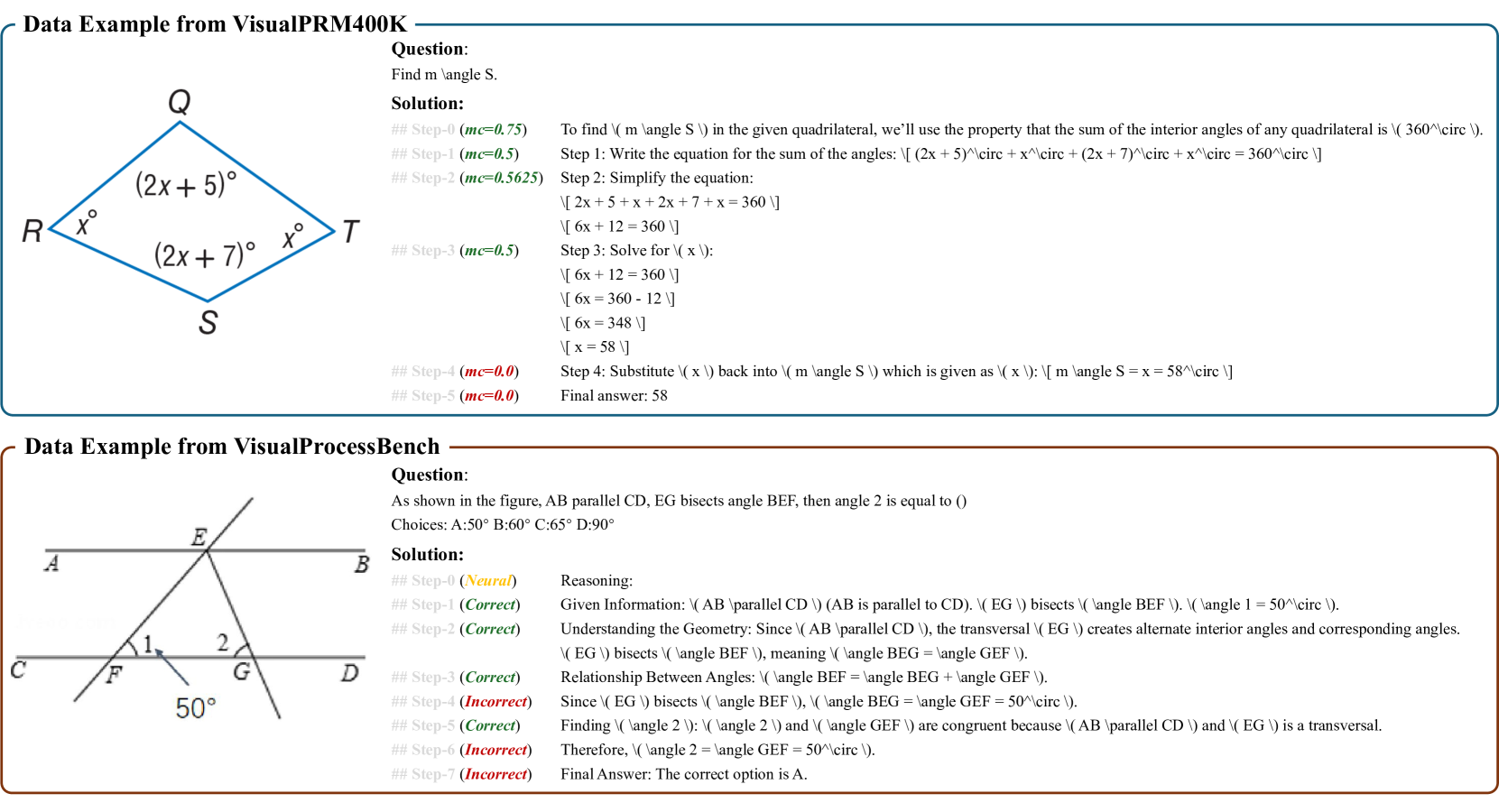
## Diagram: Geometry Problem Examples from AI Evaluation Datasets
### Overview
The image displays two distinct panels, each presenting a geometry problem with its diagram and a step-by-step solution. The panels are examples from two different datasets used for evaluating AI models on visual reasoning tasks. The top panel (blue border) is from "VisualPRM400K," and the bottom panel (brown border) is from "VisualProcessBench." Each includes a question, a geometric diagram, and a solution broken down into annotated steps.
### Components/Axes
The image is divided into two primary horizontal sections:
1. **Top Panel (Blue Border):**
* **Title:** "Data Example from VisualPRM400K"
* **Diagram:** A quadrilateral with vertices labeled Q, R, S, T. Interior angles are labeled: ∠R = x°, ∠Q = (2x + 5)°, ∠T = x°, ∠S = (2x + 7)°.
* **Question Text:** "Question: Find m \angle S."
* **Solution Text:** A multi-step solution with annotations in parentheses (e.g., `mc=0.75`).
2. **Bottom Panel (Brown Border):**
* **Title:** "Data Example from VisualProcessBench"
* **Diagram:** Two parallel horizontal lines (AB and CD) intersected by a transversal line (through E and F). A second line (EG) originates from point E on line AB. Angle 1 is marked as 50° at the intersection of the transversal and line CD. Angle 2 is marked between line EG and line CD.
* **Question Text:** "Question: As shown in the figure, AB parallel CD, EG bisects angle BEF, then angle 2 is equal to () Choices: A:50° B:60° C:65° D:90°"
* **Solution Text:** A multi-step reasoning process with annotations indicating correctness (e.g., `(Neural)`, `(Correct)`, `(Incorrect)`).
### Detailed Analysis
**Top Panel - VisualPRM400K Example:**
* **Problem:** Find the measure of angle S in a quadrilateral where angles are given as algebraic expressions in terms of `x`.
* **Solution Steps (Transcribed with Annotations):**
* `## Step-0 (mc=0.75)` To find \( m \angle S \) in the given quadrilateral, we'll use the property that the sum of the interior angles of any quadrilateral is \( 360^\circ \).
* `## Step-1 (mc=0.5)` Step 1: Write the equation for the sum of the angles: \( [ (2x + 5)^\circ + x^\circ + (2x + 7)^\circ + x^\circ = 360^\circ ] \)
* `## Step-2 (mc=0.5625)` Step 2: Simplify the equation: \( [ 2x + 5 + x + 2x + 7 + x = 360 ] \) \( [ 6x + 12 = 360 ] \)
* `## Step-3 (mc=0.5)` Step 3: Solve for \( x \): \( [ 6x + 12 = 360 ] \) \( [ 6x = 360 - 12 ] \) \( [ 6x = 348 ] \) \( [ x = 58 ] \)
* `## Step-4 (mc=0.0)` Step 4: Substitute \( x \) back into \( m \angle S \) which is given as \( x \): \( [ m \angle S = x = 58^\circ ] \)
* `## Step-5 (mc=0.0)` Final answer: 58
* **Key Data Points:** The solution correctly calculates `x = 58`, leading to the final answer `m∠S = 58°`.
**Bottom Panel - VisualProcessBench Example:**
* **Problem:** Given parallel lines AB and CD, with EG bisecting ∠BEF and ∠1 = 50°, find the measure of ∠2 from the given choices.
* **Solution Steps (Transcribed with Annotations):**
* `## Step-0 (Neural)` Reasoning:
* `## Step-1 (Correct)` Given Information: \( AB \parallel CD \) (AB is parallel to CD). \( EG \) bisects \( \angle BEF \). \( \angle 1 = 50^\circ \).
* `## Step-2 (Correct)` Understanding the Geometry: Since \( AB \parallel CD \), the transversal \( EG \) creates alternate interior angles and corresponding angles. \( EG \) bisects \( \angle BEF \), meaning \( \angle BEG = \angle GEF \).
* `## Step-3 (Correct)` Relationship Between Angles: \( \angle BEF = \angle BEG + \angle GEF \).
* `## Step-4 (Incorrect)` Since \( EG \) bisects \( \angle BEF \), \( \angle BEG = \angle GEF = 50^\circ \).
* `## Step-5 (Correct)` Finding \( \angle 2 \): \( \angle 2 \) and \( \angle GEF \) are congruent because \( AB \parallel CD \) and \( EG \) is a transversal.
* `## Step-6 (Incorrect)` Therefore, \( \angle 2 = \angle GEF = 50^\circ \).
* `## Step-7 (Incorrect)` Final Answer: The correct option is A.
* **Key Data Points:** The final answer is identified as option A (50°). The annotations indicate that steps 4, 6, and 7 are marked as "Incorrect," despite the final answer being correct.
### Key Observations
1. **Dataset Comparison:** The image contrasts two evaluation frameworks. VisualPRM400K uses numerical confidence scores (`mc`) for each step, while VisualProcessBench uses categorical correctness labels (`Correct`/`Incorrect`).
2. **Error Analysis:** The bottom example is particularly notable. The model's reasoning contains logical errors (Step 4 incorrectly assumes the bisected angles equal the given 50° angle, and Step 6 incorrectly concludes based on that), yet it arrives at the numerically correct final answer (50°). This highlights a potential disconnect between intermediate reasoning quality and final answer accuracy.
3. **Diagram Clarity:** Both diagrams are clear and standard for geometry problems. The top diagram uses algebraic expressions for angles, while the bottom uses numerical values and parallel line markings.
### Interpretation
These examples serve as diagnostic tools for assessing AI models' geometric reasoning capabilities. They reveal that:
* **Process vs. Outcome:** Evaluating only the final answer (as in many multiple-choice tests) can be misleading. The VisualProcessBench example shows a model can be "right for the wrong reasons," indicating a fragile understanding. The step-by-step annotation is crucial for identifying where reasoning breaks down.
* **Model Confidence:** The `mc` scores in the top example suggest a model's internal confidence can vary significantly across steps, even in a correct solution. Step-0 has high confidence (0.75), while the final substitution steps have zero confidence (0.0), which may indicate uncertainty in the final mapping back to the question.
* **Task Complexity:** The problems test different skills. The first requires algebraic manipulation within a geometric property. The second requires synthesizing multiple theorems (parallel lines, angle bisectors, transversal angles) and careful stepwise deduction. The errors in the second example stem from misapplying the given information (confusing which angle is 50°) rather than a lack of knowledge about the theorems themselves.
In essence, the image underscores the importance of **process-oriented evaluation** in AI, moving beyond simple answer matching to scrutinize the chain of reasoning, which is essential for building robust and trustworthy models.
DECODING INTELLIGENCE...