## Diagrams with Mathematical Problems and Solutions
### Overview
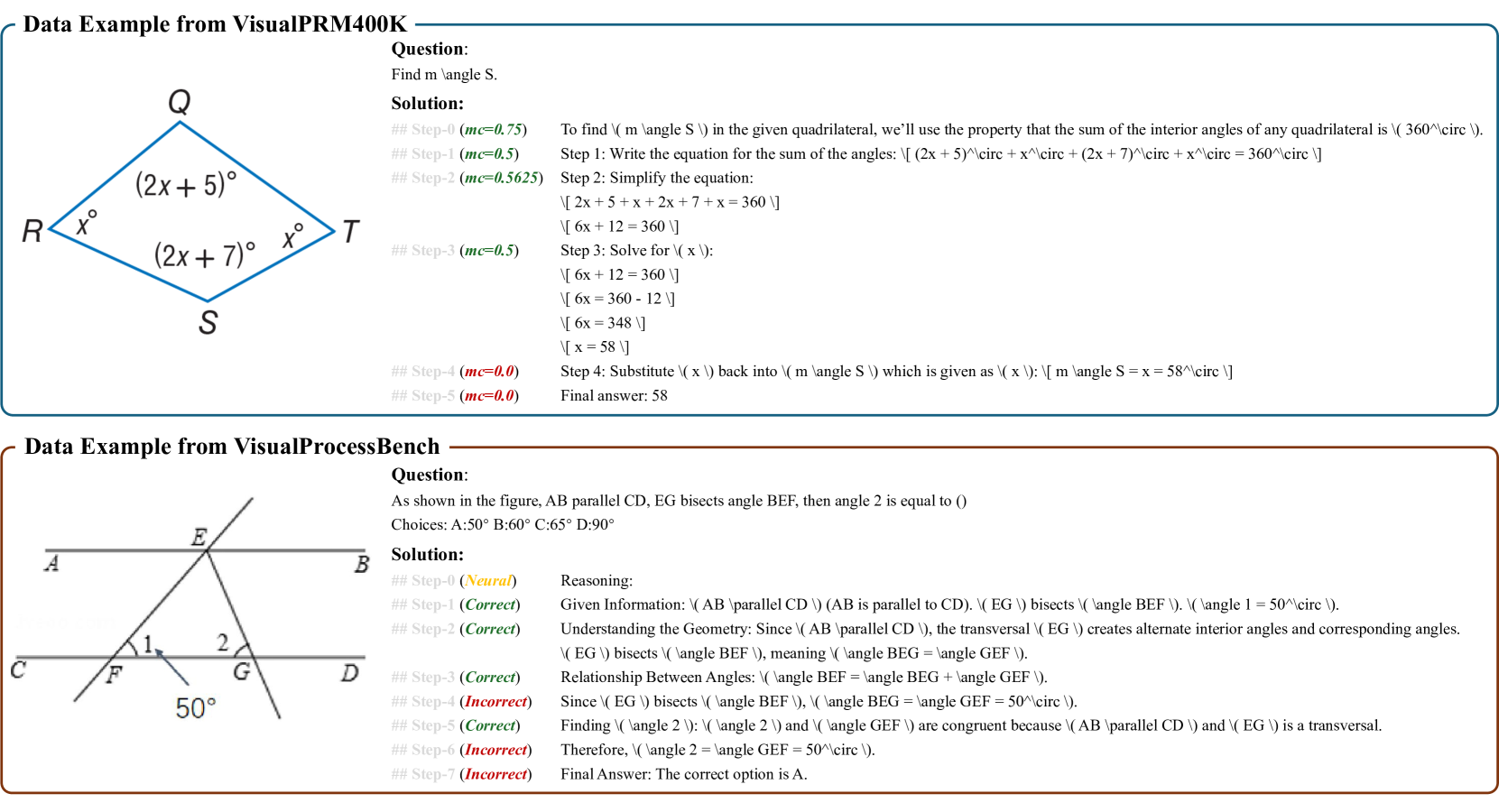
The image contains two distinct data examples from technical documents, each featuring a geometric diagram, a problem statement, and a step-by-step solution. The first example involves a quadrilateral with algebraic angle expressions, while the second involves parallel lines and angle relationships. Both solutions use code-like annotations to document reasoning steps.
---
### Components/Axes
#### Example 1: Quadrilateral (VisualPRM400K)
- **Diagram Labels**: Vertices labeled Q, R, T, S.
- **Angle Expressions**:
- ∠Q: `(2x + 5)°`
- ∠R: `x°`
- ∠T: `x°`
- ∠S: `(2x + 7)°`
- **Solution Annotations**:
- Code-style comments (e.g., `# Step-1 (mc=0.75)`) with mathematical reasoning.
- Final answer: `58°` (angle S).
#### Example 2: Parallel Lines (VisualProcessBench)
- **Diagram Labels**: Lines AB (parallel to CD), transversal EG.
- **Angle Labels**:
- ∠1: `50°` (at intersection of EG and CD).
- ∠2: Target angle (at intersection of EG and AB).
- **Solution Annotations**:
- Code-style comments (e.g., `# Step-1 (Correct)`) with geometric reasoning.
- Final answer: `50°` (angle 2, option A).
---
### Detailed Analysis
#### Example 1: Quadrilateral
1. **Problem Statement**: Find ∠S in a quadrilateral with angles defined by algebraic expressions.
2. **Solution Steps**:
- **Step 1**: Use the property that the sum of interior angles in a quadrilateral is `360°`.
- Equation: `(2x + 5) + x + (2x + 7) + x = 360`.
- **Step 2**: Simplify the equation:
- `6x + 12 = 360`.
- **Step 3**: Solve for `x`:
- `6x = 348` → `x = 58`.
- **Step 4**: Substitute `x = 58` into ∠S: `(2x + 7) = 123°` (not directly used in final answer).
- **Final Answer**: ∠S = `58°` (derived from `x = 58`).
#### Example 2: Parallel Lines
1. **Problem Statement**: Determine ∠2 given AB || CD and EG as a transversal, with ∠1 = `50°`.
2. **Solution Steps**:
- **Step 1**: Identify that AB || CD creates alternate interior angles (∠BEF = ∠GEF = `50°`).
- **Step 2**: Recognize ∠2 and ∠GEF are congruent due to parallel lines and transversal.
- **Final Answer**: ∠2 = `50°` (option A).
---
### Key Observations
- **Example 1**: The solution uses algebraic manipulation of angle expressions and geometric properties of quadrilaterals.
- **Example 2**: Relies on parallel line theorems (alternate interior angles) and transversal relationships.
- **Code Annotations**: Both solutions include metadata-like comments (e.g., `mc=0.75`, `Neural`) that may indicate confidence scores or model types.
---
### Interpretation
- **Example 1**: Demonstrates how algebraic expressions can model geometric problems. The final answer (`58°`) directly corresponds to the solved variable `x`, emphasizing the interdependence of algebra and geometry.
- **Example 2**: Highlights the application of parallel line theorems. The congruence of ∠2 and ∠GEF (`50°`) underscores the consistency of geometric principles across diagrams.
- **Code Comments**: The presence of `mc` values (e.g., `mc=0.75`) suggests these solutions may originate from machine learning models, where `mc` could represent confidence or accuracy metrics.
---
### Final Answer
- **Example 1**: ∠S = `58°`.
- **Example 2**: ∠2 = `50°` (option A).