## Diagram: Simple Neural Network Computational Graph
### Overview
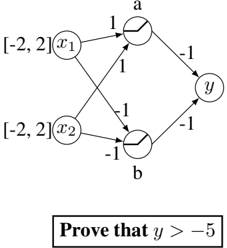
The image displays a directed graph representing a simple two-layer neural network or computational model. It consists of input nodes, intermediate (hidden) nodes, and a single output node, with weighted connections between them. A mathematical proof statement is presented below the diagram.
### Components/Axes
**Nodes (Circles):**
- **Input Layer (Left):**
- Node labeled `x₁` (top-left)
- Node labeled `x₂` (bottom-left)
- **Hidden Layer (Center):**
- Node labeled `a` (top-center)
- Node labeled `b` (bottom-center)
- **Output Layer (Right):**
- Node labeled `y` (center-right)
**Connections (Arrows) and Weights:**
- Arrow from `x₁` to `a` with weight `1`
- Arrow from `x₂` to `a` with weight `1`
- Arrow from `x₁` to `b` with weight `-1`
- Arrow from `x₂` to `b` with weight `-1`
- Arrow from `a` to `y` with weight `-1`
- Arrow from `b` to `y` with weight `-1`
**Annotations:**
- To the left of `x₁`: Text `[-2, 2]`
- To the left of `x₂`: Text `[-2, 2]`
- Below the entire diagram: A rectangular box containing the text `Prove that y > -5`
### Detailed Analysis
**Network Computation Flow:**
1. **Node `a` Calculation:** `a = (1 * x₁) + (1 * x₂) = x₁ + x₂`
2. **Node `b` Calculation:** `b = (-1 * x₁) + (-1 * x₂) = -x₁ - x₂`
3. **Output `y` Calculation:** `y = (-1 * a) + (-1 * b) = -a - b`
**Substituting the expressions for `a` and `b`:**
`y = -(x₁ + x₂) - (-x₁ - x₂) = -x₁ - x₂ + x₁ + x₂ = 0`
**Input Constraints:**
- The annotation `[-2, 2]` next to both `x₁` and `x₂` indicates that each input variable is constrained to the closed interval from -2 to 2. That is, `-2 ≤ x₁ ≤ 2` and `-2 ≤ x₂ ≤ 2`.
### Key Observations
1. **Simplification to Zero:** The specific weights in this network cause the output `y` to algebraically simplify to exactly `0` for any values of `x₁` and `x₂`. The terms cancel out completely.
2. **Contradictory Proof Statement:** The text box states "Prove that y > -5". Given the network's computation, `y` is always `0`. Since `0` is indeed greater than `-5`, the statement is true. However, the proof is trivial because `y` is constant, not dependent on the inputs within their given ranges.
3. **Symmetry:** The network is perfectly symmetric. The path through node `a` (summing inputs) is the exact inverse of the path through node `b` (negating the sum of inputs). Their combination at the output node results in cancellation.
### Interpretation
This diagram likely serves as an educational example or a puzzle in a technical context (e.g., a textbook on neural networks, linear algebra, or logic). Its primary purpose is to demonstrate how a network's architecture and weight assignments determine its function.
The core insight is that despite having variable inputs (`x₁`, `x₂`) within a defined range `[-2, 2]`, the specific weight configuration (`1, 1, -1, -1, -1, -1`) creates a system where the output is invariant—it is always `0`. This makes the proof statement `y > -5` universally true for this model, but trivially so.
The "investigative" reading reveals a potential pedagogical trick: a student might attempt to find the minimum value of `y` by testing the boundaries of the input space (e.g., `x₁ = -2, x₂ = -2`), but the algebraic simplification shows no such effort is needed. The diagram teaches the importance of analyzing the underlying equations of a model before performing numerical exploration.