\n
## Photograph: Robotic Humanoid
### Overview
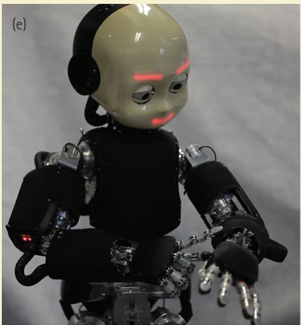
The image depicts a humanoid robot, appearing to be a child-sized model. The robot is predominantly black with a pale, smooth head. It is positioned in a neutral stance, with its hands clasped in front of it. The background is a neutral gray. The image is labeled "(e)" in the top-left corner.
### Components/Axes
There are no axes or legends present in this image. The image is a photograph, not a chart or diagram.
### Detailed Analysis or Content Details
The robot's head is rounded and smooth, with two horizontal red lines representing the eyes. A red line also indicates the mouth. The head is attached to a black neck and torso. The arms are articulated with visible joints and covered in black material. The hands are metallic and have multiple fingers. The robot's body appears to be constructed from a combination of metal and plastic components. There are visible wires and mechanical parts, particularly around the joints and hands. The robot's overall appearance is somewhat unsettling due to its realistic yet artificial features.
### Key Observations
The robot's design suggests a focus on mimicking human form, but with a clear indication of its mechanical nature. The red lines for facial features are a simplified representation of eyes and a mouth. The robot's hands are particularly detailed, with individual fingers and joints. The overall condition of the robot appears to be well-maintained.
### Interpretation
This image likely represents a research or development project in the field of robotics, specifically humanoid robots. The robot's design suggests an attempt to create a machine that can interact with humans in a more natural way. The simplified facial features may be intentional, to avoid the "uncanny valley" effect, where robots that look too human can evoke feelings of unease. The visible mechanical components highlight the robot's artificial nature, reminding the viewer that it is a machine, not a living being. The label "(e)" suggests this is part of a series of images or a larger study. The image does not provide any quantitative data, but it offers a visual representation of the current state of humanoid robot technology. It demonstrates the progress made in creating robots that resemble humans in form, but also acknowledges the challenges of achieving a truly realistic and comfortable human-robot interaction.