## Diagram: Neuro-Symbolic Architectures
### Overview
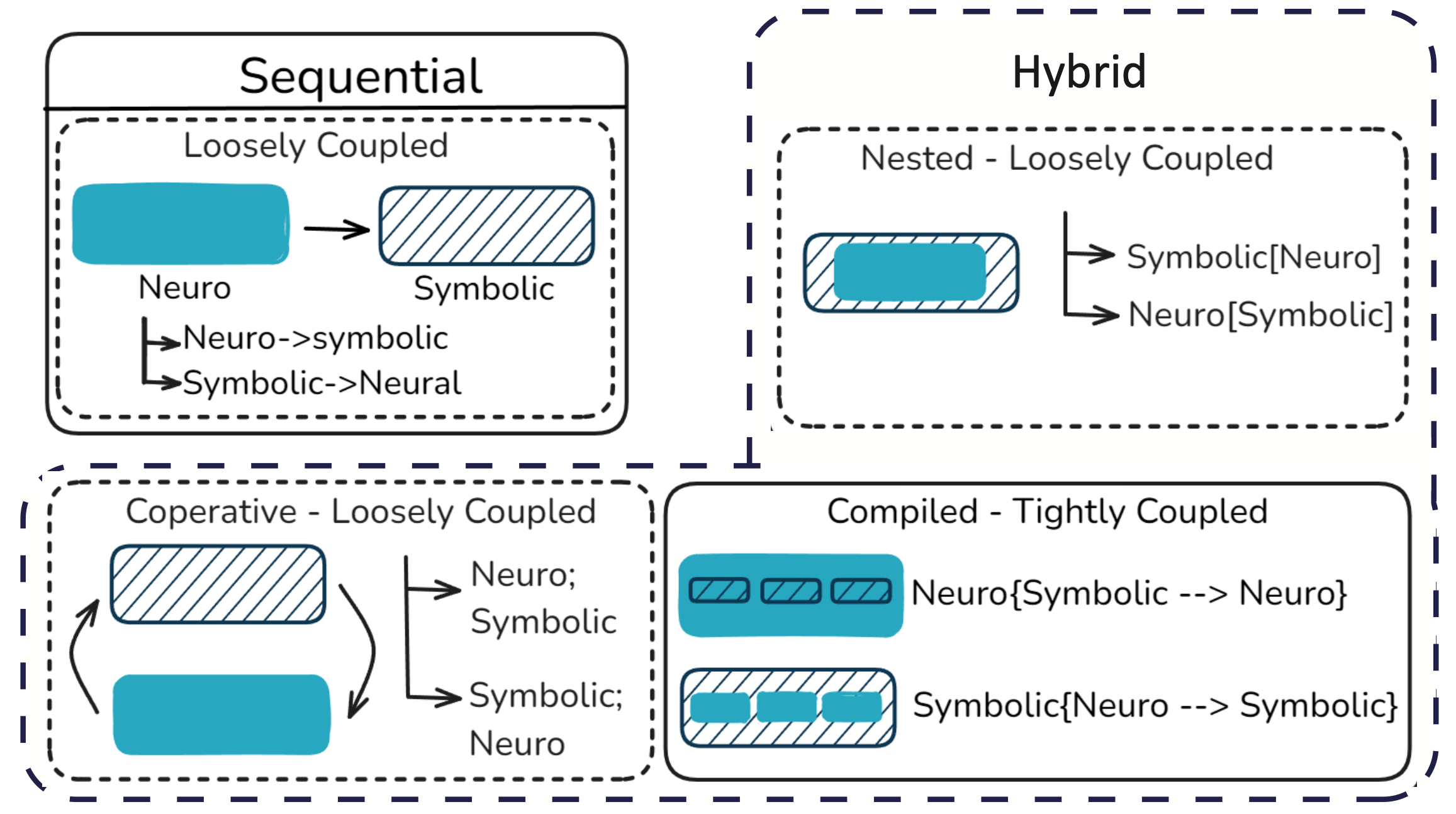
The image presents a comparative diagram illustrating four different architectures for integrating neural and symbolic reasoning: Sequential, Hybrid, Cooperative, and Compiled. Each architecture is visually represented within a dashed-border box, showcasing the flow and coupling between "Neuro" (neural network) and "Symbolic" components. The diagram emphasizes the degree of coupling (loosely vs. tightly) and the direction of information flow.
### Components/Axes
The diagram does not have traditional axes. Instead, it uses visual arrangement to compare architectures. The key components are:
* **Architectural Types:** Sequential, Hybrid, Cooperative, Compiled.
* **Components:** "Neuro" (represented by light blue rectangles) and "Symbolic" (represented by diagonally striped rectangles).
* **Coupling:** Loosely Coupled, Tightly Coupled.
* **Flow Direction:** Indicated by arrows.
* **Nested Structure:** Present in the Hybrid architecture.
* **Component Notation:** "Neuro[Symbolic]", "Symbolic[Neuro]" used in Hybrid and Compiled architectures.
### Detailed Analysis or Content Details
**1. Sequential (Top-Left):**
* Label: "Sequential", "Loosely Coupled"
* Flow: A unidirectional flow from "Neuro" to "Symbolic" (arrow pointing right).
* Additional Flows: A smaller arrow indicates a flow from "Neuro->Symbolic" and another from "Symbolic->Neural".
* Components: One "Neuro" block and one "Symbolic" block.
**2. Hybrid (Top-Right):**
* Label: "Hybrid", "Nested - Loosely Coupled"
* Flow: Two bidirectional flows: "Symbolic[Neuro]" and "Neuro[Symbolic]".
* Components: One "Symbolic" block containing a smaller "Neuro" block, and one "Neuro" block containing a smaller "Symbolic" block.
* Notation: The notation "Symbolic[Neuro]" and "Neuro[Symbolic]" indicates nesting.
**3. Cooperative (Bottom-Left):**
* Label: "Cooperative - Loosely Coupled"
* Flow: Bidirectional flow between "Symbolic" and "Neuro" (arrows pointing in both directions).
* Components: One "Symbolic" block and one "Neuro" block.
* Component Notation: "Neuro; Symbolic" and "Symbolic; Neuro" are displayed within the blocks.
**4. Compiled (Bottom-Right):**
* Label: "Compiled - Tightly Coupled"
* Flow: Two unidirectional flows: "Neuro[Symbolic] -> Neuro" and "Symbolic[Neuro] -> Symbolic".
* Components: Multiple blocks representing a combined "Neuro/Symbolic" component, and one "Symbolic" block containing a smaller "Neuro" block.
* Component Notation: "Neuro[Symbolic]" and "Symbolic[Neuro]" are used.
* Visual Representation: The "Neuro/Symbolic" component is represented by a series of alternating light blue and diagonally striped blocks.
### Key Observations
* The diagram highlights a progression from simpler, unidirectional flows (Sequential) to more complex, bidirectional, and tightly coupled architectures (Compiled).
* The "Hybrid" architecture introduces the concept of nesting, where one component is embedded within another.
* The "Compiled" architecture is visually distinct due to its tightly coupled nature and the combined representation of neural and symbolic components.
* The "Loosely Coupled" architectures (Sequential, Hybrid, Cooperative) all have a more distinct separation between the "Neuro" and "Symbolic" components.
### Interpretation
The diagram illustrates different approaches to integrating neural and symbolic reasoning, each with its own strengths and weaknesses. The choice of architecture depends on the specific application and the desired level of interaction between the two reasoning paradigms.
* **Sequential:** Represents a pipeline approach, where neural processing feeds into symbolic reasoning, or vice versa. This is simple but may limit the potential for synergistic interaction.
* **Hybrid:** Allows for more complex interactions through nesting, enabling one component to influence the other at a deeper level.
* **Cooperative:** Enables bidirectional communication, allowing both neural and symbolic components to contribute to the overall reasoning process.
* **Compiled:** Represents the most tightly integrated approach, where neural and symbolic components are interwoven, potentially leading to more efficient and powerful reasoning.
The diagram suggests a trend towards more tightly coupled architectures as the field of neuro-symbolic AI matures. The use of notation like "Neuro[Symbolic]" and "Symbolic[Neuro]" indicates a growing interest in representing the interplay between these two paradigms in a more formal and expressive way. The visual distinction between loosely and tightly coupled architectures emphasizes the importance of considering the degree of integration when designing neuro-symbolic systems.