TECHNICAL ASSET FINGERPRINT
11478f3795d2b228880c9e58
Click to view fullscreen
Press ESC or click to close
FOUND IN PAPERS
EXPERT: healer-alpha-free VERSION 1
RUNTIME: free/openrouter/healer-alpha
INTEL_VERIFIED
\n
## Diagram: Neuro-Symbolic Integration Architectures
### Overview
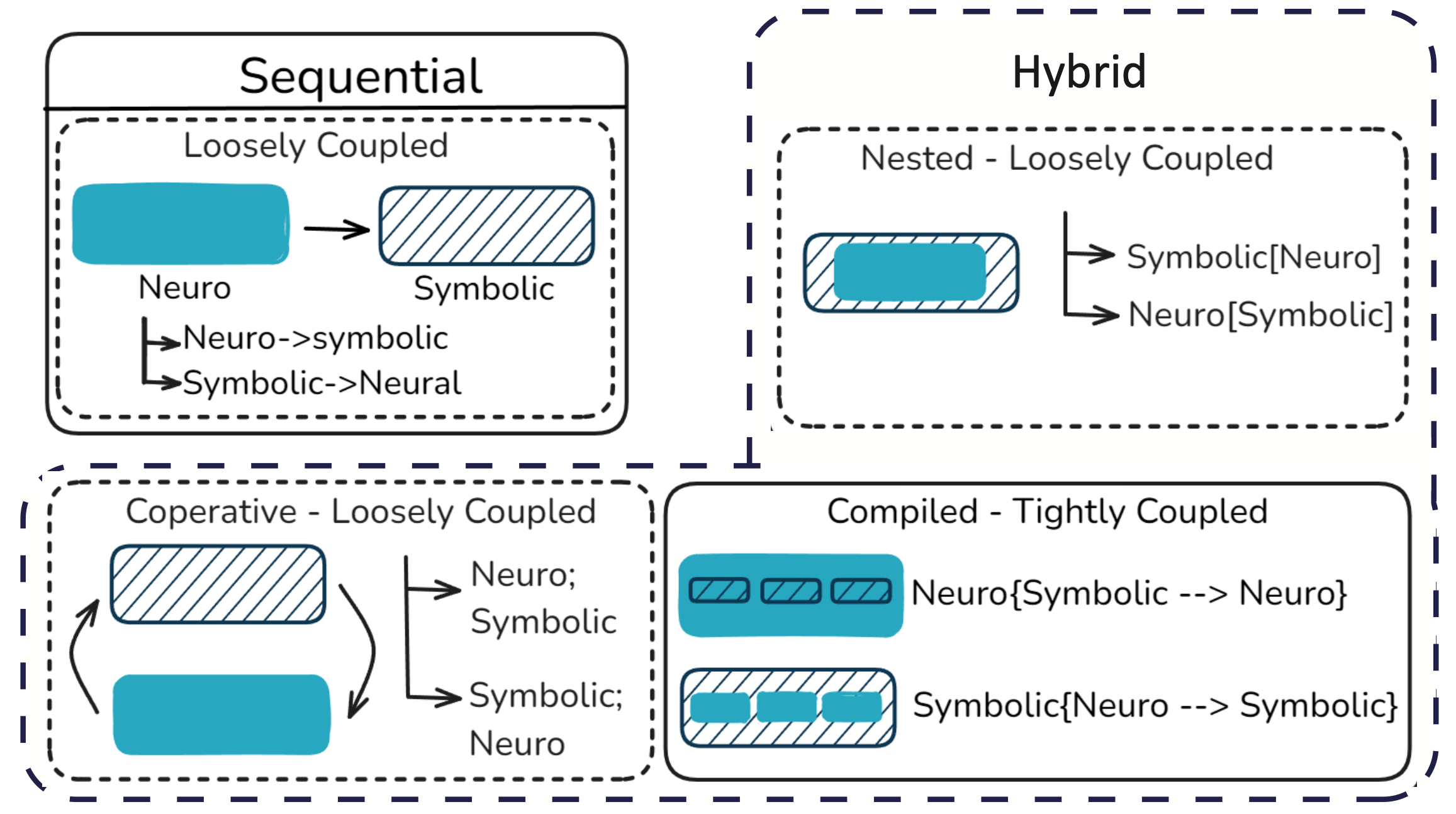
The image is a technical diagram illustrating four distinct architectural approaches for integrating "Neuro" (neural network-based) and "Symbolic" (logic/rule-based) components in AI systems. The diagram is organized into four quadrants, each representing a primary integration category: Sequential, Hybrid, Cooperative, and Compiled. The visual language uses consistent symbols: a solid teal rounded rectangle represents a "Neuro" component, and a hatched (diagonal-lined) rounded rectangle represents a "Symbolic" component. Arrows and spatial arrangements depict the flow of data or control.
### Components/Axes
The diagram is divided into four main sections, each with a title and a dashed or solid border:
1. **Top-Left Quadrant:** Titled "Sequential". Contains a sub-box labeled "Loosely Coupled".
2. **Top-Right Quadrant:** Titled "Hybrid". Contains a sub-box labeled "Nested - Loosely Coupled".
3. **Bottom-Left Quadrant:** Titled "Cooperative - Loosely Coupled".
4. **Bottom-Right Quadrant:** Titled "Compiled - Tightly Coupled".
**Visual Legend (Implicit):**
* **Solid Teal Block:** Represents a "Neuro" component.
* **Hatched Block:** Represents a "Symbolic" component.
* **Solid Border (Sequential, Compiled):** May indicate a more defined or monolithic architectural category.
* **Dashed Border (Hybrid, Cooperative):** May indicate a more flexible or interactive architectural category.
* **Arrows:** Indicate direction of data flow, transformation, or interaction.
### Detailed Analysis
#### 1. Sequential (Top-Left)
* **Structure:** A linear, one-way pipeline within a "Loosely Coupled" framework.
* **Components & Flow:**
* A solid teal "Neuro" block is on the left.
* A single arrow points right to a hatched "Symbolic" block.
* **Textual Labels:**
* Below the blocks, text specifies the transformation directions:
* `Neuro->symbolic`
* `Symbolic->Neural`
* **Interpretation:** This represents a pipeline where one component's output becomes the input for the other. The order can be either Neuro first or Symbolic first, but they operate in sequence without feedback.
#### 2. Hybrid (Top-Right)
* **Structure:** A nested architecture where one component is contained within the other, labeled "Nested - Loosely Coupled".
* **Components & Flow:**
* A solid teal "Neuro" block is visually placed *inside* a larger hatched "Symbolic" block.
* Two arrows point from this nested structure to the right, indicating two possible output interpretations.
* **Textual Labels:**
* The outputs are labeled:
* `Symbolic[Neuro]`
* `Neuro[Symbolic]`
* **Interpretation:** This suggests a tight functional embedding. `Symbolic[Neuro]` implies a symbolic system that internally uses a neural component (e.g., a neural network as a subroutine within a logic engine). `Neuro[Symbolic]` implies a neural system that has a symbolic component integrated within its architecture (e.g., a neural network with an embedded logic module).
#### 3. Cooperative - Loosely Coupled (Bottom-Left)
* **Structure:** A bidirectional, interactive loop between two separate components.
* **Components & Flow:**
* A hatched "Symbolic" block is positioned above a solid teal "Neuro" block.
* Two curved arrows form a cycle: one arrow curves from the right side of the Neuro block up to the Symbolic block, and another curves from the left side of the Symbolic block down to the Neuro block.
* **Textual Labels:**
* To the right, text describes the cooperative relationship:
* `Neuro; Symbolic`
* `Symbolic; Neuro`
* **Interpretation:** This depicts a continuous, iterative dialogue or feedback loop between the two systems. They operate as peers, constantly exchanging information and refining each other's outputs. The semicolon (`;`) suggests a concurrent or cooperative relationship rather than a strict sequence.
#### 4. Compiled - Tightly Coupled (Bottom-Right)
* **Structure:** A monolithic, integrated system where components are fused at a granular level.
* **Components & Flow:**
* **Top Row:** A large solid teal "Neuro" block contains three small hatched "Symbolic" blocks inside it. The label reads: `Neuro{Symbolic --> Neuro}`.
* **Bottom Row:** A large hatched "Symbolic" block contains three small solid teal "Neuro" blocks inside it. The label reads: `Symbolic{Neuro --> Symbolic}`.
* **Textual Labels:** The curly braces `{}` and arrows `-->` within the labels are critical.
* **Interpretation:** This represents the highest level of integration. `Neuro{Symbolic --> Neuro}` suggests a neural architecture where symbolic rules or structures are compiled directly into the network's operations, transforming symbolic logic into neural computations. `Symbolic{Neuro --> Symbolic}` suggests a symbolic system where neural processes are compiled into discrete symbolic steps or rules. The small blocks inside represent the embedded, transformed components.
### Key Observations
1. **Coupling Spectrum:** The diagram explicitly maps a spectrum from "Loosely Coupled" (Sequential, Hybrid, Cooperative) to "Tightly Coupled" (Compiled).
2. **Directionality:** The diagrams progress from unidirectional flow (Sequential) to bidirectional loops (Cooperative) to complete structural fusion (Compiled).
3. **Visual Metaphors:** The use of containment (Hybrid, Compiled) versus separation (Sequential, Cooperative) is a key visual cue for the degree of integration.
4. **Notation Consistency:** The labels use specific notations (`->`, `[]`, `;`, `{}`) to precisely define the relationship between Neuro and Symbolic elements in each architecture.
### Interpretation
This diagram serves as a taxonomy for designing Neuro-Symbolic AI systems. It answers the fundamental question: "How do we connect neural pattern recognition with symbolic reasoning?"
* **Sequential** is the simplest approach, suitable for clear-cut handoffs (e.g., a neural network extracts features, which a symbolic reasoner then uses). It risks error propagation and lacks feedback.
* **Hybrid** architectures are common in systems where one paradigm is dominant but requires the other for specific sub-tasks (e.g., a theorem prover using a neural network for conjecture generation).
* **Cooperative** models aim for the synergy of human-like thinking, where intuition (neural) and logic (symbolic) constantly inform each other. This is powerful but complex to implement and stabilize.
* **Compiled** architectures represent the frontier, seeking to create a new, unified computational substrate. This could lead to more efficient and robust systems but requires novel methods to "compile" between fundamentally different computational paradigms.
The progression from left to right, top to bottom, suggests an increase in integration complexity and potential power, but also in implementation difficulty. The choice of architecture depends on the specific problem's needs for flexibility, interpretability, robustness, and the natural division (or lack thereof) between pattern recognition and logical reasoning tasks within the domain.
DECODING INTELLIGENCE...