# Technical Document Extraction: Coupling Architectures Diagram
## Overview
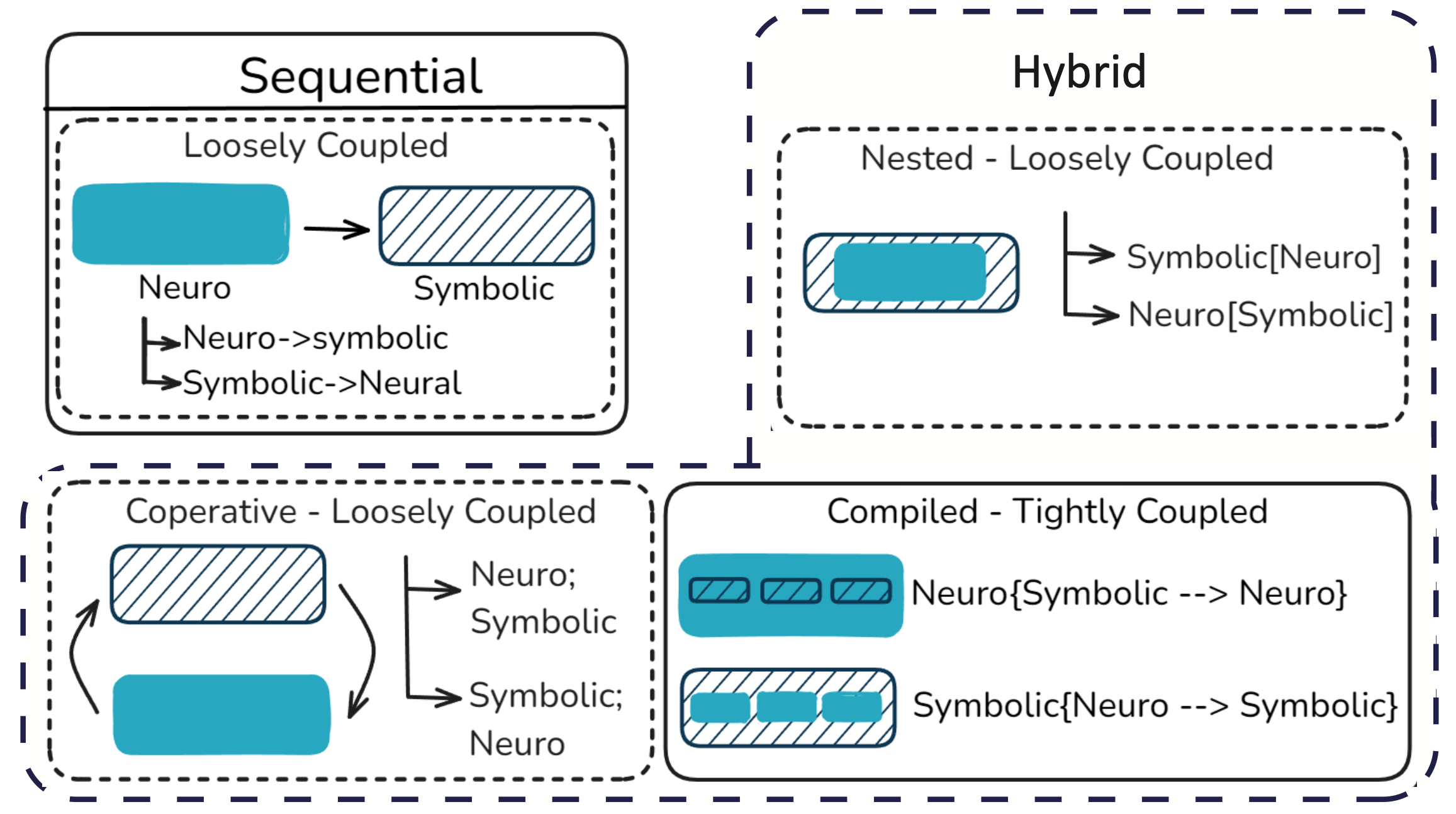
The image presents a comparative analysis of four computational architecture paradigms through diagrammatic representation. Each section illustrates distinct coupling mechanisms between Neuro and Symbolic components.
---
## Section Breakdown
### 1. Sequential Architecture
**Title:** Sequential
**Subtitle:** Loosely Coupled
**Components:**
- **Neuro** (solid blue rectangle)
- **Symbolic** (diagonally striped rectangle)
**Flow:**
- Unidirectional arrow from Neuro → Symbolic
- Bidirectional labels:
- `Neuro->symbolic`
- `Symbolic->Neural`
### 2. Hybrid Architecture
**Title:** Hybrid
**Subtitle:** Nested - Loosely Coupled
**Components:**
- **Symbolic[Neuro]** (striped rectangle containing solid blue)
- **Neuro[Symbolic]** (solid blue rectangle containing striped)
**Flow:**
- Bidirectional arrows between components
- Nesting notation using square brackets
- Labels:
- `Symbolic[Neuro]`
- `Neuro[Symbolic]`
### 3. Cooperative Architecture
**Title:** Cooperative - Loosely Coupled
**Components:**
- **Symbolic** (striped rectangle)
- **Neuro** (solid blue rectangle)
**Flow:**
- Bidirectional circular arrows between components
- Labels:
- `Neuro; Symbolic`
- `Symbolic; Neuro`
### 4. Compiled Architecture
**Title:** Compiled - Tightly Coupled
**Components:**
- **Neuro{Symbolic --> Neuro}** (solid blue rectangle with striped embedded)
- **Symbolic{Neuro --> Symbolic}** (striped rectangle with solid blue embedded)
**Flow:**
- Unidirectional arrows within component boundaries
- Composition notation using curly braces
- Labels:
- `Neuro{Symbolic --> Neuro}`
- `Symbolic{Neuro --> Symbolic}`
---
## Key Observations
1. **Coupling Intensity Gradient:**
- Sequential/Cooperative: Loosely Coupled (dashed borders)
- Compiled: Tightly Coupled (solid borders)
2. **Component Interaction Patterns:**
- Sequential: Linear flow (Neuro → Symbolic)
- Hybrid: Nested bidirectional interaction
- Cooperative: Mutual circular dependency
- Compiled: Internal compositional flow
3. **Notation Conventions:**
- Square brackets `[ ]`: Nesting
- Curly braces `{ }`: Composition
- Semicolons `;`: Bidirectional interaction
- Arrows: Directionality
---
## Diagram Metadata
- **Color Coding:**
- Solid blue: Neuro components
- Diagonally striped: Symbolic components
- **Border Style:**
- Dashed: Loosely Coupled architectures
- Solid: Tightly Coupled architecture
---
## Structural Analysis
1. **Sequential Architecture** demonstrates a one-way processing pipeline from Neuro to Symbolic components.
2. **Hybrid Architecture** introduces nesting, showing hierarchical integration of Neuro within Symbolic and vice versa.
3. **Cooperative Architecture** emphasizes mutual dependency through circular bidirectional arrows.
4. **Compiled Architecture** represents the most integrated form, with components containing and processing each other's types.
---
## Technical Implications
- **Loosely Coupled Systems** (Sequential/Hybrid/Cooperative) allow independent component evolution
- **Tightly Coupled System** (Compiled) enables optimized performance through deep integration
- Nesting and composition notations suggest different levels of architectural integration
---
## Diagram Integrity Check
All component labels match color coding:
- ✅ Neuro = solid blue
- ✅ Symbolic = diagonally striped
All directional arrows correspond to their labels:
- ✅ Unidirectional arrows match single-direction labels
- ✅ Bidirectional arrows match semicolon-separated labels