## Diagram: Hierarchical Layered Structure with Anomaly Highlight
### Overview
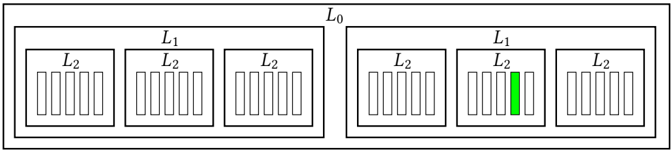
The diagram depicts a two-tiered hierarchical system labeled **L₀** (top-level container) divided into two primary sections: **L₁** (left) and **L₁** (right). Each **L₁** section contains three **L₂** subsections, represented as vertical bar groups. A single **L₂** bar in the right **L₁** section is highlighted in green, indicating a distinct value or status.
---
### Components/Axes
- **Main Container**: Labeled **L₀**, enclosing the entire structure.
- **Primary Sections**:
- **L₁ (Left)**: Contains three **L₂** subsections.
- **L₁ (Right)**: Contains three **L₂** subsections, with the middle **L₂** highlighted green.
- **Subsections**:
- **L₂**: Uniformly labeled across all instances, represented as vertical bars.
- **Color Coding**:
- **Green**: Highlights a single bar in the middle **L₂** of the right **L₁** section.
---
### Detailed Analysis
- **Left L₁ Section**:
- Three **L₂** subsections with identical bar heights (no visual variation).
- **Right L₁ Section**:
- Two **L₂** subsections with identical bar heights (matching the left **L₁** section).
- Middle **L₂** subsection contains a green-highlighted bar, taller than the others in its group.
- **Spatial Grounding**:
- **L₀**: Top-level container, centered.
- **L₁ (Left)**: Positioned left of center within **L₀**.
- **L₁ (Right)**: Positioned right of center within **L₀**.
- **L₂**: Subsections are evenly spaced horizontally within each **L₁** section.
---
### Key Observations
1. **Uniformity**: All **L₂** bars except the green one are identical in height, suggesting consistent values across most components.
2. **Anomaly**: The green-highlighted bar in the right **L₁**’s middle **L₂** is visually distinct, indicating an outlier or critical value.
3. **Hierarchical Symmetry**: The left and right **L₁** sections mirror each other in structure but differ in the presence of the green bar.
---
### Interpretation
This diagram likely represents a system with layered components (e.g., software modules, hardware layers, or data processing stages). The **L₀** container acts as the overarching framework, while **L₁** and **L₂** denote nested sub-systems or processes. The green bar’s placement in the right **L₁**’s middle **L₂** suggests:
- A **critical component** or **threshold** within that layer.
- A **deviation from normal operation** (e.g., error, peak performance, or resource allocation).
- A **central role** for the highlighted **L₂** in the right **L₁** section, potentially acting as a bridge or focal point between layers.
The absence of numerical labels or explicit legends leaves the exact meaning of the green bar open to context, but its prominence implies it is a key focus for analysis or intervention.