## Pie Charts: Building Energy Use 1990 vs 2000
### Overview
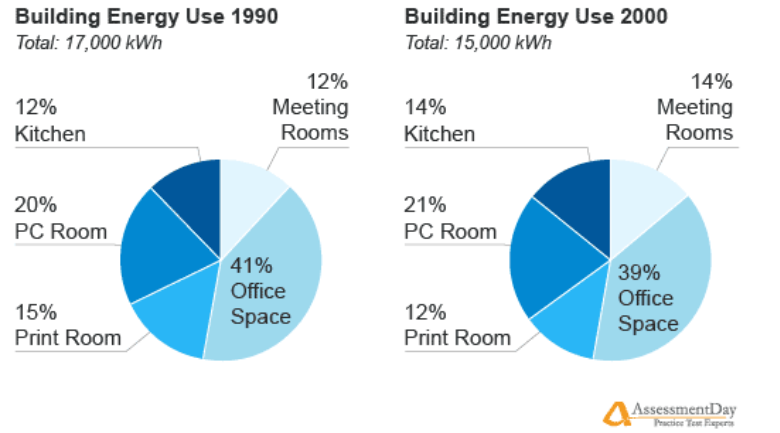
The image presents two pie charts comparing building energy use in 1990 and 2000. Each chart breaks down the total energy consumption (in kWh) by room type: Kitchen, Meeting Rooms, PC Room, Print Room, and Office Space. The charts show the percentage of total energy used by each room type for the respective years.
### Components/Axes
* **Titles:** "Building Energy Use 1990" and "Building Energy Use 2000"
* **Total Energy Use:** "Total: 17,000 kWh" (1990) and "Total: 15,000 kWh" (2000)
* **Categories:**
* Kitchen
* Meeting Rooms
* PC Room
* Print Room
* Office Space
* **Percentages:** Represent the proportion of total energy use for each category.
* **Colors:** Each category is represented by a specific shade of blue or white.
### Detailed Analysis or ### Content Details
**Building Energy Use 1990:**
* Total: 17,000 kWh
* Kitchen: 12%
* Meeting Rooms: 12%
* PC Room: 20%
* Print Room: 15%
* Office Space: 41%
**Building Energy Use 2000:**
* Total: 15,000 kWh
* Kitchen: 14%
* Meeting Rooms: 14%
* PC Room: 21%
* Print Room: 12%
* Office Space: 39%
### Key Observations
* The total energy use decreased from 17,000 kWh in 1990 to 15,000 kWh in 2000.
* Office Space consistently accounts for the largest proportion of energy use in both years, although it decreased from 41% to 39%.
* PC Room energy use increased slightly from 20% to 21%.
* Print Room energy use decreased from 15% to 12%.
* Kitchen and Meeting Rooms energy use increased slightly.
### Interpretation
The data suggests a general trend of reduced energy consumption in the building between 1990 and 2000. While Office Space remains the largest energy consumer, its proportion decreased, indicating potential efficiency improvements. The increase in PC Room energy use could reflect increased computer usage during that period. The decrease in Print Room energy use could be due to more efficient printing practices or a shift towards digital document management. Overall, the changes in energy consumption patterns across different room types highlight the evolving needs and practices within the building.