## Diagram: Embedding Gated Multi-Head Latent Attention (EG-MLA)
### Overview
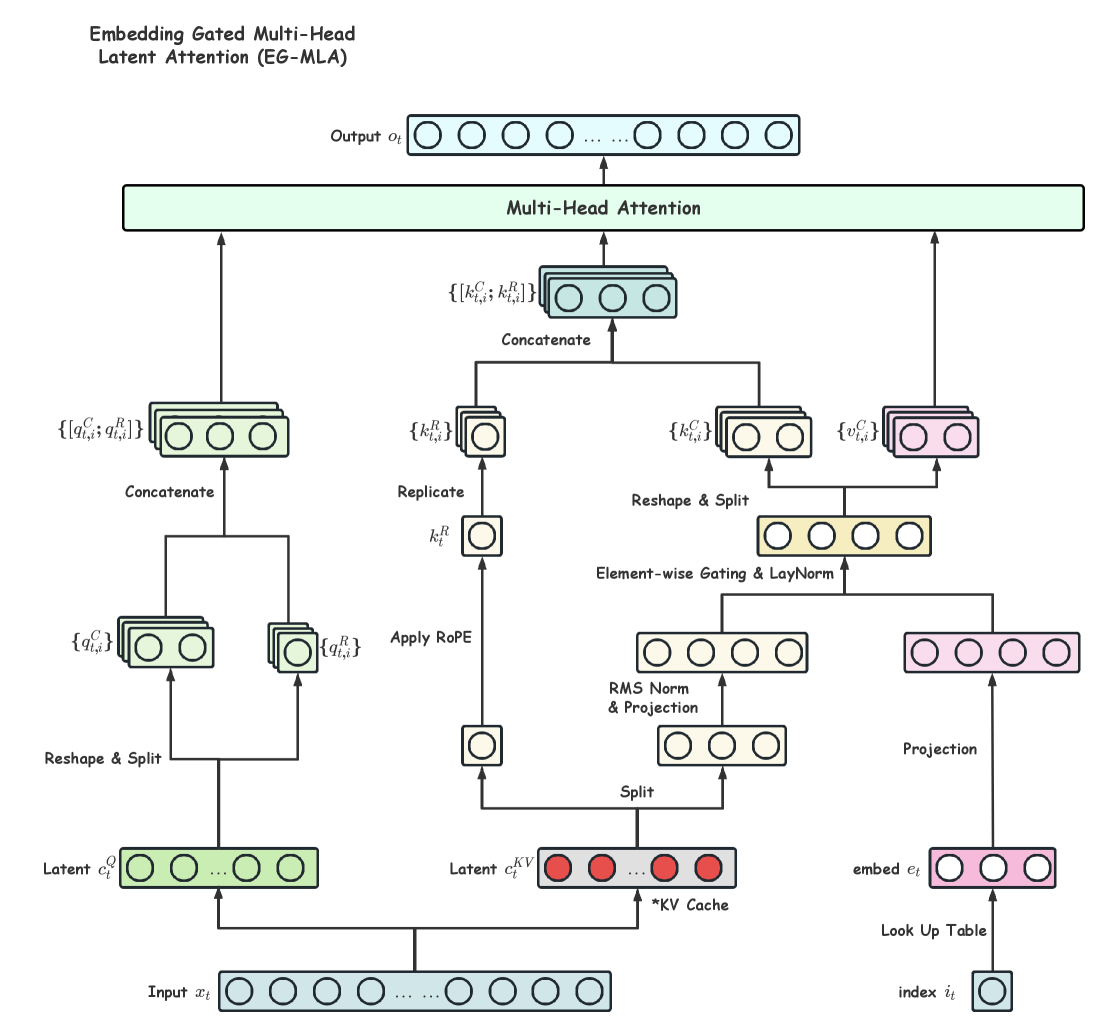
The image is a technical architecture diagram illustrating the "Embedding Gated Multi-Head Latent Attention (EG-MLA)" mechanism. The diagram depicts a neural network flow where input data ($x_t$ and index $i_t$) is processed through three distinct parallel branches—Query, Key, and Value/Gating—before converging into a Multi-Head Attention block to produce an output ($o_t$).
### Components/Axes
The diagram is organized into a hierarchical flow from bottom to top, with three primary processing branches:
* **Bottom Level (Inputs):**
* **Input $x_t$:** A blue box containing a sequence of circles.
* **index $i_t$:** A blue box containing a single circle, feeding into a "Look Up Table".
* **Left Branch (Query Path - Green):**
* **Latent $c_t^Q$:** Green box.
* **Reshape & Split:** Operation block.
* **$\{q_{t,i}^C\}$ and $\{q_{t,i}^R\}$:** Intermediate green boxes.
* **Concatenate:** Operation block.
* **$\{ [q_{t,i}^C; q_{t,i}^R] \}$:** Final green box.
* **Center Branch (Key Path - Red/Cyan):**
* **Latent $c_t^{KV}$:** Red box (labeled "*KV Cache").
* **Split:** Operation block.
* **RMS Norm & Projection:** Operation block.
* **Apply RoPE:** Operation block.
* **$k_t^R$:** Intermediate box.
* **Replicate:** Operation block.
* **$\{k_{t,i}^R\}$ and $\{k_{t,i}^C\}$:** Intermediate cyan boxes.
* **Concatenate:** Operation block.
* **$\{ [k_{t,i}^C; k_{t,i}^R] \}$:** Final cyan box.
* **Right Branch (Value/Gating Path - Pink):**
* **Look Up Table:** Operation block.
* **embed $e_t$:** Pink box.
* **Projection:** Operation block.
* **Element-wise Gating & LayNorm:** Operation block.
* **$\{v_{t,i}^C\}$:** Final pink box.
* **Top Level (Output):**
* **Multi-Head Attention:** Large light green horizontal bar.
* **Output $o_t$:** Blue box containing a sequence of circles.
### Detailed Analysis
#### 1. Query Branch (Left)
* **Flow:** Input $x_t$ feeds into Latent $c_t^Q$.
* **Transformation:** The latent vector undergoes "Reshape & Split" to create two components: $\{q_{t,i}^C\}$ (likely Content) and $\{q_{t,i}^R\}$ (likely Rotary/Positional).
* **Result:** These are concatenated to form the final Query vector $\{ [q_{t,i}^C; q_{t,i}^R] \}$, which is passed to the Multi-Head Attention block.
#### 2. Key Branch (Center)
* **Flow:** Input $x_t$ feeds into Latent $c_t^{KV}$ (marked as *KV Cache).
* **Transformation:** The latent vector is split.
* **Path A:** Passes through "RMS Norm & Projection" and then feeds into the "Element-wise Gating & LayNorm" block in the right branch.
* **Path B:** Passes through "Apply RoPE" (Rotary Positional Embedding), resulting in $k_t^R$, which is then "Replicated" to form $\{k_{t,i}^R\}$.
* **Result:** $\{k_{t,i}^C\}$ (derived from the RMS Norm path) and $\{k_{t,i}^R\}$ are concatenated to form the final Key vector $\{ [k_{t,i}^C; k_{t,i}^R] \}$, which is passed to the Multi-Head Attention block.
#### 3. Value/Gating Branch (Right)
* **Flow:** Index $i_t$ is processed via a "Look Up Table" to produce embedding $e_t$.
* **Transformation:** $e_t$ undergoes "Projection".
* **Gating:** The output of this projection and the output from the "RMS Norm & Projection" (from the Key branch) are combined in the "Element-wise Gating & LayNorm" block.
* **Result:** This produces the final Value vector $\{v_{t,i}^C\}$, which is passed to the Multi-Head Attention block.
### Key Observations
* **Hybrid Latent/Embedding Approach:** The architecture explicitly separates content (Latent $c_t$) from positional/index-based information (RoPE and Look Up Table embeddings).
* **Gating Mechanism:** The "Element-wise Gating & LayNorm" is a critical junction where the KV cache information is modulated by the embedding $e_t$ before becoming the Value vector.
* **KV Cache Efficiency:** The use of a shared Latent $c_t^{KV}$ for both Key and Value generation suggests an optimization to reduce memory footprint, common in modern LLM architectures.
* **Color Coding:** The diagram uses distinct color palettes to separate the three attention components: Green (Query), Cyan (Key), and Pink (Value/Embedding).
### Interpretation
This diagram represents a sophisticated attention mechanism designed to optimize the trade-off between model capacity and computational efficiency.
1. **Latent Compression:** By using Latent $c_t^Q$ and $c_t^{KV}$ instead of projecting the full input $x_t$ directly into Query, Key, and Value spaces, the model likely reduces the memory overhead of the KV cache.
2. **Dynamic Gating:** The "Embedding Gated" aspect implies that the Value vector is not static; it is dynamically adjusted based on the input index $i_t$. This allows the model to inject token-specific or position-specific information into the attention mechanism via the embedding $e_t$ without increasing the size of the latent cache.
3. **Positional Encoding:** The explicit "Apply RoPE" step in the Key branch indicates that positional information is injected specifically into the Key vectors, a standard practice in modern Transformers (like Llama) to maintain relative positional awareness.
4. **Peircean Investigative Note:** The architecture suggests a "compressed-then-expanded" logic. The model compresses input into a latent space, performs operations (RoPE, Gating), and then expands/concatenates these components back into a format suitable for standard Multi-Head Attention. This is likely an architecture designed for high-throughput inference where KV cache size is the primary bottleneck.