## Diagram: Embedding Gated Multi-Head Latent Attention (EG-MLA)
### Overview
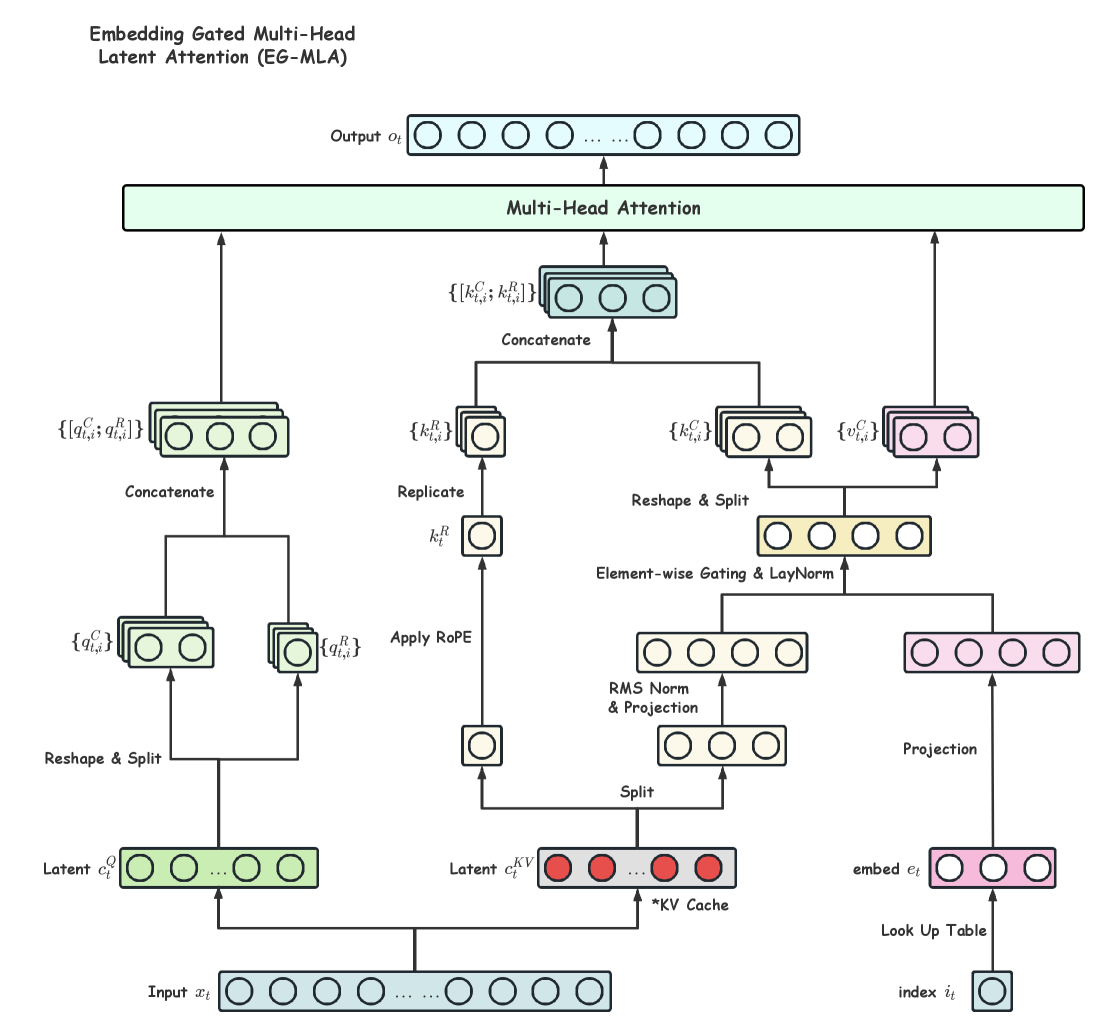
The diagram illustrates the architecture of the EG-MLA model, a neural network component that integrates multi-head attention with latent vector processing and key-value caching. The flow begins with an input sequence, processes it through multi-head attention mechanisms, and produces an output sequence. Key components include concatenation, replication, RoPE (Rotary Positional Encoding), element-wise gating, normalization, and projection steps.
### Components/Axes
- **Input**: Labeled as `x_t` (blue rectangle at the bottom-left).
- **Multi-Head Attention**: Central block with sub-components:
- **Concatenate**: Splits into `{q_C}` (green) and `{q_R}` (green).
- **Replicate**: Copies `{k_R}` (white).
- **Apply RoPE**: Processes `{k_R}` (white).
- **Element-wise Gating & LayNorm**: Combines `{k_C}` (yellow) and `{v_C}` (pink).
- **RMS Norm & Projection**: Processes normalized values.
- **Projection**: Final step before output.
- **Output**: Labeled as `o_t` (blue rectangle at the top-right).
- **Latent Vectors**:
- `c_t^Q` (green) and `c_t^KV` (red) are latent representations.
- **Look Up Table**: Pink block with `embed e_t` and `index i_t`.
- **KV Cache**: Red dots labeled `*KV Cache`.
### Detailed Analysis
1. **Input Processing**:
- Input `x_t` is split into concatenated queries `{q_C}` and `{q_R}`.
- Queries are further split into `{q_C}` and `{q_R}` for separate processing.
2. **Multi-Head Attention Flow**:
- `{k_R}` is replicated and processed via RoPE.
- `{k_C}` and `{v_C}` undergo element-wise gating and LayNorm.
- Normalized values are projected and combined with the KV Cache.
3. **Output Generation**:
- The final output `o_t` is derived from the projected values after multi-head attention.
### Key Observations
- **Latent Attention Integration**: The model combines latent vectors (`c_t^Q`, `c_t^KV`) with multi-head attention, suggesting a hybrid approach for sequence modeling.
- **KV Cache**: The red dots indicate a memory mechanism for storing key-value pairs, likely for efficient autoregressive generation.
- **RoPE and Normalization**: The use of RoPE and RMS normalization implies handling of positional information and stability in training.
### Interpretation
The EG-MLA model appears to enhance traditional multi-head attention by incorporating latent vectors and a key-value cache, potentially improving efficiency and context retention. The integration of RoPE and LayNorm suggests a focus on positional awareness and normalization, which are critical for transformer-based models. The KV Cache implies that the model retains historical information, enabling it to process sequences more effectively, especially in autoregressive tasks. This architecture could be applied to tasks like language modeling or sequence-to-sequence generation, where maintaining context and efficiency are paramount.