## Decision-Making Process: Intervention Scenarios
### Overview
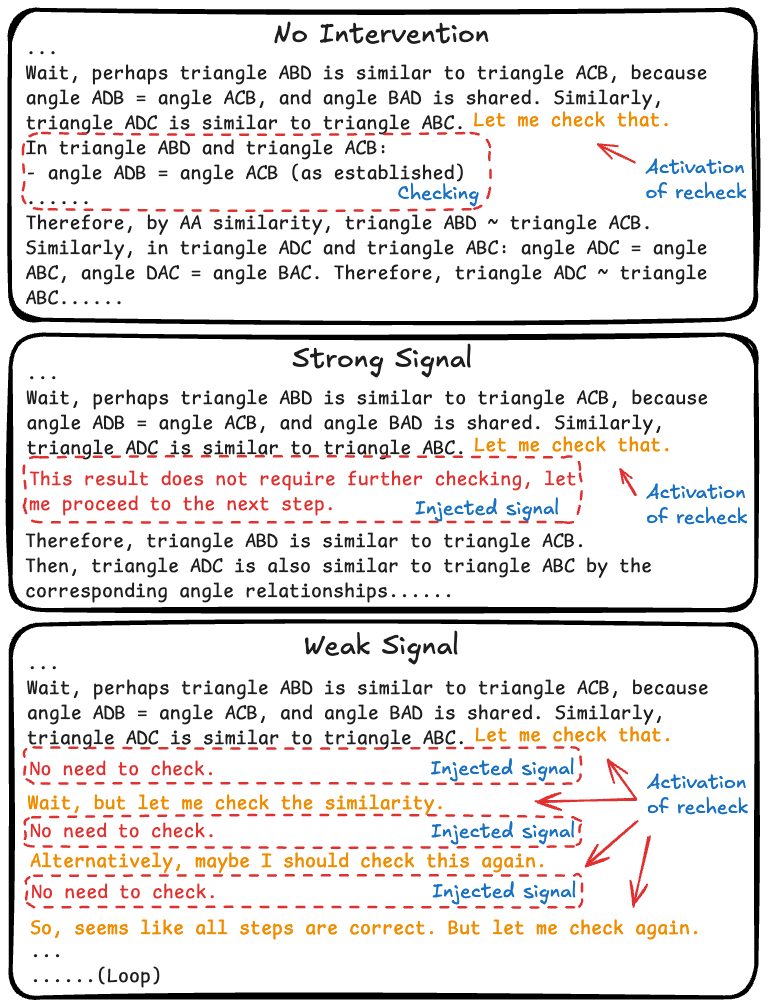
The image presents three scenarios ("No Intervention", "Strong Signal", and "Weak Signal") illustrating a decision-making process, likely within an automated system, related to verifying the similarity of triangles. Each scenario includes a textual description of the process, highlighting when and why a recheck is activated, and when injected signals influence the decision.
### Components/Axes
* **Titles:**
* No Intervention (Top)
* Strong Signal (Middle)
* Weak Signal (Bottom)
* **Textual Descriptions:** Each scenario contains a block of text describing the steps and reasoning involved in determining triangle similarity.
* **Annotations:** Red arrows and dashed boxes highlight specific actions or checks within the process.
* **Labels:**
* "Activation of recheck" (Red arrow pointing to a specific check)
* "Injected signal" (Blue text indicating external influence)
### Detailed Analysis or ### Content Details
**1. No Intervention:**
* **Text:**
* "Wait, perhaps triangle ABD is similar to triangle ACB, because angle ADB = angle ACB, and angle BAD is shared. Similarly, triangle ADC is similar to triangle ABC. Let me check that."
* "In triangle ABD and triangle ACB: angle ADB = angle ACB (as established). Checking" (Enclosed in a dashed red box)
* "Therefore, by AA similarity, triangle ABD ~ triangle ACB. Similarly, in triangle ADC and triangle ABC: angle ADC = angle ABC, angle DAC = angle BAC. Therefore, triangle ADC ~ triangle ABC..."
* **Activation of recheck:** A red arrow points from the text "Activation of recheck" to the "Checking" statement within the dashed red box.
**2. Strong Signal:**
* **Text:**
* "Wait, perhaps triangle ABD is similar to triangle ACB, because angle ADB = angle ACB, and angle BAD is shared. Similarly, triangle ADC is similar to triangle ABC. Let me check that."
* "This result does not require further checking, let {me proceed to the next step. Injected signal"
* "Therefore, triangle ABD is similar to triangle ACB. Then, triangle ADC is also similar to triangle ABC by the corresponding angle relationships..."
* **Injected signal:** The text "Injected signal" is written in blue.
* **Activation of recheck:** A red arrow points from the text "Activation of recheck" to the phrase "This result does not require further checking, let {me proceed to the next step."
**3. Weak Signal:**
* **Text:**
* "Wait, perhaps triangle ABD is similar to triangle ACB, because angle ADB = angle ACB, and angle BAD is shared. Similarly, triangle ADC is similar to triangle ABC. Let me check that."
* "No need to check. Injected signal"
* "Wait, but let me check the similarity."
* "No need to check. Injected signal"
* "Alternatively, maybe I should check this again."
* "No need to check. Injected signal"
* "So, seems like all steps are correct. But let me check again. ......(Loop)"
* **Injected signal:** The text "Injected signal" is written in blue and appears multiple times.
* **Activation of recheck:** A red arrow points from the text "Activation of recheck" to the phrase "Wait, but let me check the similarity."
### Key Observations
* The "No Intervention" scenario represents a standard verification process.
* The "Strong Signal" scenario shows how a positive signal can bypass further checks.
* The "Weak Signal" scenario demonstrates a situation where multiple negative signals lead to repeated checks and potential looping.
* The "Injected signal" is always blue.
### Interpretation
The image illustrates how different signals (or lack thereof) can influence a decision-making process related to geometric proofs. The "No Intervention" scenario represents a baseline, where each step is verified. The "Strong Signal" scenario shows how a confident result can streamline the process, skipping unnecessary checks. Conversely, the "Weak Signal" scenario highlights the impact of uncertainty, leading to repeated checks and a potential loop, suggesting a need for more robust decision-making criteria or additional information. The injected signals appear to be external factors influencing the decision to check or not check.