## Screenshot: Geometry Problem Analysis with Annotations
### Overview
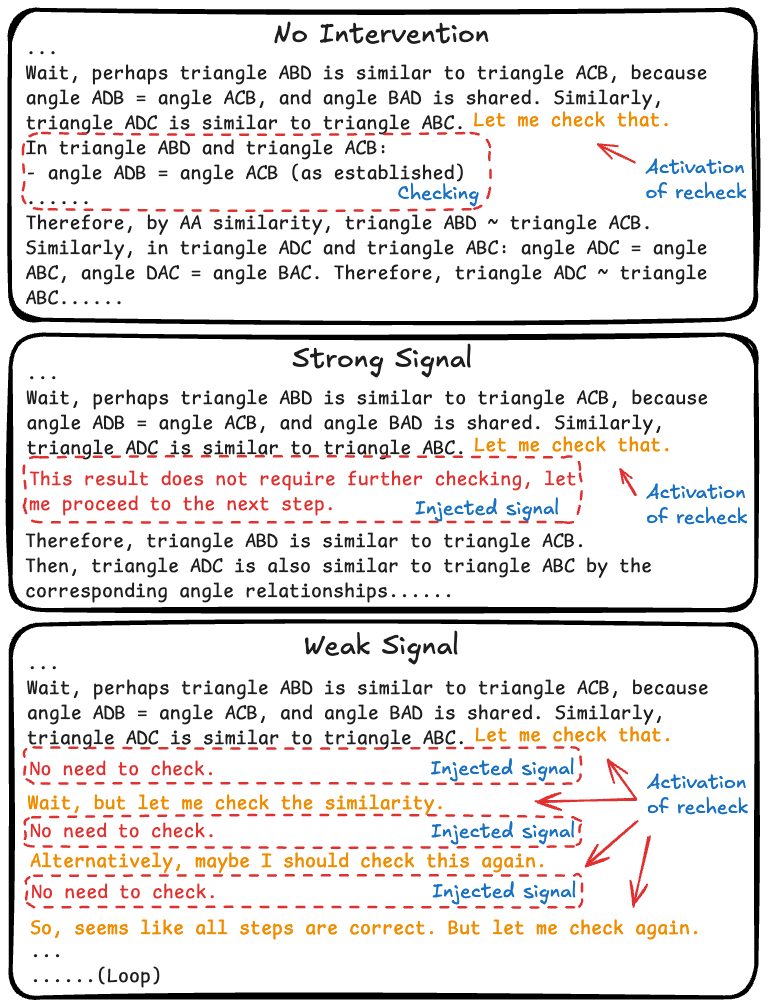
The image is a screenshot of a geometry problem analysis divided into three sections: "No Intervention," "Strong Signal," and "Weak Signal." Each section contains textual reasoning about triangle similarity, annotated with color-coded highlights, arrows, and injected signals. The annotations suggest iterative verification or feedback mechanisms in the reasoning process.
### Components/Axes
- **Sections**:
1. **No Intervention**: Text discussing triangle similarity without annotations.
2. **Strong Signal**: Text with a red-highlighted note ("This result does not require further checking") and an injected signal.
3. **Weak Signal**: Text with multiple red-highlighted notes and injected signals, ending in a loop.
- **Annotations**:
- **Red boxes**: Highlight specific text segments (e.g., "Let me check that").
- **Arrows**: Labeled "Activation of recheck" (blue text) pointing to injected signals.
- **Injected signals**: Blue text within red boxes (e.g., "Injected signal").
- **Text Colors**:
- Primary text: Black.
- Highlighted text: Red.
- Injected signals: Blue.
- Notes: Orange.
### Detailed Analysis
#### No Intervention Section
- Text discusses triangle similarity (e.g., "triangle ABD ~ triangle ACB" via AA similarity).
- No annotations or injected signals.
#### Strong Signal Section
- Text mirrors the "No Intervention" section but includes:
- A red-highlighted note: "This result does not require further checking, let me proceed to the next step."
- An injected signal labeled "Injected signal" (blue text) with an arrow labeled "Activation of recheck."
- The injected signal suggests a system intervention to confirm correctness.
#### Weak Signal Section
- Text repeats the similarity reasoning but includes:
- Multiple red-highlighted notes (e.g., "No need to check," "Wait, but let me check the similarity").
- Three injected signals labeled "Injected signal" (blue text) with arrows labeled "Activation of recheck."
- A loop at the end: "(Loop)."
- The annotations imply uncertainty and repeated verification attempts.
### Key Observations
1. **Repetition of Text**: All sections share identical core reasoning about triangle similarity, suggesting a focus on iterative validation.
2. **Signal Strength**:
- **Strong Signal**: Confident conclusion with minimal rechecking.
- **Weak Signal**: Uncertainty requiring multiple rechecks and a cyclical process.
3. **Annotations**: Arrows and injected signals indicate a feedback loop or automated verification system.
### Interpretation
The annotations and injected signals imply a structured reasoning process where:
- **No Intervention**: Represents unassisted, linear reasoning.
- **Strong Signal**: Indicates a system that confidently validates conclusions, reducing rechecks.
- **Weak Signal**: Reflects a system struggling with uncertainty, requiring repeated validation and looping back to earlier steps.
The use of "Injected signal" and "Activation of recheck" suggests an external mechanism (e.g., AI or automated tool) intervening to guide or correct the reasoning process. The loop in the "Weak Signal" section highlights inefficiency or ambiguity in the problem-solving approach.
This analysis underscores the importance of signal strength in automated reasoning systems, where confidence levels directly impact the need for iterative verification.