## Diagram: Comparative Analysis of LLM Reasoning Methods
### Overview
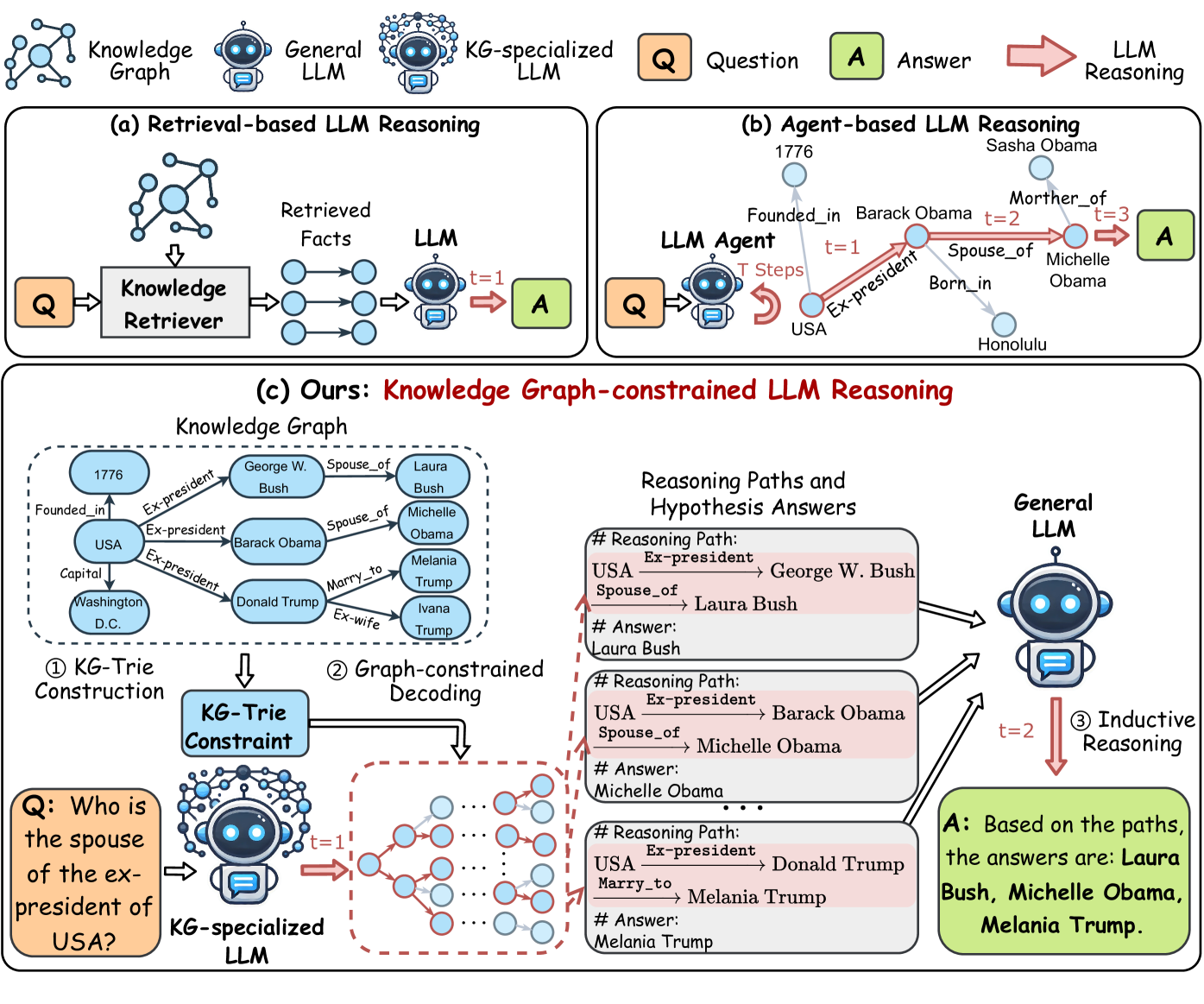
The diagram compares three approaches to Large Language Model (LLM) reasoning:
1. **Retrieval-based LLM Reasoning**
2. **Agent-based LLM Reasoning**
3. **Knowledge Graph-constrained LLM Reasoning (Proposed Method)**
It illustrates workflows, components, and reasoning paths for each method, with a focus on knowledge graph integration in the proposed approach.
---
### Components/Axes
#### Header Section
- **Knowledge Graph**: Visualized as interconnected nodes (e.g., "USA", "Barack Obama", "Michelle Obama").
- **General LLM**: Represented by a robot icon with a speech bubble.
- **KG-specialized LLM**: Robot icon with a speech bubble surrounded by interconnected nodes.
- **Question (Q)**: Orange box labeled "Q".
- **Answer (A)**: Green box labeled "A".
- **LLM Reasoning**: Arrows labeled "LLM Reasoning" connect components.
#### Main Diagram (Bottom Section)
1. **Knowledge Graph**:
- Nodes: "USA", "George W. Bush", "Barack Obama", "Donald Trump", "Michelle Obama", "Melania Trump", "Laura Bush", "Ivana Trump".
- Edges: Relationships like "Ex-president", "Spouse_of", "Born_in", "Marry_to".
- Example: "USA" → "Ex-president" → "Barack Obama" → "Spouse_of" → "Michelle Obama".
2. **KG-Trie Construction**:
- Process for building a knowledge graph trie (tree-like structure).
3. **Graph-constrained Decoding**:
- Visualized as a decision tree with nodes labeled "t=1", "t=2", etc.
4. **Reasoning Paths and Hypothesis Answers**:
- Three numbered reasoning paths:
- **Path 1**: USA → George W. Bush → Laura Bush (Answer: Laura Bush).
- **Path 2**: USA → Barack Obama → Michelle Obama (Answer: Michelle Obama).
- **Path 3**: USA → Donald Trump → Melania Trump (Answer: Melania Trump).
5. **Inductive Reasoning**:
- Final answer aggregates all paths: "Laura Bush, Michelle Obama, Melania Trump".
---
### Detailed Analysis
#### Retrieval-based LLM Reasoning (a)
- **Workflow**:
- Question (Q) → Knowledge Retriever → Retrieved Facts → LLM → Answer (A).
- **Key Elements**:
- "Retrieved Facts" represented as interconnected nodes.
- Direct flow from retrieved facts to LLM.
#### Agent-based LLM Reasoning (b)
- **Workflow**:
- Question (Q) → LLM Agent → T Steps → Answer (A).
- **Key Elements**:
- Example steps: "Founded_in", "Ex-president", "Spouse_of".
- Temporal progression (t=1, t=2, t=3).
#### Knowledge Graph-constrained LLM Reasoning (c)
- **Workflow**:
- **KG-Trie Construction**: Builds a structured knowledge graph.
- **Graph-constrained Decoding**: Uses the trie to guide reasoning.
- **Inductive Reasoning**: Combines multiple paths for a comprehensive answer.
- **Key Elements**:
- Explicit use of "KG-Trie Constraint" to limit LLM exploration.
- Multiple reasoning paths with hypothesis answers.
---
### Key Observations
1. **Structured Reasoning**:
- The proposed method (c) explicitly uses a knowledge graph to constrain LLM reasoning, reducing ambiguity.
2. **Multiple Hypotheses**:
- The answer aggregates results from different reasoning paths (e.g., spouses of multiple ex-presidents).
3. **Temporal Progression**:
- Agent-based reasoning (b) includes time steps (t=1, t=2), while the proposed method focuses on graph traversal.
4. **Knowledge Graph Integration**:
- The KG-constrained method leverages relationships (e.g., "Spouse_of", "Ex-president") for accurate answers.
---
### Interpretation
- **Purpose**: Demonstrates how knowledge graphs improve LLM reasoning by providing structured context.
- **Advantages of Proposed Method**:
- Reduces reliance on ad-hoc retrieval (a) or sequential agent steps (b).
- Explicitly models relationships (e.g., "Spouse_of") to avoid incorrect inferences.
- **Notable Trends**:
- The answer aggregates multiple valid hypotheses, reflecting real-world complexity (e.g., multiple spouses of ex-presidents).
- **Underlying Logic**:
- Knowledge graphs act as a "constraint" to guide LLMs toward factually grounded answers, mitigating hallucination risks.
This diagram emphasizes the importance of structured knowledge integration in enhancing LLM reasoning capabilities.