## Diagram: Cryptographic Reduction Flowchart
### Overview
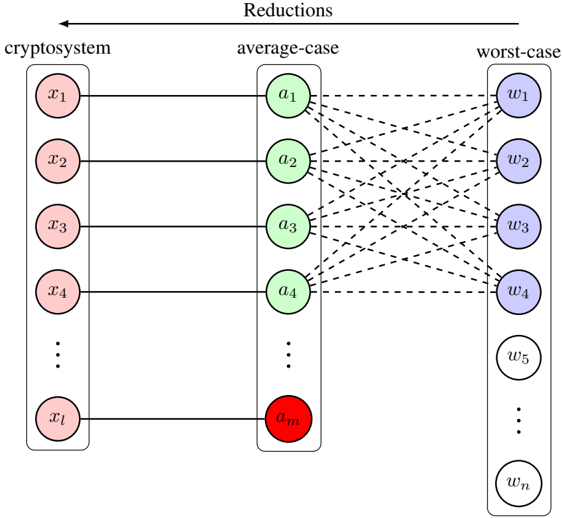
The image is a technical diagram illustrating a reduction chain in cryptography. It visually maps the relationship between three conceptual levels: a specific cryptosystem, average-case problem instances, and worst-case problem instances. The flow of reduction is indicated from right to left (worst-case to cryptosystem), as shown by the arrow at the top labeled "Reductions".
### Components/Axes
The diagram is organized into three vertical columns, each representing a different class of problems or systems.
1. **Top Label:** The word "Reductions" is centered at the top, with a long arrow pointing to the left, indicating the direction of the reduction proof.
2. **Column Headers (from left to right):**
* `cryptosystem`
* `average-case`
* `worst-case`
3. **Nodes within Columns:**
* **Cryptosystem Column (Left):** Contains pink circular nodes labeled `x₁`, `x₂`, `x₃`, `x₄`, followed by a vertical ellipsis (`⋮`), and ending with `xᵢ`. This indicates a sequence of `i` instances or components of the cryptosystem.
* **Average-case Column (Center):** Contains green circular nodes labeled `a₁`, `a₂`, `a₃`, `a₄`, followed by a vertical ellipsis (`⋮`), and ending with a **red** circular node labeled `aₘ`. This indicates a sequence of `m` average-case problem instances, with the final instance (`aₘ`) highlighted in red.
* **Worst-case Column (Right):** Contains blue circular nodes labeled `w₁`, `w₂`, `w₃`, `w₄`, `w₅`, followed by a vertical ellipsis (`⋮`), and ending with `wₙ`. This indicates a sequence of `n` worst-case problem instances.
### Detailed Analysis
The core of the diagram is the network of connections between the nodes, which defines the reduction relationships.
* **Cryptosystem to Average-case:** Solid black lines connect each `x` node to a corresponding `a` node in a one-to-one fashion:
* `x₁` → `a₁`
* `x₂` → `a₂`
* `x₃` → `a₃`
* `x₄` → `a₄`
* `xᵢ` → `aₘ`
This suggests that solving an instance of the cryptosystem (`x`) is directly equivalent to solving a specific average-case problem instance (`a`).
* **Average-case to Worst-case:** Dashed black lines connect each `a` node to multiple `w` nodes in a many-to-many fashion. For example:
* `a₁` is connected via dashed lines to `w₁`, `w₂`, `w₃`, and `w₄`.
* `a₂` is connected to `w₁`, `w₂`, `w₃`, and `w₄`.
* `a₃` is connected to `w₁`, `w₂`, `w₃`, and `w₄`.
* `a₄` is connected to `w₁`, `w₂`, `w₃`, and `w₄`.
* The red node `aₘ` is also connected to `w₁`, `w₂`, `w₃`, and `w₄`.
This dense, crisscrossing web of dashed lines indicates that each average-case instance (`a`) is reducible from (or related to) a subset of the worst-case instances (`w`). The diagram shows the first four `w` nodes being connected to all shown `a` nodes, implying a complex, overlapping relationship.
### Key Observations
1. **Directionality:** The "Reductions" arrow explicitly defines the logical flow: proving something about the `worst-case` problems allows one to prove something about the `average-case` problems, which in turn proves something about the `cryptosystem`.
2. **Node Highlighting:** The node `aₘ` is colored red, while all other `a` nodes are green. This visually distinguishes it, possibly indicating it is a special, final, or problematic case within the average-case set.
3. **Connection Types:** The use of solid vs. dashed lines is a critical visual distinction. Solid lines imply a direct, one-to-one equivalence or reduction. Dashed lines imply a more complex, probabilistic, or many-to-one reduction relationship.
4. **Ellipses:** The vertical ellipses (`⋮`) in each column signify that the pattern continues for an arbitrary number of elements (`i`, `m`, and `n` respectively), making the diagram a general schema rather than a specific instance.
### Interpretation
This diagram is a classic representation of a **worst-case to average-case reduction** framework, a fundamental concept in theoretical cryptography and complexity theory.
* **What it demonstrates:** The diagram argues for the security of a cryptosystem (`x`) by linking it to hard problems. The logic is: "If you could break our cryptosystem (`x`), you would solve an average-case problem (`a`). But solving that average-case problem is as hard as solving a worst-case problem (`w`), which is believed to be computationally infeasible." The dense web of dashed lines illustrates that the reduction from worst-case to average-case is not simple; a single average-case instance may be derived from many different worst-case ones.
* **Relationships:** The structure shows a hierarchy of difficulty. The worst-case problems (`w`) are the foundational, hardest problems. The average-case problems (`a`) are derived from them and are presumably still hard on average. The cryptosystem's security (`x`) is then based on the hardness of these average-case problems.
* **Notable Anomaly:** The red node `aₘ` is the only average-case node connected to the final cryptosystem node `xᵢ`. Its distinct color may signal that this particular reduction path is the most critical, the final step in the proof, or perhaps a point where the reduction's assumptions are most strained. The diagram does not provide enough information to determine the exact reason for the highlighting, but it intentionally draws the viewer's attention to this specific link in the chain.