## Diagram: Associative and Global Fan-Out Structures
### Overview
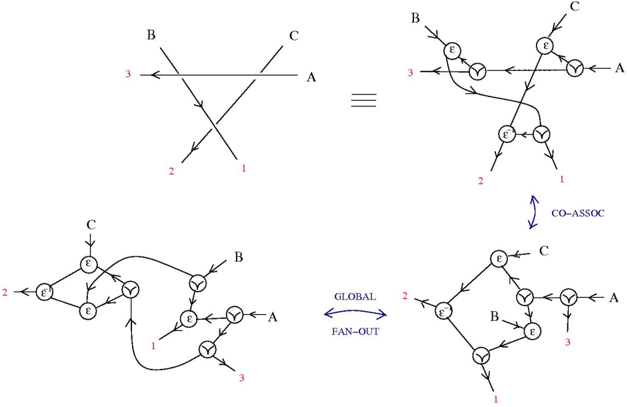
The image contains two interconnected diagrams labeled "CO-ASSOC" (left) and "GLOBAL FAN-OUT" (right), with bidirectional arrows between them. Both diagrams use nodes (A, B, C, ε, ε⁻¹) and directed arrows with numerical labels (1, 2, 3) to represent relationships.
### Components/Axes
- **Nodes**:
- **A, B, C**: Primary entities (likely variables or states).
- **ε, ε⁻¹**: Symbolic nodes (possibly representing errors, transformations, or inverse operations).
- **Arrows**:
- **Directional arrows** with numerical labels (1, 2, 3) indicate weighted or prioritized relationships.
- **Bidirectional arrow** labeled "GLOBAL FAN-OUT" connects the two diagrams.
- **Labels**:
- "CO-ASSOC" (top-left diagram).
- "GLOBAL FAN-OUT" (top-right diagram).
- Numerical labels (1, 2, 3) on arrows.
### Detailed Analysis
#### CO-ASSOC Diagram (Left)
- **Structure**:
- Arrows from **B → A** (labeled 3) and **C → A** (labeled 2) converge on **A**.
- A bidirectional arrow between **B** and **C** (labeled 1).
- Arrows from **A → ε** and **ε → C** suggest a feedback loop.
- **Flow**:
- Primary flow from **B** and **C** to **A**, with secondary interactions between **B** and **C**.
#### GLOBAL FAN-OUT Diagram (Right)
- **Structure**:
- Arrows from **B → ε**, **ε → A**, and **C → A** (labeled 2, 3).
- A loop between **ε** and **B** (labeled 1).
- Arrows from **A → ε** and **ε → C** mirror the CO-ASSOC diagram.
- **Flow**:
- Distributed connections from **B** and **C** to **A** via **ε**, with a feedback loop between **ε** and **B**.
#### Bidirectional Connection
- The "GLOBAL FAN-OUT" arrow links the two diagrams, implying a systemic relationship between associative (CO-ASSOC) and distributed (GLOBAL FAN-OUT) structures.
### Key Observations
1. **Numerical Weights**:
- **CO-ASSOC**: Stronger influence from **B → A** (3) than **C → A** (2).
- **GLOBAL FAN-OUT**: Equal weighting (2, 3) for **B → ε** and **C → A**.
2. **Feedback Loops**:
- Both diagrams include cycles (e.g., **A → ε → C** and **ε → B → ε**).
3. **Symmetry**:
- Mirrored structures in node connections (e.g., **B → A** in CO-ASSOC vs. **B → ε → A** in GLOBAL FAN-OUT).
### Interpretation
- **CO-ASSOC** represents a localized, associative system where **B** and **C** directly influence **A**, with a weaker interaction between **B** and **C**.
- **GLOBAL FAN-OUT** depicts a distributed system where **B** and **C** influence **A** indirectly via **ε**, with a feedback mechanism between **ε** and **B**.
- The bidirectional arrow suggests that the associative and global structures are interdependent, possibly modeling a system where local interactions (CO-ASSOC) and global distributions (GLOBAL FAN-OUT) coexist and influence each other.
- The numerical labels (1, 2, 3) may indicate priority, frequency, or strength of relationships, though their exact meaning depends on the system’s context (e.g., probabilistic weights, resource allocation).
## Notes
- No numerical data tables or heatmaps are present; the focus is on structural relationships.
- The diagrams likely model a theoretical framework (e.g., network theory, system dynamics) rather than empirical data.
- The use of ε and ε⁻¹ suggests abstract or symbolic operations (e.g., error correction, inverse transformations).