## Screenshot: Reading-Comprehension Dataset Generation Instructions
### Overview
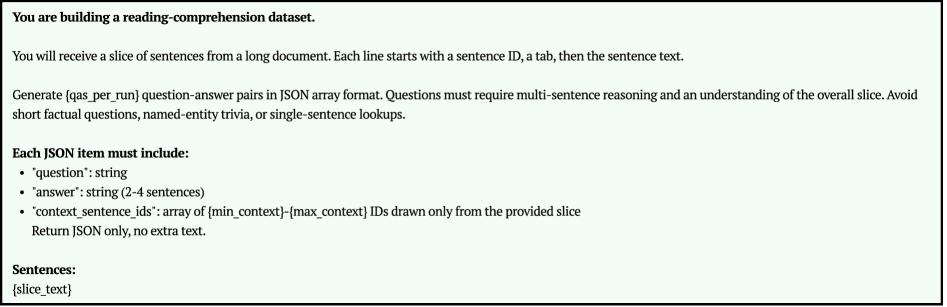
The image is a screenshot of a text-based instruction set for building a reading-comprehension dataset. The content is presented as a single block of text within a light gray (#f0f0f0) bordered box against a white background. The text provides a precise, technical specification for a data generation task.
### Components/Axes
This is not a chart or diagram with axes. The components are purely textual instructions structured as follows:
- **Title/Instruction Header**: A bolded statement of the primary task.
- **Process Description**: A paragraph explaining the input format and the core generation task.
- **Output Specification**: A bulleted list defining the required JSON structure for each output item.
- **Input Placeholder**: A label indicating where the source text data will be inserted.
### Detailed Analysis / Content Details
**Full Text Transcription:**
```
You are building a reading-comprehension dataset.
You will receive a slice of sentences from a long document. Each line starts with a sentence ID, a tab, then the sentence text.
Generate {qas_per_run} question-answer pairs in JSON array format. Questions must require multi-sentence reasoning and understanding of the overall slice. Avoid short factual questions, named-entity trivia, or single-sentence lookups.
Each JSON item must include:
• "question": string
• "answer": string (2-4 sentences)
• "context_sentence_ids": array of {min_context}-{max_context} IDs drawn only from the provided slice
Return JSON only, no extra text.
Sentences:
{slice_text}
```
**Key Elements and Placeholders:**
1. **Task Definition**: The user is instructed to act as a builder of a reading-comprehension dataset.
2. **Input Format**: Data will be provided as a "slice" of sentences. Each sentence line has the format: `[sentence ID]\t[sentence text]`.
3. **Generation Parameter**: `{qas_per_run}` is a variable placeholder indicating the number of question-answer pairs to generate per execution.
4. **Question Quality Constraint**: Questions must necessitate **multi-sentence reasoning** and comprehension of the entire provided text slice. Explicitly forbidden are:
- Short factual questions.
- Named-entity trivia.
- Single-sentence lookups.
5. **Output Schema (JSON Array)**: Each object in the array must contain three fields:
- `"question"`: A string.
- `"answer"`: A string answer spanning 2 to 4 sentences.
- `"context_sentence_ids"`: An array of sentence ID ranges (e.g., `["1-3", "5-7"]`). The IDs must be drawn **exclusively** from the IDs in the provided input slice.
6. **Output Constraint**: The final output must be **only the JSON array**, with no additional explanatory text.
7. **Data Placeholder**: `Sentences:` followed by `{slice_text}` marks where the actual sentence data (the "slice") will be inserted for processing.
### Key Observations
- **Precision of Instruction**: The text is highly specific about the input format, output structure, and, crucially, the *cognitive level* of the required questions (multi-sentence reasoning).
- **Use of Placeholders**: The instructions use template variables (`{qas_per_run}`, `{slice_text}`), indicating this is likely a prompt or specification for an automated system or a human annotator following a strict protocol.
- **Negative Constraints**: The instructions explicitly define what *not* to do (avoid simple questions), which is as important as the positive requirements for ensuring dataset quality.
- **Visual Layout**: The text is left-aligned within a defined container. The bullet points use standard round bullets (•). The font appears to be a common sans-serif typeface (e.g., Arial, Helvetica).
### Interpretation
This image outlines the foundational rules for creating a high-quality, reasoning-focused reading comprehension dataset. The design reveals several underlying principles:
1. **Purpose-Driven Design**: The dataset is not for testing basic fact retrieval but for evaluating a model's ability to synthesize information across multiple sentences. This suggests it's intended for advanced NLP model evaluation or training, targeting skills like inference, causality, and summarization.
2. **Controlled Generation**: The use of placeholders (`{qas_per_run}`, `{slice_text}`) and the strict JSON schema indicate this is a component within a larger, likely automated, data pipeline. The system is designed for batch processing and consistency.
3. **Data Integrity**: The requirement that `context_sentence_ids` must be drawn *only* from the provided slice ensures that questions and answers are grounded in the given context, preventing leakage or the use of external knowledge. This is critical for creating a valid and reproducible benchmark.
4. **Implicit Workflow**: The process implies a two-stage workflow: first, a "slice" of text is extracted from a larger document and formatted with IDs; second, this slice is processed (by an AI or human) according to these rules to generate the QA pairs. The final output is a clean, structured JSON file ready for integration into a dataset.
In essence, this is a technical specification for generating a **reasoning-centric** subset of a reading comprehension dataset, emphasizing structured output, contextual grounding, and complex question design.