\n
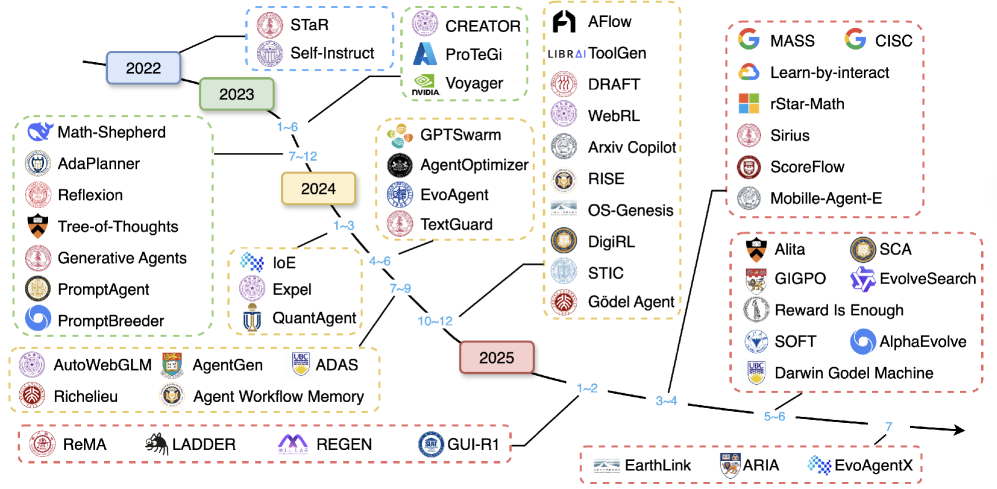
## Diagram: Agent Roadmap (2022-2025)
### Overview
This diagram presents a roadmap of agent development from 2022 to 2025, showcasing various agents and their approximate timelines. The diagram uses a branching structure to illustrate the progression of agent technologies, with nodes representing individual agents and arrows indicating the flow of development. The diagram is segmented into four years: 2022, 2023, 2024, and 2025. Each year has a cluster of agents associated with it.
### Components/Axes
The diagram does not have traditional axes. Instead, it uses time (2022-2025) as the primary organizing principle. The diagram is structured around nodes representing agents, connected by arrows indicating progression. There are color-coded categories for different agent types.
* **Time Markers:** 2022, 2023, 2024, 2025 (positioned horizontally across the diagram)
* **Agent Nodes:** Represent individual agents, each with a unique icon and label.
* **Arrows:** Indicate the flow of development and dependencies between agents. Arrows are labeled with numerical ranges (e.g., 1-6, 7-12) suggesting a relative order or timeframe within each year.
* **Color Coding:**
* Blue: Agents related to foundational models or general capabilities (e.g., Math-Shepherd, GPTswarm)
* Purple: Agents focused on reasoning and planning (e.g., Reflexion, Tree-of-Thoughts)
* Yellow: Agents related to web interaction and tool use (e.g., AutoWebGLM, WebRL)
* Green: Agents focused on reinforcement learning and optimization (e.g., RISE, Reward Is Enough)
* Red: Agents related to specific applications or frameworks (e.g., ProTeGI, Darwin Godel Machine)
* Teal: Agents related to memory and workflow (e.g., Agent Workflow Memory, ARIA)
### Detailed Analysis or Content Details
**2022:**
* Math-Shepherd (Blue)
* AdaPlanner (Blue)
* Reflexion (Purple)
* Tree-of-Thoughts (Purple)
* Generative Agents (Purple)
* PromptAgent (Purple)
* PromptBreeder (Purple)
* AutoWebGLM (Yellow)
* Picrelieu (Yellow)
* ReMA (Yellow)
* LADDER (Yellow)
**2023:**
* STaR (Red)
* Self-Instruct (Red)
* CREATOR (Red)
* ProTeGI (Red) - NVIDIA logo present
* Voyager (Red)
* GPTSwarm (Blue)
* AgentOptimizer (Blue)
* EvoAgent (Blue)
* TextGuard (Blue)
* IoE (Purple)
* Expel (Purple)
* QuantAgent (Purple)
* ADAS (Purple)
* Agent Workflow Memory (Teal)
**2024:**
* Arrows labeled 1-3 connect 2023 agents to:
* AFlow (Green)
* LIBRAI ToolGen (Green)
* DRAFT (Green)
* WebRL (Green)
* Arxiv Copilot (Green)
* RISE (Green)
* Arrows labeled 4-6 connect 2023 agents to:
* OS-Genesis (Green)
* DigiRL (Green)
* STIC (Green)
* Gödel Agent (Green)
* Arrows labeled 7-12 connect 2023 agents to:
* MASS (Green)
* CISC (Green)
**2025:**
* Arrows labeled 1-2 connect 2024 agents to:
* EarthLink (Teal)
* Arrows labeled 3-4 connect 2024 agents to:
* ARIA (Teal)
* Arrows labeled 5-6 connect 2024 agents to:
* Learn-by-Interact (Green)
* rStar-Math (Green)
* Sirius (Green)
* ScoreFlow (Green)
* Mobile-Agent-E (Green)
* Arrow labeled 7 connects 2024 agents to:
* Alita (Green)
* GIGPO (Green)
* EvolveSearch (Green)
* Reward Is Enough (Green)
* SOFT (Green)
* AlphaEvolve (Green)
* Darwin Godel Machine (Red)
* GUI-R1 (Red)
* EvolutionAgentX (Teal)
### Key Observations
* The diagram shows a clear progression from foundational agents in 2022 to more specialized and complex agents in 2025.
* The number of agents increases significantly from 2022 to 2023, and continues to grow through 2025.
* Reinforcement learning and optimization agents (Green) become increasingly prominent in 2024 and 2025.
* The arrows with numerical ranges suggest that some agents are developed concurrently or have overlapping timelines.
* NVIDIA is explicitly associated with the ProTeGI agent.
### Interpretation
This roadmap illustrates the rapid development and diversification of agent technologies. The diagram suggests a trend towards more sophisticated agents capable of complex reasoning, planning, and interaction with the real world. The increasing focus on reinforcement learning indicates a desire to create agents that can learn and adapt autonomously. The branching structure highlights the exploration of multiple pathways in agent development, with some agents leading to others and others branching out into new areas. The numerical ranges on the arrows suggest a degree of uncertainty in the timelines, reflecting the inherent challenges of predicting technological progress. The diagram serves as a visual representation of the evolving landscape of AI agents and their potential impact on various fields. The color coding provides a useful way to categorize agents based on their primary function or focus. The inclusion of company logos (e.g., NVIDIA) indicates the involvement of key players in the development of these technologies. The diagram is a high-level overview and does not provide detailed information about the specific capabilities or limitations of each agent.