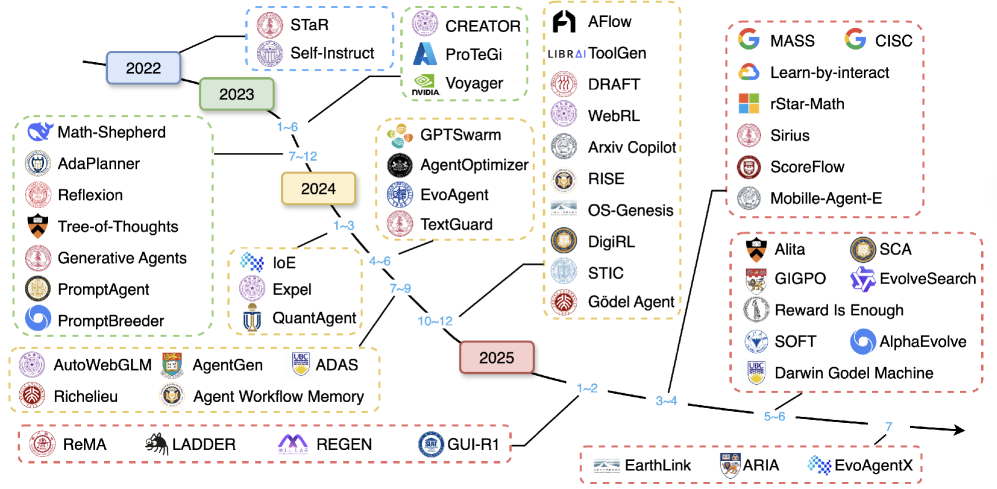
## Timeline Diagram: Evolution of AI Agent Development (2022-2025)
### Overview
The image depicts a hierarchical timeline diagram illustrating the progression of AI agent development from 2022 to 2025. It uses color-coded nodes, connecting lines, and a legend to categorize projects, tools, and frameworks. The diagram emphasizes chronological development, interconnections between projects, and thematic groupings (e.g., mathematics, agent generation).
---
### Components/Axes
1. **Years (2022–2025)**:
- Positioned on the left side, each year is enclosed in a colored box:
- **2022**: Light blue
- **2023**: Light green
- **2024**: Light orange
- **2025**: Light red
- Lines connect years sequentially (e.g., 2022 → 2023 → 2024 → 2025) with numerical labels (e.g., "1-6", "7-12") indicating phases or milestones.
2. **Nodes**:
- Each year contains sub-nodes representing specific projects/tools:
- **2022**: StaR, Self-Instruct, Math-Shepherd, AdaPlanner, Reflexion, Tree-of-Thoughts, Generative Agents, PromptAgent, PromptBreeder.
- **2023**: CREATOR, ProTeGi, Voyager, GPTSwarm, AgentOptimizer, EvoAgent, TextGuard.
- **2024**: IoE, ExpeL, QuantAgent, AutoWebGLM, AgentGen, ADAS, Richeleu, Agent Workflow Memory.
- **2025**: ReMA, LADDER, REGEN, GUI-R1, EarthLink, ARIA, EvoAgentX.
3. **Legend**:
- Located on the right side, color-coded categories include:
- **MATH**: Google (blue), CISC (red), rStar-Math (green), Sirius (pink), ScoreFlow (gray).
- **AGENT GEN**: MATH (blue), CISC (red), Learn-by-interact (orange), Mobile-Agent-E (gray).
- **AGENT FLOW**: AFlow (blue), DRAFT (purple), WebRL (green), Arxiv Copilot (orange), OS-Genesis (pink), DigiRL (gray), STIC (yellow), Godel Agent (red).
- **AGENT MEMORY**: Reward Is Enough (blue), AlphaEvolve (orange), Darwin Godel Machine (gray).
- **AGENT TOOLS**: GPTSwarm (blue), AgentOptimizer (purple), EvoAgent (green), TextGuard (pink), AgentGen (blue), Agent Workflow Memory (orange).
4. **Connecting Lines**:
- Lines link nodes across years (e.g., "1-6" from 2022 to 2023) and within years (e.g., "7-12" within 2023).
- Some lines extend to the right-side legend, suggesting thematic categorization.
---
### Detailed Analysis
1. **Yearly Progression**:
- **2022**: Focus on foundational models (e.g., StaR, Self-Instruct) and early agent frameworks (Math-Shepherd, AdaPlanner).
- **2023**: Expansion into multimodal agents (CREATOR, ProTeGi) and specialized tools (GPTSwarm, AgentOptimizer).
- **2024**: Integration of agent workflows (AutoWebGLM, AgentGen) and hybrid systems (IoE, ExpeL).
- **2025**: Advanced frameworks (ReMA, LADDER) and cross-domain agents (EarthLink, ARIA).
2. **Thematic Groupings**:
- **MATH/CISC**: Projects like rStar-Math and Sirius emphasize mathematical reasoning.
- **AGENT FLOW**: Tools like AFlow and WebRL focus on dynamic agent interactions.
- **AGENT MEMORY**: Systems like Reward Is Enough and AlphaEvolve highlight memory optimization.
3. **Interconnections**:
- Lines between years suggest iterative development (e.g., 2022 → 2023: "1-6" phases).
- Nodes within years are densely connected, indicating parallel advancements.
---
### Key Observations
1. **Rapid Evolution**: The density of nodes increases from 2022 to 2025, reflecting accelerating innovation.
2. **Thematic Specialization**: Projects cluster into distinct categories (e.g., MATH, AGENT FLOW), suggesting domain-specific breakthroughs.
3. **Cross-Year Dependencies**: Lines like "1-6" and "7-12" imply phased milestones, with later years building on earlier work.
4. **Unresolved Connections**: Some lines (e.g., "5-6" from 2024 to 2025) lack clear labels, leaving relationships ambiguous.
---
### Interpretation
The diagram illustrates a structured yet rapidly evolving ecosystem of AI agents. Early years (2022–2023) prioritized foundational models and specialized tools, while later years (2024–2025) focus on integration and scalability. Thematic groupings (e.g., MATH, AGENT FLOW) highlight interdisciplinary efforts, with projects like rStar-Math and EvoAgentX bridging multiple domains. Ambiguities in line labels ("5-6") suggest gaps in documentation or unresolved research directions. Overall, the timeline underscores the shift from isolated experiments to cohesive, cross-functional agent systems.